When high finance, deep obsession, and cutting-edge artificial intelligence collide, the resulting paper trail can expose the darkest corners of human premeditation. In a case that has sent shockwaves through the legal and tech worlds, a former Wall Street analyst used an AI chatbot to draft a horrifying, step-by-step blueprint for violence against the woman he once claimed to love.
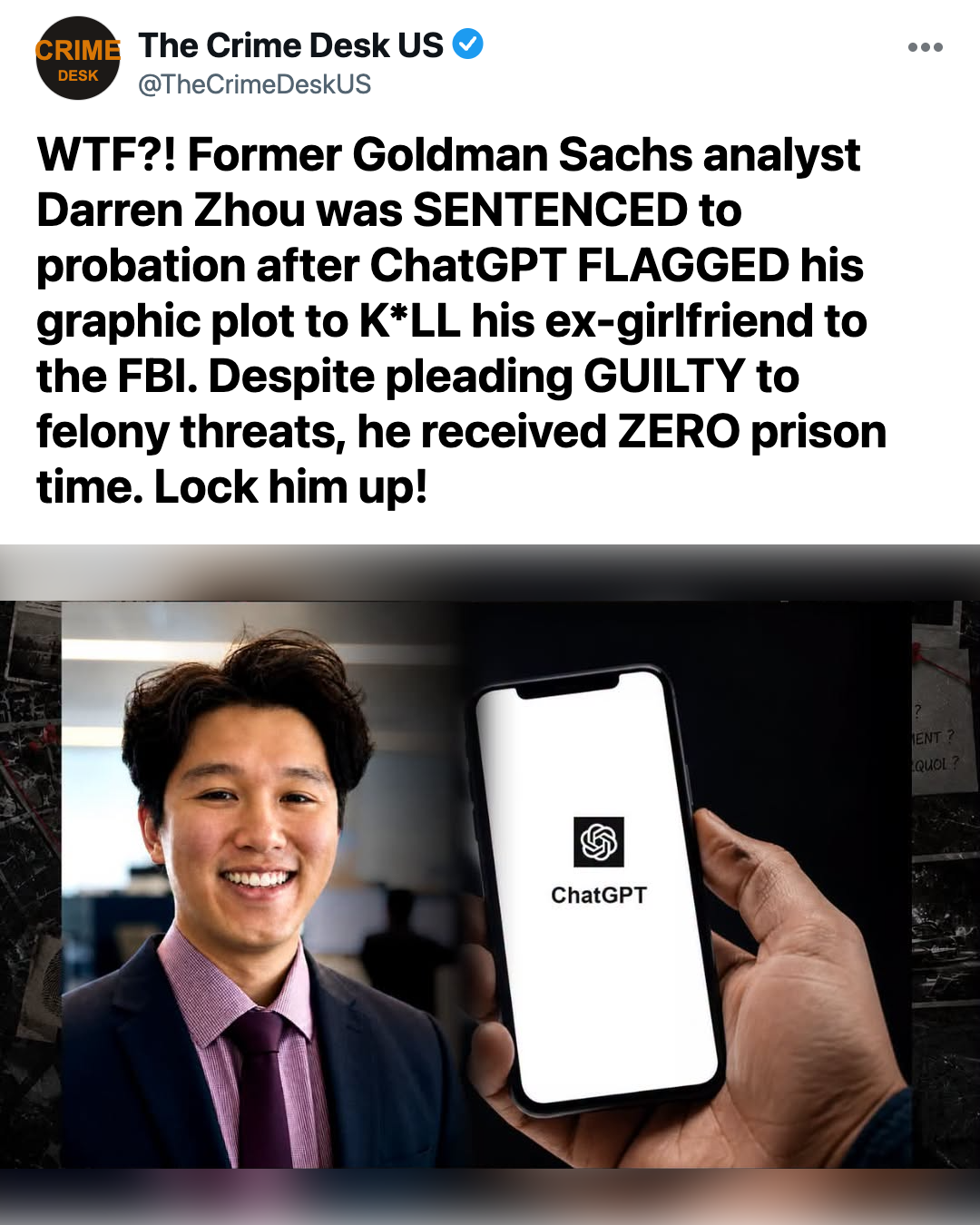
Darren Zhou, a 25-year-old former Goldman Sachs financial analyst based in Florida, found himself at the center of a chilling criminal investigation after his private digital prompts crossed an unthinkable line. What began as an apparent struggle with heartbreak rapidly devolved into an explicit catalog of violence, detailing calculated plans to stalk, rape, and murder his former girlfriend.
The disturbing timeline began unfolding in March 2026, when Zhou reportedly turned to ChatGPT to process a painful romantic breakup. Initially, his prompts centered on his emotional distress and an intense desire to win his ex-girlfriend back. Yet as the days progressed, the tone of those interactions shifted dramatically from romantic yearning into an alarming spiral of violent obsession.
According to sworn court documents, Zhou’s digital entries ceased being simple expressions of grief and transformed into an active, lethal strategy. He began typing out explicit declarations of intent, writing that he planned to kill his ex-girlfriend before the month came to an end. The cold precision of his words revealed a mindset that had moved far beyond ordinary heartbreak.
The scope of the alleged plot did not stop with the young woman alone. The records indicate that Zhou also documented his desire to target her family members, expanding the perimeter of his intended violence to encompass those closest to her. His prompts demonstrated a sweeping desire for total destruction that left investigators deeply alarmed.
Investigators discovered that Zhou was not simply typing vague threats, but was actively logging actionable surveillance data into the AI platform. He allegedly fed the system detailed information regarding his ex-girlfriend’s daily routines, the specific establishments she visited, and the precise spots where she parked her vehicle. This digital ledger effectively mapped out her daily life for ambush.
Among the most terrifying revelations in the investigative files was a meticulously staged scenario centered around her fitness routine. Zhou reportedly described waiting in ambush for his ex-girlfriend near the gym she regularly frequented. The plan relied on catching her off guard in an ordinary, everyday setting where she would least expect danger.
The scenario contained a deeply disturbing psychological dynamic that blended feigned affection with immediate, deadly violence. Zhou allegedly considered approaching her with flowers as an offering of reconciliation, intending to present her with an ultimatum. If she refused to rekindle their relationship on the spot, he planned to execute her immediately.
Law enforcement officials who analyzed the extensive chat logs emphasized that these messages could not be dismissed as harmless venting or unhinged emotional distress. Instead, the evidence painted a clear picture of systematic, repeated planning of violent acts. The sheer volume and specificity of the entries suggested an escalating threat that was inching closer to real-world execution.
A Digital Paper Trail and a Federal Alert
The terrifying scenario might have escalated into physical violence had it not been for automated safeguards within the artificial intelligence system itself. In May 2026, the alarming nature of Zhou’s ongoing conversations triggered internal safety protocols at OpenAI. Recognizing the imminent danger outlined in the text, the company flagged the logs and notified the Federal Bureau of Investigation.
Federal agents quickly evaluated the severity of the threat and recognized that immediate intervention was required to protect the potential victims. The FBI forwarded the critical intelligence packet directly to local authorities on the ground. The Palm Beach County Sheriff’s Office immediately mobilized to neutralize the threat and secure the safety of the young woman.
Armed with the detailed digital transcripts, deputies swiftly moved in to take the 25-year-old former financial professional into custody. Zhou was formally arrested and slapped with a slate of severe felony charges. The legal hammer came down in the form of charges for aggravated stalking, written threats to kill or cause bodily injury, and the unlawful use of a communication device to commit a crime.
 Justice Stands Firm: Texas Court Shuts Down Bid for New Trial in Fatal Student Attack
 Eight Months Pregnant and Charged With Murder: The Harrowing Case of Keshia Golden and the Lethal Fight for Survival
 Louisiana Woman Wakes Up Drunk in Passenger Seat, Tries to ‘Park’ the Car Right in Front of a State Trooper During a Traffic Stop
The case moved rapidly through the Florida legal system as the weight of the digital evidence became undeniable. On August 13, 2026, Zhou entered a formal guilty plea to the charges levied against him, admitting to the chilling digital paper trail he had authored. The plea marked a decisive legal acknowledgment of the terror he had detailed on his screen.
Yet, despite the terrifying specifics of the murder and rape plot detailed in the court filings, the legal proceedings concluded with a result that has left many observers stunned. When the time came for sentencing, Darren Zhou was not ordered to serve a single day behind state prison bars. The resolution immediately ignited fierce debate surrounding justice and accountability in high-profile stalking cases.
Judge Scott Suskauer presided over the case and handed down a sentence of eight years of probation. Rather than sending the former financial analyst to a correctional facility, the court opted for a structured period of community supervision. The sentence instantly became a focal point for intense public scrutiny and viral commentary.
Under the specific terms of the eight-year probation order, Zhou will be subject to strict physical and technological limitations. The sentence mandates that he must wear an electronic monitoring device for the first two years of his term. This continuous tracking is intended to ensure he remains within designated geographic boundaries and away from forbidden areas.
The Sentence, the Conditions, and the Debate
The court also imposed a comprehensive, permanent prohibition that strips Zhou of his right to possess firearms for the rest of his life. In addition to the weapons ban, the judicial order strictly prohibits him from initiating any direct or indirect contact with his ex-girlfriend or any members of her family, establishing a permanent protective buffer.
To address the underlying psychological drivers of his alarming behavior, the sentencing order mandates that Zhou undergo compulsory psychological treatment. The court emphasized the necessity of clinical intervention to manage and evaluate his mental state throughout his supervised release. The requirement aims to dismantle the dangerous obsessive tendencies revealed in his AI transcripts.
In explaining the rationale behind the sentence, the court highlighted key mitigating factors that shaped the final ruling. Judge Suskauer took into consideration that the 25-year-old had no prior criminal record before this arrest. The clean legal slate positioned Zhou as a first-time offender in the eyes of the Florida judicial system.
Crucially, the court also noted that the victim herself agreed to the resolution negotiated between defense attorneys and prosecutors. The young woman’s formal consent to the plea deal provided the judicial foundation for avoiding prison time. Her concurrence played a decisive role in allowing the probation agreement to move forward without a contested trial.
Nevertheless, the lack of prison time for someone who plotted such graphic, premeditated violence has sparked widespread unease. Legal observers and domestic violence advocates frequently note that detailed stalking and planning are the most reliable indicators of potential physical lethality. Many argue that an ambush plot involving flowers and firearms demands far harsher consequences than monitored home confinement.
The case stands as a chilling modern landmark at the intersection of criminal justice and emerging consumer technology. It demonstrates how artificial intelligence platforms are increasingly becoming the silent witnesses to dangerous real-world malice. Were it not for corporate reporting and swift law enforcement intervention, the line between digital planning and physical execution might have been crossed.
Zhou’s guilty plea closes the legal chapter of the case, but the broader questions surrounding accountability remain intensely urgent. As digital tools become more embedded in daily life, the justice system faces unprecedented challenges in measuring the true danger posed by calculated online threats. The narrow margin between ideation and tragedy in this case serves as a haunting reminder of what was narrowly averted.
With eight years of supervision ahead and a permanent record of his actions, Darren Zhou remains outside prison walls under the watchful eye of the state. It leaves the public grappling with a haunting question about justice, mercy, and public safety: Do you think probation is truly enough for someone who documented his murder plans in such horrific, methodical detail?
No Comments yet!