In one of the most surreal and alarming security incidents in recent memory, law enforcement officers in Washington, DC, found themselves confronting a literal instrument of the French Revolution. A Southern California man has been taken into custody after authorities discovered a full-sized, fully assembled guillotine standing upright in the open bed of his pickup truck right outside the nation’s most sacred halls of government.
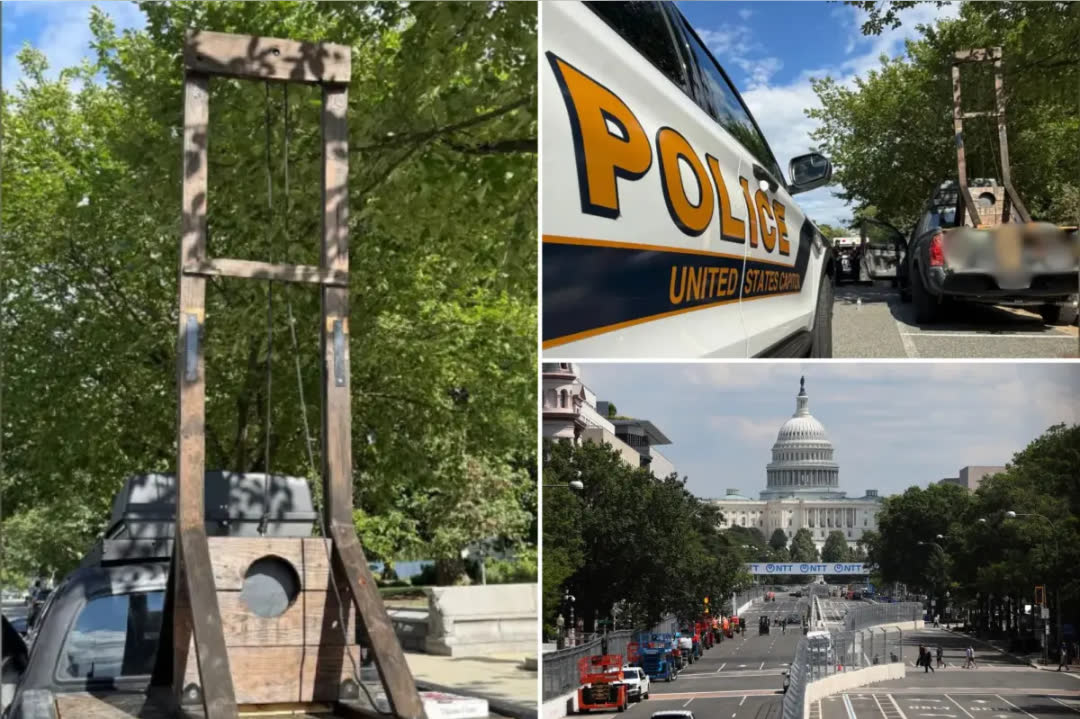
The bizarre confrontation unfolded on a routine Tuesday afternoon when United States Capitol Police officers noticed a suspicious vehicle parked along the 100 block of East Capitol Street. The location could not have been more sensitive, sitting directly adjacent to both the historic US Capitol complex and the Supreme Court of the United States. What initially appeared to be a standard parking violation quickly escalated into a high-stakes security alert.
When officers approached the vehicle shortly after 3 p.m., they were met with an unbelievable sight that immediately triggered federal protocols. Towering in the back of the pickup truck was a wooden execution device complete with a mounted blade, fully erected and ready to draw immediate attention from anyone passing by. The sudden discovery immediately shifted the interaction from a simple municipal traffic check to an urgent criminal investigation.
The driver of the truck has been identified as 35-year-old Philan-Tam-Duy Le, a resident of Julian, California. Authorities were stunned to learn that Le had apparently driven all the way from Southern California across the continental United States with the massive wooden contraption sitting openly in his truck bed. The sheer scale and determination behind such a cross-country journey have left both law enforcement and the public searching for answers.
US Capitol Police wasted no time taking decisive action on the scene. Officers quickly impounded the truck, seized the towering apparatus as evidence, and placed Le under arrest without further incident. The 35-year-old now faces formal charges of carrying a dangerous weapon, alongside traffic citations for parking illegally directly beside the heavily guarded Supreme Court grounds.
Photographs officially released by Capitol Police illustrate the sheer brazenness of the display. The images confirm that the guillotine was not merely broken down into spare lumber or concealed beneath a protective tarp during transit. Instead, it stood completely upright, its heavy frame and deadly cutting mechanism exposed to the open air right on the doorstep of the federal judiciary.
The visual impact of such a weapon parked beside the pillars of American democracy has sent shockwaves through the capital city. While law enforcement personnel in Washington are trained to handle a wide spectrum of modern threats, encountering an archaic beheading machine on East Capitol Street is an unprecedented development that defies conventional security modeling. Investigators are now working around the clock to piece together the timeline of Le’s cross-country voyage.
Federal authorities are digging deeply into Le’s background in Julian, California, attempting to unravel the specific motive that drove him to travel thousands of miles with an execution device in tow. At this stage of the inquiry, officials have not disclosed what prompted the California man to bring the weapon to the epicenter of the federal government, leaving open crucial questions about intent, ideology, or potential protest messaging.
Security observers point out that the logistics of hauling such a towering structure across multiple state lines without drawing prior intervention are nothing short of remarkable. A fully assembled guillotine in an open pickup bed is virtually impossible to miss on modern interstate highways. Yet, Le managed to navigate from the Pacific coast all the way into the heavily fortified heart of the District of Columbia before being intercepted.
The specific geography of where the arrest occurred has only heightened the gravity of the situation. The 100 block of East Capitol Street serves as a vital corridor separating the legislative branch from the supreme judicial authority of the nation. For an individual armed with a functioning execution tool to park unhindered so close to government leadership highlights the perpetual challenges facing federal perimeter security.
A Cross-Country Trek and a Dark Historical Symbol
The guillotine is not just any crude weapon; it is one of the most historically charged and terrifying instruments of death ever constructed by human hands. Invented in late-18th-century France during a period of intense sociopolitical upheaval, the machine was originally designed to provide a mechanized, swift, and uniform method of capital punishment by beheading. It quickly transformed from an engineering novelty into the defining centerpiece of state-sanctioned violence.
Throughout history, the towering wooden frame and weighted falling blade became forever synonymous with the Reign of Terror during the French Revolution. It was the very instrument used to execute King Louis XVI in January 1793, cementing its place as a universal emblem of radical political uprising, institutional collapse, and the violent overthrow of established governing orders. Its presence near the US Capitol inevitably evokes those dark historical parallels.
 Pretending to leave for Chicago, I returned secretly to my Houston mansion because I suspected housekeeper Clara was manipulating my five-year-old twins.
 Horror in the Closet: How a Domestic Violence Call Uncovered an Infant Encased in Concrete and a Cross-Country Secret
 My sister Vanessa smiled just before my six-year-old daughter Emily fell into the Bellmore Grand hotel pool.
Because of its terrifying legacy, the appearance of such an apparatus near the seats of constitutional power carries unavoidable symbolic weight. Observers note that throughout modern political discourse, the guillotine has occasionally resurfaced in radical rhetoric and protest imagery as an explicit threat against ruling elites. Whether Le intended the device as a theatrical political statement, an artistic stunt, or something far more sinister remains the core mystery of the USCP probe.
The transition from a quiet rural life in Julian, California—a historic mountain town known for apple orchards and tranquil scenery—to the steps of the Supreme Court with an execution device is a startling trajectory. Investigators are actively examining Le’s communications, digital footprint, and personal history to understand what led a resident of San Diego County to undertake such an extraordinary and perilous endeavor.
The physical construction of the seized device is also central to the criminal case moving forward. Described as featuring a tall wooden scaffolding paired with a heavy, dangerous blade, the contraption was not a miniature model or a decorative prop. It was a functional execution instrument capable of inflicting catastrophic physical harm, which provided law enforcement with immediate legal grounds for a felony-level weapons arrest.
The visual of the upright frame sitting in the bed of a standard pickup truck has captivated online audiences and drawn intense scrutiny from news commentators nationwide. As images circulated across media channels, the incident rapidly transformed into a viral talking point, highlighting the strange and unpredictable nature of contemporary threats directed toward Washington’s federal enclave.
Despite the weapon’s theatrical and anachronistic appearance, federal protective services cannot afford to treat any unauthorized dangerous object near government leadership as a harmless novelty. With high-profile officials, judges, and lawmakers moving through the area daily, the immediate assumption must always prioritize public safety and rapid threat containment.
The Legal Tightrope and Strict Capitol Security Rules
From a legal perspective, the case against Le highlights the sharp distinction between private ownership and the strict regulations governing public federal spaces. Under general American property laws, owning a historical reproduction of a guillotine on private land is typically not a criminal offense, as unusual or eccentric as such a collection piece might be. Citizens have wide latitude to possess oddities within the confines of their private residences.
However, transporting a massive, operational blade into the most protected zones of the federal government fundamentally alters the legal framework. The Capitol complex, the Supreme Court grounds, and the surrounding streets are governed by rigorous local and federal statutes specifically enacted to neutralize potential violence and maintain strict physical security barriers.
Within these heavily monitored perimeters, the definition of a dangerous weapon is interpreted broadly to protect public officials, staff, and visitors from physical harm. Bringing an oversized, mechanized cutting instrument directly into the immediate vicinity of supreme judicial and legislative offices instantly violates baseline federal security mandates, regardless of whether the owner claims decorative or communicative intent.
The illegal parking citation issued by the Capitol Police underscores how even a minor municipal infraction can quickly dismantle a suspicious operation. Had the truck not been parked unlawfully along East Capitol Street, it is possible the vehicle might have continued circulating undetected for hours longer. The sharp eyes of patrolling officers proved decisive in neutralizing the situation before any escalation could occur.
As the legal process gets underway, Le remains under intense federal scrutiny. Capitol Police have not indicated whether additional federal charges could be filed as their background investigation continues to develop. The primary objective for federal prosecutors will be establishing Le’s mental state, his ultimate destination, and precisely what he intended to do once he reached the Capitol grounds.
The broader implications of this arrest resonate strongly within the law enforcement community tasked with protecting the District of Columbia. In an era marked by heightened political tensions and unprecedented security challenges, federal officers are forced to stay vigilant against an astonishingly diverse array of potential hazards, ranging from high-tech threats to centuries-old execution instruments.
The California Post reached out to the US Capitol Police for further comment regarding the status of the investigation and potential forthcoming court appearances for the Julian resident. As the nation watches this bizarre chapter unfold, the sight of an 18th-century beheading machine parked beside the Supreme Court will undoubtedly endure as one of the most astonishing security breaches ever documented along East Capitol Street.
No Comments yet!