The pin on my phone said the bridge was out. I already knew that. I’d watched it go under on the local news an hour before the call came in, brown water chewing the guardrails off like they were made of paper.
I’m Dr. Evelyn Marsh. Sixty-one years old, semi-retired, the kind of doctor small mountain towns still call at two in the morning because I’m the one who answers. That night the voice on the line was a man’s, flat and clipped, the way people talk when they’re one wrong breath from panic and refuse to show it. His name was Damien Kroll. He said a woman was in labor at his estate, that something was wrong, that the roads were gone and the ambulance couldn’t reach them and he would send someone for me if I would only come.
I went. Of course I went. A boat took me across water that had no business being where it was, and a truck carried me up a private drive I’d never had reason to climb, to a house I’d only ever seen from a distance and assumed belonged to someone who wanted nothing to do with a country doctor.
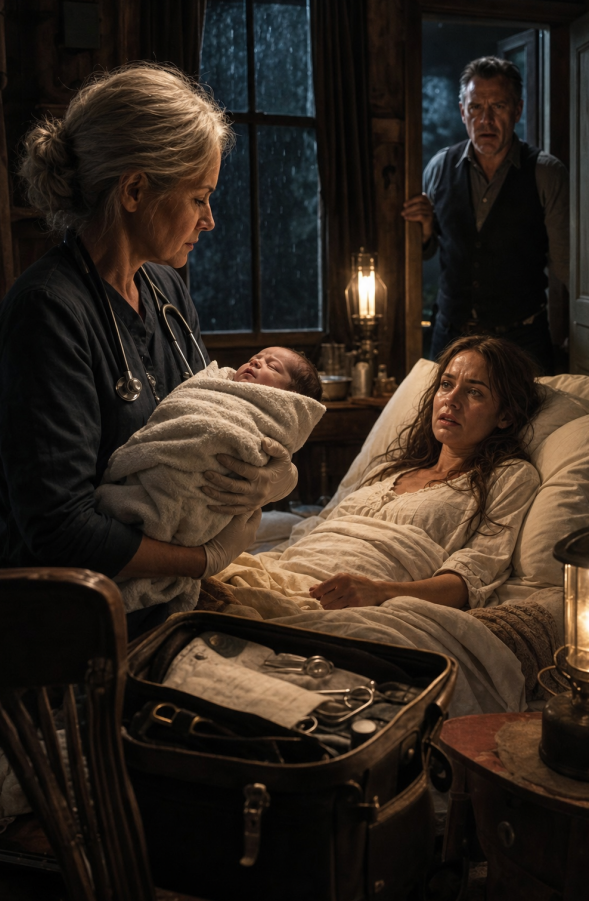
Inside, past the cold marble and the tall black windows streaming rain, a girl was dying by inches in a bed too grand for what was happening in it. Cassie. Twenty-seven, though she looked younger, fair hair plastered to her forehead, exhausted past fear into that dangerous calm where the body starts giving up. The baby was breech and stuck and had been for too long. She’d been laboring since before the storm cut them off.
I did what forty years teaches your hands to do without asking your brain first. I turned the child. I talked to Cassie in the low steady voice I’ve used on a hundred frightened women, telling her she was strong, telling her to push, telling her we were almost there when I wasn’t sure we were. The lamp threw one warm circle of light and everything outside it was black rain and Damien Kroll standing rigid in the doorway with a face I couldn’t read.
The baby came. A boy. Slick and blue and silent.
There’s a particular kind of quiet that fills a room when a newborn doesn’t cry, and it is the worst sound in the world. I had him on the bed in a heartbeat, the little bag and mask out of my kit, two fingers finding the tiny chest. I gave him careful breaths, the smallest puffs, watching that motionless ribcage, willing it. Cassie was sobbing my name. Damien had come off the doorframe and was on his knees beside the bed without seeming to have crossed the room.
And then the boy screamed. That thin, furious, magnificent scream that means the whole thing was worth it. His color came up like a sunrise. Cassie laughed and cried at once. I remember my own hands were shaking, which they don’t usually do anymore.
I should have just wrapped him up and gone home. But when I laid him on his mother’s chest, my eyes fell on the nightstand, where someone had already started a birth-record card in careful handwriting, the way people do when they’ve been waiting a long time for a child. Mother: Cassie Reneau. And under father, a name I knew better than my own.
My son’s name. The son who stopped speaking to me eleven years ago, who cut every thread between us over a disagreement that had long since stopped mattering to anyone but him, who I had not seen since his father’s funeral.
I stood in that stranger’s grand bedroom holding the edge of the nightstand, and I understood that the baby I had just breathed back to life was my grandson. That Cassie was the daughter-in-law I’d never been told existed. That the man in the doorway, Damien, was my son’s business partner, who had taken them in when the storm trapped them here on their way to somewhere else.
Cassie saw my face. “Doctor? Are you all right?”
I asked her, very carefully, her partner’s name. She said it. She said it with love, the way you say the name of someone you’re building a life with. And then she looked at me more closely, at my eyes, which are my son’s eyes, which are now her son’s eyes, and she went very still.
“Marsh,” she whispered. “Your name is Marsh.”
I told her yes. I told her who I was. I watched a young woman I’d just met realize that the doctor who’d saved her baby was the grandmother her partner had told her was as good as dead to him.
My son arrived at dawn, when the water dropped enough to cross. He came through the door already talking, already braced for whatever had gone wrong, and he stopped cold when he saw me sitting by the bed with his son asleep in the crook of my arm.
I have imagined our reunion a hundred ways in eleven years. I never once imagined it like this, both of us wrecked and speechless, a newborn between us that neither of us could deny, a debt that had nothing to do with the old fight and everything to do with the fact that I had kept his child breathing on this earth.
He didn’t apologize. Not that morning. Men like my son take longer than a single storm to unlearn their pride. But he crossed the room, and he looked down at the boy, and then he looked at me, and he said the only thing that mattered. “You saved him.”
“Yes,” I said. “I did.”
Cassie named the baby after his father. And she asked me, before I left, if I would come back on Sundays. I said I would. I have gone every Sunday since.
The bridge is fixed now. The water went back where it belonged. But I still keep that birth-record card, the one with my son’s name written in his wife’s careful hand, because it’s the piece of paper that gave me back the family I thought I’d buried. Eleven years of silence, and it took a flood and a baby who wouldn’t breathe to end it in a single night.
Comments are closed.