My hands were shaking so hard I couldn’t break the wax seal.
The man in the dark suit saw. He gently took the envelope back, slid a thumb under the flap, and returned it open. “Take your time,” he said quietly. “You’ve earned every second of it.”
Behind him, the woman in the black hat had risen halfway out of her seat. “Excuse me,” she said, her voice sharp and bright. “There’s been a mistake. I am Mrs. Ashford. I have his photograph, his—”
“You have a photograph,” the man agreed without turning around. “Ms. Devereaux, please sit down. We know exactly who you are.”
The room went silent in a way I had never heard silence before.
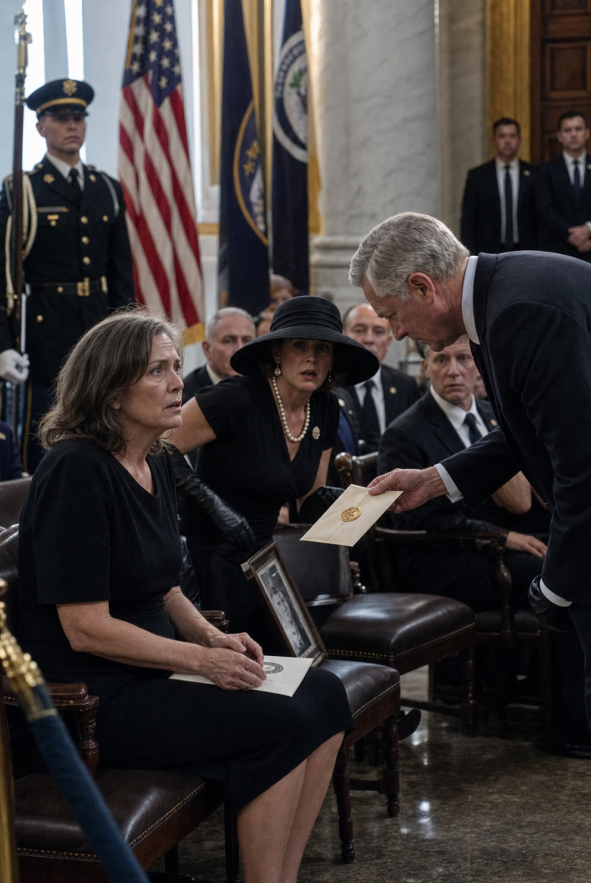
I unfolded the paper inside. It was a formal letter, embossed at the top, and beneath the seal it named my husband. Thomas Ashford. But not as logistics. Not as scheduling.
Cultural attaché and senior intelligence liaison, twenty-two years of service.
The words swam. I read them three times.
“Your husband,” the man said, turning to me now and lowering his voice so only the front rows could hear, “was not what his paperwork said he was. Very few people knew. It was designed that way. To protect you.”
“Protect me from what,” I whispered.
He glanced, just once, at the woman in the black hat. “From her.”
Her name, he told me, was Lena Devereaux. She had spent the last four years positioning herself in the same overseas social circles Thomas moved through. Charity galas. Embassy dinners. She had photographs with him because she had spent years making sure there were photographs with him. She had cultivated an entire identity as the wife of a rising diplomat.
Because Thomas’s real work made him a target. And Lena, the man said carefully, had been working for the people who wanted to know what Thomas knew.
“She came to this service,” he said, “to be recognized. Publicly. As his widow. Because an acknowledged widow receives things. Records. Effects. Access to a sealed file that should have been buried with him.”
I looked at her. The pearls. The gloves. The rehearsed tears.
“She isn’t grieving,” I said.
“No,” he said. “She’s collecting.”
Lena’s composure finally cracked. She stood fully now, and two men who had been standing quietly by the side doors — men I’d assumed were ushers — took a step toward her.
“This is insane,” she said, but her voice had lost its brightness. “You have no proof of anything.”
The man in the dark suit finally turned to face her. “We have four years of it,” he said. “We let you keep playing the part because it told us who you reported to. Every dinner. Every photograph. Every condolence card you sent to the wrong address on purpose. Thank you for that, by the way. You made the network very easy to map.”
Her face changed then. All the elegance drained out of it and what was left underneath was something cold and calculating and afraid.
“You used a funeral,” she said.
“You came to a funeral to steal a dead man’s secrets,” he answered. “Don’t lecture anyone in this room about decency.”
The two men reached her. They didn’t grab her. They simply stood on either side and spoke too quietly for me to hear, and she went with them, heels clicking on the marble, out a side door, and just like that the woman who had been honored as my husband’s widow was gone.
The man in the dark suit sat down in the empty chair beside me. Up close he looked tired, human, older than his posture suggested.
“Thomas requested that if anything ever happened to him, the real acknowledgment go to you,” he said. “In person. Publicly. He was very specific. He said you’d spent twenty-two years being told your marriage was smaller than it was, and he wanted the record set straight in front of witnesses.”
I thought of all the missed anniversaries. The phone calls he stepped outside to take. The way he’d hold me a beat too long before every trip, like he was memorizing me.
Logistics. Scheduling.
“He never told me,” I said. “Any of it.”
“He couldn’t,” the man said. “But he never lied about the one thing that mattered.” He nodded at the letter in my hands. “Read the last line.”
I looked down. Beneath the official language, in a handwritten line I would have known anywhere, was my husband’s cramped, careful print.
Give it to Claire. She’s the only widow in the room.
The color guard was still standing at attention. The flags hung heavy in the still air. Three hundred people watched me, but I wasn’t invisible anymore.
I sat in the front row where I belonged, holding the only true thing my husband ever left me, and for the first time all day the chair beside me felt like it was finally mine to grieve in.
Comments are closed.