Cousin Jason had run the Thornton estate for six years by the time they walked me down the aisle to marry Elliot.
Everyone had a version of Elliot they’d agreed on. The accident had left him unable to speak, they said. He sat in his chair by the tall windows and stared at nothing, they said. The doctors had signed the papers; the family had signed the papers; and a marriage to a quiet, biddable outsider would tidy up the trust before it vested. That was me. The tidy outsider. I was told to keep him company, sign what I was told to sign, and expect nothing.
The night I wrote about — the night I finally confessed to a man everyone swore couldn’t hear me that I felt like a purchased object — that was the night everything I’d been told fell apart.
Because he moved.
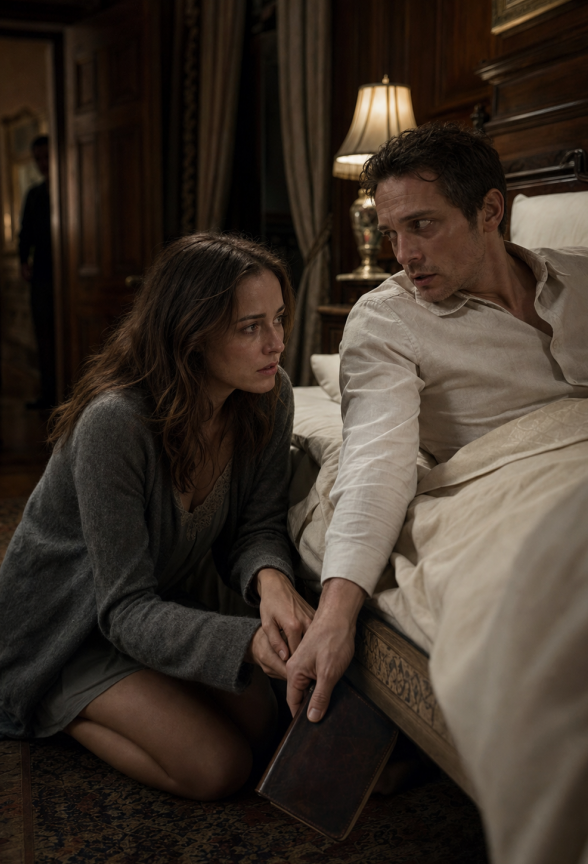
He guided my hand, slow and deliberate, to the underside of the mattress, and my fingers closed on a spiral notebook gone soft at the corners from handling. I opened it on my knees in the lamplight, and I understood, page by page, that Elliot Thornton was not empty. He was hiding.
The notebook was a ledger of theft. Dates. Account numbers. The name of a bank in the Caymans. Jason’s signature forged onto transfer after transfer, siphoning the trust’s holdings into shells while everyone congratulated him for “managing things so the poor boy doesn’t have to.” There were photographs tucked between the pages — documents shot in low light, a safe left open, Jason at a desk that wasn’t his.
I looked up at Elliot. His eyes were wet and fierce and completely present.
He couldn’t give me the whole story out loud that night — his speech came back slowly, and only later — but he could squeeze my hand, and he could write. Over the next hours, in a handwriting that shook, he told me what had happened. The accident had been real. The recovery had been faster than he let anyone see. And when he’d started to understand what Jason was doing to the estate, he’d made a choice that probably saved his life: he let them believe he was gone.
A man they thought was empty was safe. A man they knew was watching was a problem to be solved.
So Elliot became furniture. He let them wheel him to the window. He let them talk about the trust over his head. And every time Jason left a document within reach, every time a nurse looked away, he copied what he saw into a notebook he hid where no one who thought him helpless would ever look.
He’d needed one thing he couldn’t get alone. A witness. Someone in the house who wasn’t part of the family, who could carry what he’d gathered to people outside these walls. They’d handed him exactly that, wrapped in a wedding dress, and told her to expect nothing.
I want to be honest about the fear. My first instinct was that this was dangerous, that I’d married into something I couldn’t survive. But I looked at that man, who’d spent two years performing his own absence to stay alive, and I understood that the most dangerous thing was to do nothing.
We planned it carefully, the two of us, in whispers, over a week. I played the tidy outsider by day. At night we photographed the last pages we needed. When I had it all, I drove into the city under the excuse of a dress fitting and put copies in the hands of a forensic accountant and, a day later, a lawyer who did not work for the family.
Jason never saw me as a threat. Why would he? I was the arrangement. I was the girl who signed things.
The trust had a provision that let a competent beneficiary petition for review. Elliot, it turned out, had been competent all along — the “incompetence” ruling rested on a medical report that a doctor later admitted, under oath, he’d signed as a favor. When Elliot walked into that review under his own power and spoke, in a courtroom, for the first time in front of the family, his mother made a sound I will never forget.
Jason ran. He didn’t get far. The accounts told the whole story, and the notebook — my husband’s patient, shaking, two-year record — told the rest.
People ask if it was a real marriage, given how it started. I tell them the truth. It started as a transaction designed by people who thought neither of us mattered. It became something else in a lamplit room, when a man everyone had written off decided to trust me with the only weapon he had.
He talks now. Every day. And the first full sentence he ever said to me, out loud, was that he’d heard every word I’d said to him in the dark, and he was sorry he’d let me feel alone even for a night.
Comments are closed.