The label read Kestrel Valley Medical Group.
I had to read it three times before the letters stopped swimming. My hand was still on Julian’s throat, counting the thready beat coming back under my fingers, and the other hand had closed around that tipped amber bottle almost on instinct, the way you grab anything within reach when a body is trying to quit on you. It was only when I turned it toward the lamp to read the dosing that I saw the pharmacy name, and my whole ruined year came roaring back at once.
Kestrel Valley was the clinic that fired me. Fourteen months earlier I had been the attending physician who reported a supervisor for signing off on prescriptions that never should have left the building. I had the records. I had the countersignatures. And within six weeks I was the one under investigation, my license flagged, my name quietly circulated to every hospital within two hundred miles as a liability. They didn’t have to prove anything. They just had to make sure no one would hire me again, and it worked. I went from running a trauma bay to driving for a delivery app and telling my landlord the rent would be a little late.
So when a man in a tactical coat knocked on my door at eleven at night in the worst blizzard of the year and said a family needed a doctor who could keep her mouth shut, I almost said no. I’m not proud of the fact that I said yes because I needed the money. Bishop drove me through whiteout streets with the heater roaring, and he wouldn’t tell me the name of the family until the private elevator opened directly into a penthouse, and by then it didn’t matter, because a young man was dying on the floor of a steel-walled room and everything I am took over.
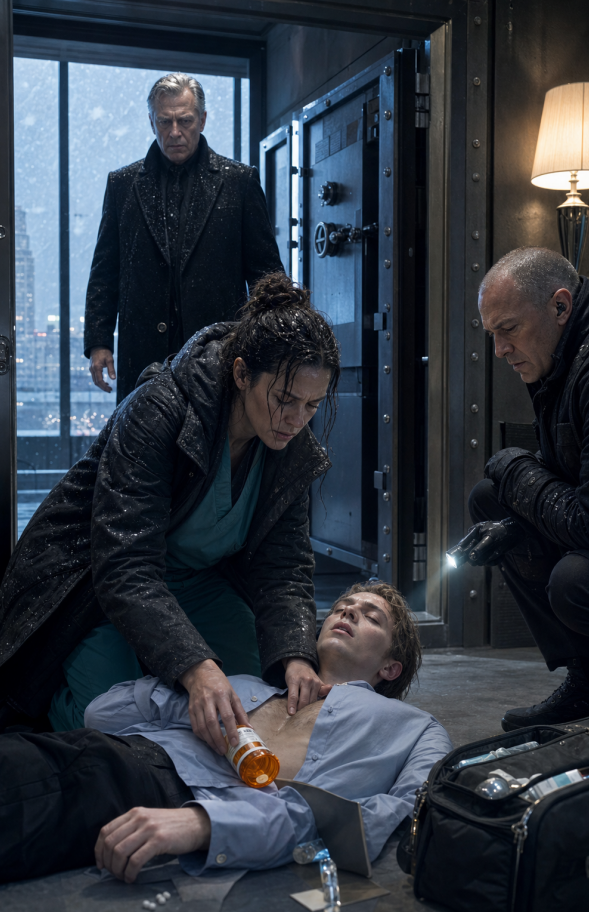
I got him back. That’s the part I want to say plainly, before any of the rest of it. Julian Ashcombe was breathing on his own and cursing weakly by the time the storm let an ambulance through, and whatever else is true, I did the job I trained half my life to do.
But when I stood up, the bottle was still in my hand, and Silas Ashcombe was staring at it, and I understood two things at the same time.
The first was that the Ashcombe family — the name that made bankers straighten their ties, the family that owned half the skyline outside those white-blind windows — was tied directly to Kestrel Valley. Not as patients. As owners. The clinic that had erased my career was a small, forgotten line item in a holding company with their name buried three shells deep. The pills that had nearly killed the heir of the empire had come from the same rotten pipeline I’d tried to report, the one they’d protected because shutting it down meant admitting it existed.
The second thing I understood was that Silas had known who I was before Bishop ever knocked on my door.
“You could have called any doctor in the city,” I said. My voice didn’t shake, which surprised me. “You called the one you destroyed. Why?”
He didn’t insult me by pretending. He was a man who had just watched his only son nearly die, and something in him had cracked open and not fully closed. “Because the doctors I trust are the reason he had those pills,” he said. “And because I wanted to know if you were what they said you were. A troublemaker. A woman who couldn’t leave things alone.” He looked at his son, then at me. “I needed someone who wouldn’t stop. I have spent a year making sure no one would ever believe you again. Tonight I needed exactly that person.”
It was, I realized later, a test. The whole night was a test disguised as an emergency. He wanted to see whether the woman he’d blacklisted would still kneel on a cold floor and fight for the life of the family that ruined her. I passed a test I hadn’t agreed to take.
Here is what I did with it.
I kept the bottle. I photographed the label, the lot number, the fill date, all of it, before I handed the physical evidence to a lawyer who had been waiting fourteen months for exactly this. The lot traced back through Kestrel Valley to the supervisor I’d reported and, above him, to the compliance officer the Ashcombes paid to look away. It was the thread that unraveled the whole tangle, because once one regulator had a reason to pull, everything I’d tried to say a year earlier suddenly had teeth.
Silas could have fought me. He had the money to bury me a second time. He didn’t. I think watching his son turn grey on that floor had shown him the actual cost of a system built to protect the wrong people. He signed a statement. He shut the clinic down himself, publicly, and let the reckoning fall where it fell, including on people he’d spent years shielding.
My license was reinstated in the spring. The letter came in a plain envelope and I sat in my car in a grocery store parking lot and cried in a way I hadn’t let myself cry the entire year.
I don’t work for the Ashcombes. I want to be clear about that. What I have from them is an apology I didn’t expect and a truth I fought a year to prove. Julian writes to me sometimes. He’s in recovery, real recovery, the hard kind, and he told me once that the last thing he remembers before the dark was a soaked stranger’s hands on his throat telling him to stay. I told him I remember it too.
The clinic that tried to end me is gone. The doctor they said would never practice again is back in a trauma bay where she belongs. And it all turned on one amber bottle, tipped on its side on a cold steel floor, with a label facing just the right way for a woman who had every reason to walk away to read it and decide, one more time, not to.
Comments are closed.