I never told the agency I had a son.
When you clean houses for people with more money than a small country, they don’t want to know you have a life. They want you invisible. In by six, out before the family stirs, no trace that a person moved through those rooms except the shine you leave behind. So for two years I kept Teo a secret, the way you keep a candle cupped against the wind.
That morning the wind won. My sitter called at ten to six, sick, apologizing, and I stood in my kitchen with my uniform half-buttoned and a sleeping three-year-old and no options that didn’t end with me losing the only job that paid the rent. So I did the thing you’re never supposed to do. I wrapped Teo in his coat over his pajamas, put a coloring book and a little tin of watercolors in my bag, and I took him with me to the Cole estate.
Mr. Cole was not a man you risked things around. The staff spoke about him the way you’d speak about weather that had killed people. Since his wife died, the house had gone quiet in a way that wasn’t peaceful, it was frozen. Mrs. Alvarez, who ran the staff, told me on my first day: he does not want to see you, he does not want to hear you, and if he ever has to do either, you will not come back. I believed her. I’d seen him exactly twice in two years, both times from the far end of a hallway, a tall gray shape that made the air colder.
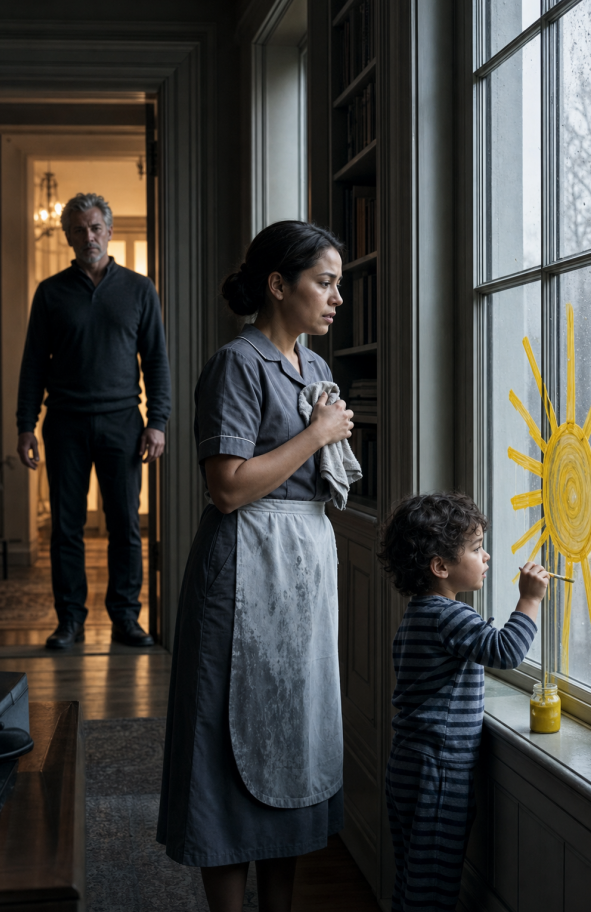
So I put Teo in the study — the one room Mr. Cole never used, the one that still had his late wife’s reading chair angled toward a window nobody opened the curtains on anymore — and I told my son the only thing that mattered. Quiet as a mouse. Paint your pictures. Mama will be right down the hall.
I was in the kitchen wiping down counters when I heard it. Footsteps on the marble. Early. Too early. Coming from the wrong wing.
I have never moved so fast in my life. But by the time I reached the study doorway, he was already there, filling it, and I stopped so hard I nearly fell.
Teo was up on his tiptoes at the tall gray window. And across that cold expensive glass, in wobbling three-year-old strokes, he had painted a huge lopsided yellow sun. Rays going every direction. A smile on it. Still wet, dripping a little at the bottom.
My son turned around, saw the tall stranger, and said, matter-of-fact the way small children explain the whole universe, “Your room was too gray. So I gave you a sun.”
I couldn’t breathe. I started to apologize, to promise I’d clean it, to gather my child and my bag and my dignity and go. I got as far as “Mr. Cole, I am so sorry—” before he raised one hand. Not sharp. Just still.
He didn’t look at me. He looked at the sun.
Then this man they all feared lowered himself down. Sixty years old in a cashmere sweater, folding down onto his knees on the study floor until he was at eye level with my son. He looked at the painting for a long time. And when he spoke, his voice came out rough, like a door that hadn’t been opened in a while.
“She used to say that too,” he said. “That the room was too gray.”
Teo, unbothered, offered him the brush.
And Mr. Cole took it.
He didn’t paint anything. He just held it, turning it in fingers that were shaking, and I saw something happen in his face that I don’t have a good word for. Like ice going soft at the edges. Like a man who had not let himself feel the size of his own grief finally setting it down for one second because a child had drawn him a sun.
He didn’t fire me. That was the first shock. The second came when I reached for a rag and he said, without turning, “Leave it.” I said it would streak, sir, it’ll be hard to get off later. He said, “I know. Leave it anyway.”
That sun stayed on the study window for four months.
The cleaning staff were told, in writing, that the glass in the east study was not to be touched. Guests asked about it. He never explained. Some mornings I’d come in early and find him just sitting in his wife’s reading chair, coffee going cold, looking through that crooked yellow sun at the garden like it was the first time he’d let himself see it.
Things changed slowly after that, the way real things do. He started asking Mrs. Alvarez if “the boy” was coming with me. Then he started leaving things in the study — a bigger set of paints, good paper, a small child’s easel that must have cost more than my car. He never made a show of it. They were just there.
One morning near the end of winter he found me in the hall and said he’d like to talk. My stomach dropped, because in my experience when the powerful want to talk it’s the end of something. Instead he told me he’d set up a fund for Teo’s schooling. That he’d already spoken to his lawyer. That he didn’t want anything in return and I could say no.
I asked him why. Why us. Why a stranger’s kid and a housekeeper he’d barely spoken to.
He was quiet a while. Then he said, “For two years I paid a great deal of money to make sure this house stayed exactly the way it was the day she left it. Frozen. I thought that was how I kept her.” He looked toward the study. “Your son painted a sun on my window in about four minutes and it did more for me than any of it. I froze the whole house to hold onto her and it just made everything cold. He warmed one window and I could breathe.”
We stayed. Not as staff, exactly — that part got complicated in the good way, over years, over a lot of shared dinners that started with Teo and ended up being about all three of us. Everett is not a warm man on the outside even now. But he keeps a photograph on his desk of a crooked yellow sun on a gray window, dated the morning everything thawed.
Teo is nine now. He still paints. And every single one has a sun in it somewhere, because a sad man once knelt on a cold floor and taught my son that the gray rooms are exactly the ones that need them most.
Comments are closed.