I’ve worked in Walter Hale’s house for four years, and in all that time I never once saw him let anyone close to him. Not a friend. Not his own grown children, who called on holidays out of duty and hung up fast. Certainly not me, the housekeeper he paid well and looked through like glass.
So I need you to understand what a miracle it was, what my son did with a crayon and a lollipop.
Mr. Hale is sixty-three, and his heart is failing. I learned that the way you learn everything in that house — by overhearing it. His cardiologist had come to the study, and I was polishing the hall banister when I heard the word “surgery,” and then Mr. Hale’s voice, cold and final, saying he would not be “cut open like a fish” and put at anyone’s mercy. He’d rather take his chances, he said. He’d rather stay in control.
I understood more than he knew. A proud man who has spent his whole life making sure no one can ever hurt him does not easily lie down on a table and hand a stranger a knife. The surgery frightened him in a way that had nothing to do with the odds and everything to do with being helpless. So he refused it, and he snapped at anyone who raised it, and the whole house learned not to say the words “sick heart” out loud.
My son Sammy is six. I bring him with me some afternoons when there’s no one to watch him, and he plays quietly in the servants’ hall with his crayons. He’s a literal little boy — the kind who takes everything you say at face value. And somehow, that day, he’d overheard the same thing I had.
I didn’t know he’d made anything until I turned around and he was gone.
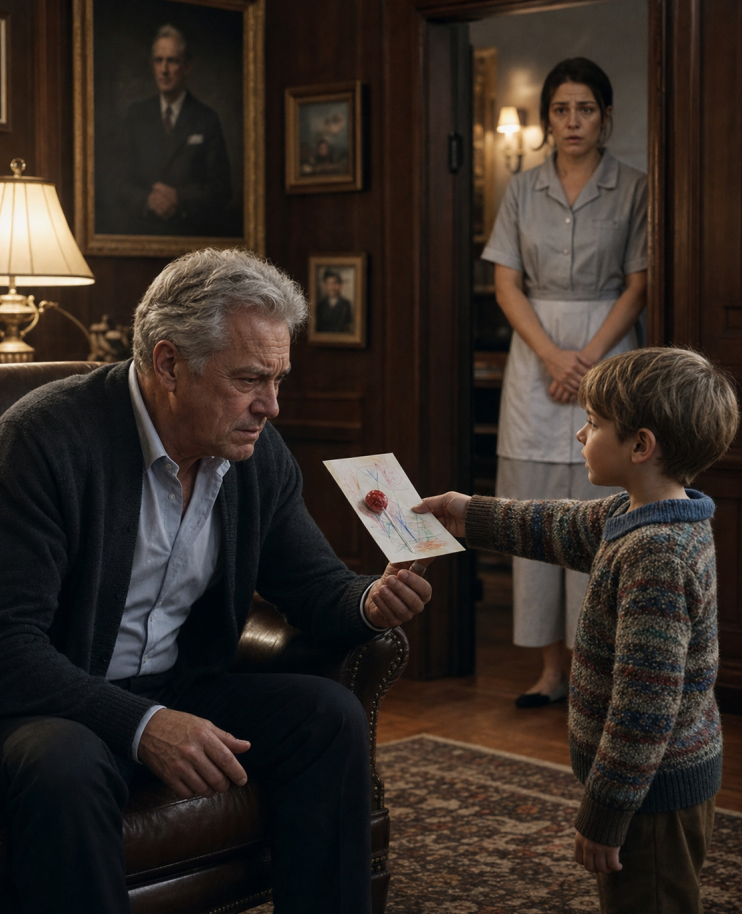
I found him in the doorway of the study. The one room in the house I’d told him a hundred times never to enter. My heart stopped. Mr. Hale was in his leather armchair, and Sammy was walking right up to him, holding out a folded piece of paper.
“I heard your heart is sick,” Sammy said, in that clear, unafraid way small children have. “So I made you a get-well card. There’s candy on it. Candy makes hearts feel better.”
He’d drawn a lopsided red heart on the front and taped a strawberry lollipop right in the middle of it. His best lollipop. The one he’d been saving.
I couldn’t breathe. I was already stepping forward to snatch him back, to apologize, to brace for the temper I knew lived in that man. Mr. Hale hated to be reminded he was weak. Mr. Hale hated to be touched by anything he hadn’t allowed in.
But Mr. Hale didn’t shout.
He leaned forward in his chair, slowly, and took the card in both hands like it might tear. He looked at the crooked heart. He looked at the lollipop. And this man I had watched be made of stone for four years — his face just came apart. Quietly. His eyes went red and wet, and his mouth worked like he’d forgotten how to speak.
“Candy makes hearts feel better,” he repeated, barely a whisper.
“Uh-huh,” Sammy said, very serious. “You have to get better. Then you can have the candy.”
I will remember what happened next for the rest of my life. Walter Hale, who had refused his own doctors, refused his own children, refused every person who’d tried to reach him — he reached out one shaking hand and rested it on the top of my son’s head. Just for a moment. Like he was steadying himself against something.
“All right,” he said. “All right. I’ll get better.”
That night I heard him on the phone in the study. Late, when he thought the house was empty. He was talking to his cardiologist. His voice was rough, and I heard him say the words I never thought that stubborn man would say: “Schedule it. Whatever’s soonest. Schedule the surgery.”
I stood in the dark hall with my hand over my mouth and cried.
I’ve thought a lot about why a six-year-old could do what a team of doctors couldn’t. And I think it’s this. Every adult in Mr. Hale’s life talked to him about odds and risks and mortality, and every one of those conversations reminded him he was afraid. Sammy didn’t do that. Sammy just decided, with total certainty, that Mr. Hale was worth getting better for. That his heart was worth fixing because there was candy waiting on the other side of it. There was no pity in it, and no fear. Just a small, stubborn kindness that assumed the best about a man who’d stopped assuming the best about anything.
You cannot armor yourself against that. It gets under the door.
The surgery went well. He’s home now, moving slow, complaining about the food I’m allowed to cook him, which is his way of saying thank you. He keeps that card on the mantel in the study, the lollipop still taped to the front, gone pale and sticky in its wrapper. His children noticed it on their last visit and asked about it, and he told them, gruffly, that it was none of their business.
But I know what it is. It’s the reason he’s still here.
Sammy asked me last week when Mr. Hale is going to eat the lollipop, since he got better like he promised. I didn’t know what to tell him. I don’t think that candy is ever coming off the card.
Some get-well wishes you keep forever.
Comments are closed.