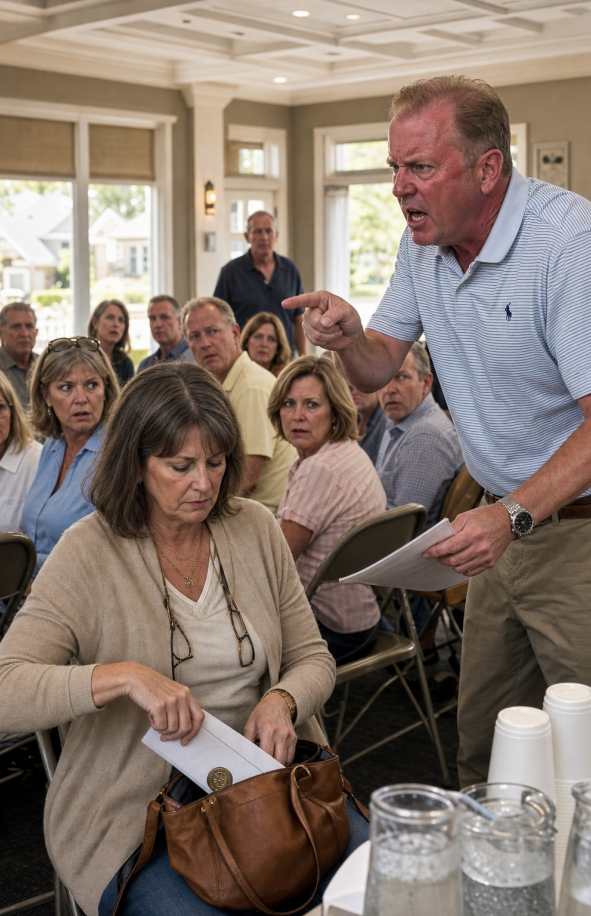
The clubhouse went quiet after Brad pointed at me, and I let it stay quiet a moment longer than was comfortable. I’ve learned that plain, quiet people are allowed one thing in a room full of loud ones: patience.
Then I reached into my handbag and took out a folded document with a county seal on it.
Let me back up, because the water is the whole story.
When my late husband and I bought our lot in that gated community nineteen years ago, the land came with something most of the neighbors never bothered to understand: deeded water rights. Not a share of the community system. The rights themselves — the legal claim to the aquifer the whole subdivision draws from. My husband was a hydrologist. He knew exactly what he was buying. When he passed, those rights came to me, filed and recorded, plain as day, in a drawer I hadn’t needed to open in years.
The developers who built the newer houses up the hill — Brad’s house among them — connected to that water assuming it belonged to the HOA. It never did. The HOA operated the pipes. I owned the water in them.
I never made a thing of it. Why would I? The water flowed, everyone paid the association, and I kept to myself in my beige cardigan and my old sedan. It cost me nothing to let people believe what they wanted to believe.
What changed was Brad.
Over the summer, the pressure on the lower street started dropping. Wells running thin, sprinklers sputtering. The HOA got frightened, and Brad — who had installed an enormous irrigation system for the golf-green lawn he was so proud of — got loud. He needed a culprit before anyone looked too closely at how much water his own property was pulling. So he picked the easiest target in the neighborhood. The plain woman. The nobody.
“She’s been tapping the shared line illegally for years,” he announced. “I’ve seen the pipes.”
He had seen pipes. He just hadn’t understood whose they were.
I unfolded the county filing and asked the HOA president if he’d read it aloud, since my voice doesn’t carry the way Brad’s does. He took it. He read the header. Then he read it again, slower, and the color of the room began to change.
The document was the recorded deed to the water rights. My name on it. My husband’s before mine. Dated, sealed, and filed with the county nineteen years ago — long before Brad ever moved in.
But that wasn’t the part that made him sit down.
The part that made Brad Osgood lower himself into a folding chair was the second page. Because when the well pressure dropped, I’d done what my husband taught me to do: I pulled the county records to see who had registered new draws on the aquifer. And someone had filed paperwork that spring to expand a tap directly into the rights I hold — paperwork that required the rights-holder’s signature.
My signature was on it. And I had never signed it.
It was forged. Clumsily. My name spelled correctly, which is more than Brad usually managed when he spoke to me, but in a hand that was not mine, authorizing a draw that fed one property. His.
He hadn’t just accused the woman he’d stolen from. He’d accused her of the exact crime he was committing, hoping the noise would cover the theft.
I didn’t shout. I’ve never once shouted at Brad Osgood. I simply told the room, in my quiet voice, that I would be happy to keep the community’s water flowing exactly as it always had — the association operating the pipes, the neighborhood paying its fair share — on one condition. That the unauthorized, forged tap feeding a single lawn up the hill be capped, and that the person who filed a county document under my forged name explain himself to the board.
Every head in that clubhouse turned from me to Brad.
He tried, for about thirty seconds, to bluster. Then his own contractor — sitting three chairs down, there for an unrelated fence dispute — quietly mentioned that yes, Brad had hired him to run that new line in April, and had assured him the paperwork was “all handled.”
The HOA capped the tap the following week. The pressure on the lower street came back within days. And Brad, who once told me to my face that I was too plain to matter, now has to nod politely to me at the mailboxes, because the plain woman in the beige cardigan is the reason his taps run at all.
I could have shut his water off entirely. The forgery alone would have justified it. I didn’t. Not out of kindness, exactly — more because I didn’t need to. The whole neighborhood watched him fold in that clubhouse. That was enough.
People spend so much energy deciding who matters and who doesn’t. They look at the car, the clothes, the volume of a voice, and they sort everyone into somebodies and nobodies. What they forget is that the quiet person in the corner is usually the one actually reading the documents.
My husband used to say water always finds its level, no matter how loud the man standing on top of it. I think about that every time Brad waves at me now, stiff and careful, from four houses down.
He finally learned whose name was on the water. It just cost him the whole neighborhood watching to teach him.
Comments are closed.