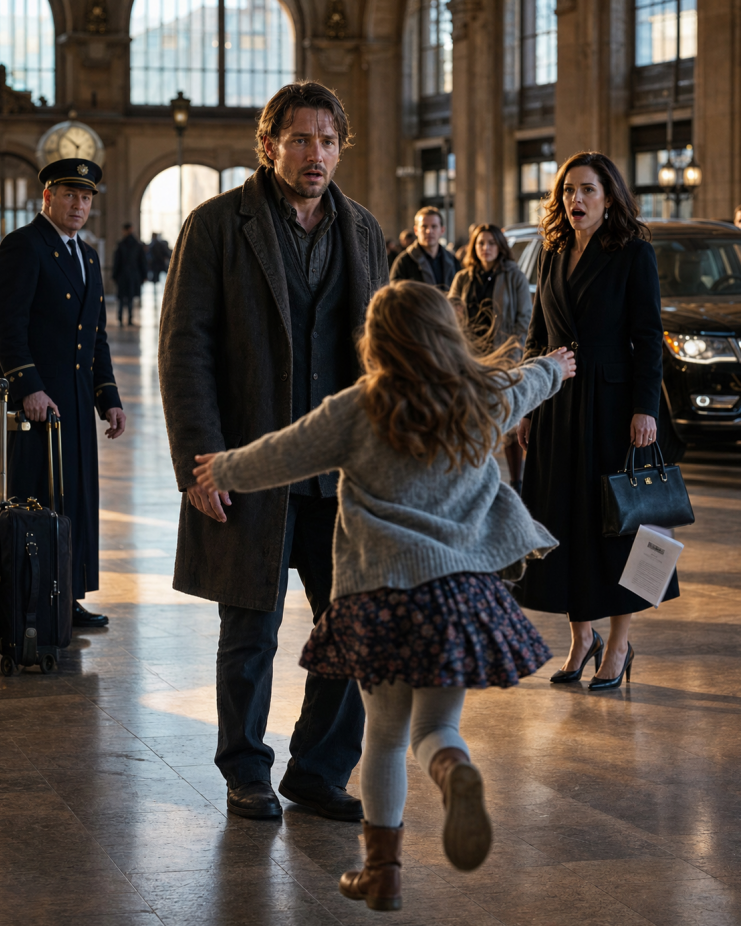
The word Sophie was shouting, over and over, sprinting down that platform in her red winter hat, was “Mommy.” And the reason it ended Ray’s performance is that he’d never once heard our daughter’s voice, because he didn’t know she existed.
Let me tell you what happened after the doors opened, because the platform was only the beginning.
Sophie reached the window and pressed both mittened hands against the glass, fogging it, grinning at me with the gap where she’d just lost a tooth. Behind her, my mother came hurrying up with the stroller and the bags, calling for her to slow down. And Ray — Ray who had spent the entire ride from downstate cataloging every cheap thing about me — went very still in his seat.
“Who is that,” he said. Not really a question.
“That’s my daughter,” I said, gathering my worn coat and my bag. “I’m getting off here.”
I stood to leave. He grabbed my sleeve — the sleeve of the coat he’d been mocking for two hours — and his grip was not cruel now, it was frightened. “Ellen. How old is she.”
I looked at him for a long moment. And I decided, standing in the aisle of that train, that I was done protecting him from the truth. Not to wound him. Just because I was tired of carrying it alone.
“She’s five,” I said. “Do the math, Ray. You always were good with numbers.”
I watched it hit him. Five years old. Which meant she’d been conceived in the last months of our marriage. Which meant the hospital bill he’d found on my dresser all those years ago — the one he’d screamed about, the one he’d decided in his fury was proof I’d “gotten rid of a problem” behind his back — had never been what he assumed. He’d never asked. He’d just raged, and packed, and left, and told everyone we knew that I was the coldhearted woman who’d ended a pregnancy to spite him.
“That bill,” he said slowly, and his face was the color of the platform concrete. “The one from the clinic. That was—”
“Prenatal care,” I said. “It was always prenatal care. I was three months along when you walked out calling me a murderer. I let you believe what you wanted because you’d already decided, and a man who could think that of me was not a man I wanted anywhere near my child.”
Union Station roared around us. Sophie was still bouncing at the window, oblivious, waiting for her mother.
Ray sat back down. This enormous, expensive, loud man just — folded, like all the air had gone out of him. “I have a daughter,” he said, to no one. “I’ve had a daughter for five years.”
“You’ve had a daughter for five years,” I agreed. “You just spent two hours on a train telling her mother she settled for less because that’s all she was worth. So no, Ray. You don’t get to walk out onto that platform and be her father because the guilt just landed. That’s not how this works.”
I want to be honest with you about what happened next, because it isn’t the clean revenge story the platform scene might promise.
He cried. Right there in the compartment, this man I’d once loved and then feared and finally pitied, he put his face in his hands and cried in a way I’d never seen in all our years of marriage. And some part of me — the part that had loved him before he taught me not to — ached at it. But I did not soften, and I did not let him meet her that day. I told him that if he was serious, truly serious, he could contact my lawyer, and we would talk about what a careful, slow, supervised introduction might look like, on Sophie’s timeline and no one else’s.
Then I picked up my bag, walked off the train, and knelt on the cold platform to catch my daughter as she flung herself into my arms.
Ray did contact my lawyer. To his credit — and I did not expect to ever write those words about him — he didn’t fight, didn’t posture, didn’t try to buy his way in. He agreed to every condition. Supervised visits at first. Family counseling. A slow build, on Sophie’s terms. He has been, in the two years since, a more careful and humble man than the one I married. Fatherhood late and by ambush seems to have done what our whole marriage couldn’t: it made him quiet. It made him listen.
Sophie knows him now as a person who comes on Sundays and is learning to braid her hair badly and takes it seriously when she corrects him. She doesn’t know the story of the train, or the bill, or the years he called me a murderer to anyone who’d listen. She’s five. She gets to just have a dad who’s trying.
I kept the coat. Ray offered, awkwardly, one Sunday, to buy me a new one — a peace offering, I think, or an apology he didn’t have the words for. I told him no. That coat kept me warm through nine winters I got through without him, including the one where I gave birth to his daughter alone. It’s not a sad coat. It’s the proof that I made it.
He looked at it for a long moment and I think, finally, he understood. “It’s a good coat,” he said.
“It is,” I said. “It’s the best coat I’ve ever owned.”
And I meant it.
Comments are closed.