I planned my ex-husband’s baby shower for his new fiancée, and I want to tell you why — and what happened in the weeks after I set that envelope in his hands — because the garden party was only the beginning of it.
Let me be honest about who I was when Grant and I were married. I was quieter then. Smaller. I let him narrate our life, and when our years of infertility ended in a divorce he engineered to make me the villain, I let him narrate that too. He told the country club I was “barren.” He told a judge the failure was mine. His lawyers put my medical history on the record to protect his pride, and I was too broken at the time to fight the way I should have.
What none of them bothered to check — what Grant’s own lawyers were too arrogant to read carefully — was the clinic paperwork.
Our final round of IVF had produced viable embryos. In his rush to declare me the barren one and be done with the whole humiliating chapter, Grant signed away all claim to what the consent forms called “the marital reproductive material.” He didn’t read it. He just wanted the clean story: her fault, not mine. That signature gave me sole custody of the embryos. He signed away his own children to win an argument, and he never knew it.
Two years later, I used one. I carried the twins myself — Noah and Grace, now seven. I didn’t do it for revenge. I did it because I wanted to be a mother and those embryos were mine and I was done letting a man’s lie decide what my body was allowed to hope for. They are the joy of my life. Revenge genuinely never entered into it.
Then Grant got engaged to Vanessa, and my event-planning firm — hired before he understood who owned it — got the contract for the shower. And I sat with the clinic’s genetic report and the custody documentation in a manila envelope I’d carried for four years, and I understood the universe was handing me a choice.
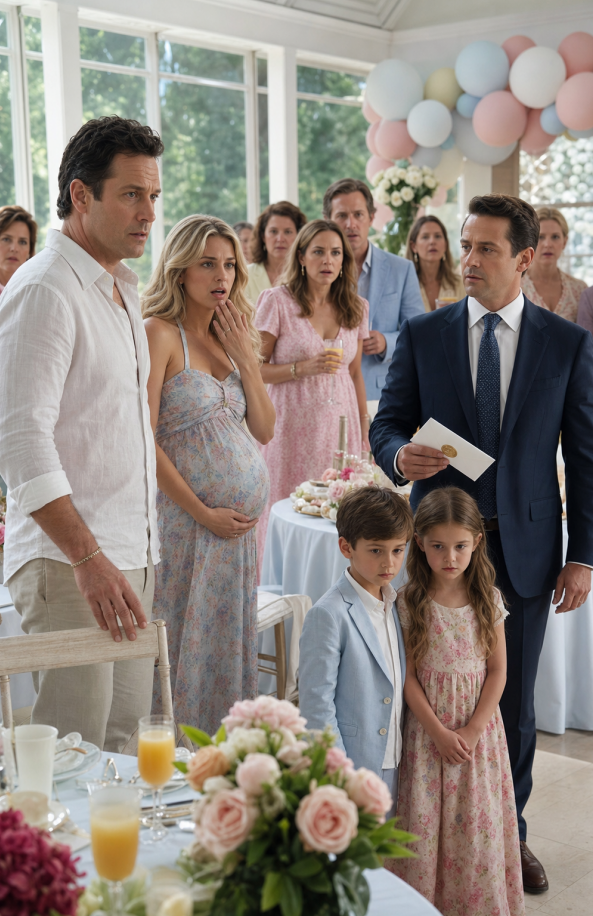
I could have skipped it. I could have sent an associate. Instead I planned the most beautiful shower of my career, and at 3:40 I had my friend walk Noah and Grace into that garden, and I walked over to Grant with the envelope.
You already know what I said. What you don’t know is what came after.
Grant sat down in a white folding chair like his legs had quit. He stared at Noah — my son has Grant’s exact eyes, there’s no denying it — and I watched a man do the math on five years he could never get back. Vanessa, pregnant, confused, kept asking who the children were, and when she finally understood, she went very still.
I said my piece quietly. I told him these were his children, that he’d signed them over to me the day he chose his pride over the truth, that I didn’t want his money or his name and my kids would never need either. I told him I just wanted him to see what the lie had actually cost. Then I gathered my children and I left my associate to manage the rest of the event, because I’d done the one thing I came to do.
The consequence unfolded over months.
Grant tried to reverse it. Lawyers, first — but my documentation was airtight and the wall he kept slamming into was his own signature. Then came the offers, the sudden desperate interest in fatherhood, the long emails alternating between apology and accusation. I answered none of it directly. I let the lawyers handle the paperwork and I protected my children’s routine like the fortress it needed to be.
Noah and Grace have met him twice, supervised, on their terms. I will not raise them to hate anyone, not even the man who denied them before they were born. What they decide about him when they’re grown is theirs to decide. My only job is to make sure the choice is actually theirs, and not something I forced on them in either direction.
Vanessa left him before the new baby came. She called me once — a strange, sad, brave phone call I never expected — and told me that a man who could disown his own children to win a divorce was not a man she trusted to raise hers. I didn’t gloat. I told her the truth: that I was sorry she’d learned it the hard way, and that her baby was lucky to have a mother paying attention. We’re not friends. But we understand each other in a way Grant will never understand either of us.
As for Grant — the last real conversation we had, he asked me why I’d done it that way. In front of everyone. At the shower.
“Because you did it that way,” I said. “You put my private pain on a public record to protect your image. You told a whole world I was empty while you were the one who signed the family away. I didn’t lie about anything, Grant. I just stopped letting you be the only one who got to tell the story.”
He didn’t have an answer. Men like Grant rarely do, once the narrative slips out of their hands.
I still plan beautiful parties. I still arrange peonies for other people’s happy days. And every so often I think about the weight of that envelope I carried for four years — and how the heaviest thing inside it was never the paper. It was the truth he’d been too proud to ever go looking for, sitting there the whole time, waiting for the afternoon I finally decided to set it down.
Comments are closed.