I opened the note standing up, because I did not trust my legs to hold if I sat.
The handwriting was hers. I had known it the moment I saw my name on the fold, and pretending otherwise had lasted exactly as long as it took to break the seal.
Her name was Iris. Eleven years ago she was a nurse in a hospital I did not yet own, and I was a younger, harder man on my way up, and for one year we were something I have never let myself name since. Then my family got involved. My family always got involved. There was a woman more suitable being lined up, a merger of two names, and Iris did not fit the plan. My mother’s lawyers made that very clear to her, in ways I told myself I didn’t know about.
I told myself she left. That’s the story I carried for a decade: she left, she wanted out, she took the check and moved on. It let me sleep.
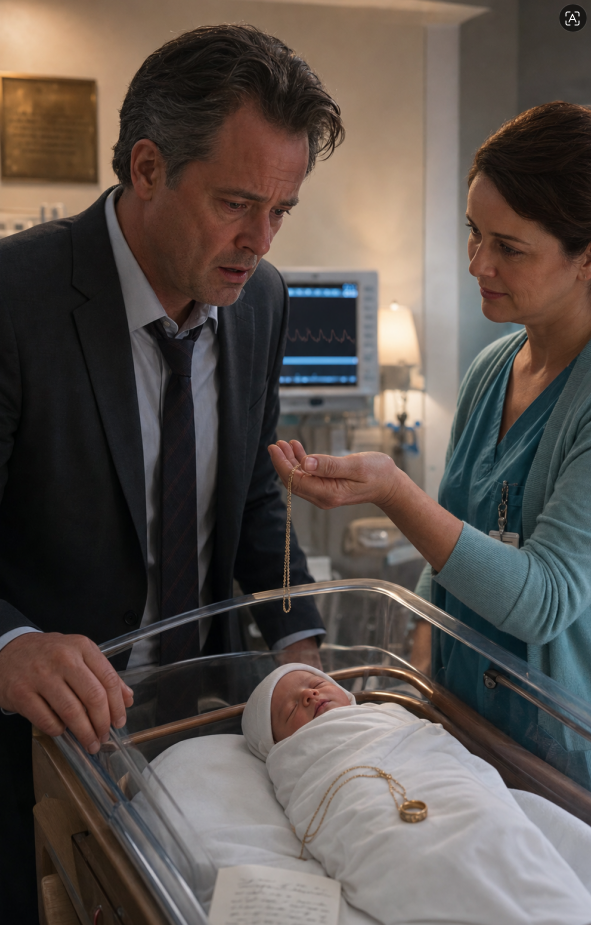
The note said otherwise.
She wrote that she had been pregnant when the lawyers came. That she never told me because she watched what my family did to people who threatened the plan, and she would not let them do it to her child. She wrote that she had raised our daughter alone, quietly, two states away, and that our daughter had grown up bright and stubborn and kind. And she wrote that she was dying. Pancreatic. Fast. By the time I read the note, she wrote, she would already be gone from the hospital, because she did not want to see my face out of pity, only to know that our granddaughter, the newborn in the bassinet, would be safe.
Our granddaughter. Iris’s daughter had a daughter of her own now, and she had died in childbirth in this very wing, hours before I arrived. The chain reaction of a single cruel decision eleven years ago had rolled all the way down to a bassinet with my grandmother’s ring on it.
The ring. Iris wrote that our daughter had kept it, the one thing I’d given her mother, and had asked, at the end, that it be left with the baby so that “he’ll know, when he sees it, and then he can decide what kind of man he wants to be for her.”
I sank into the chair beside the bassinet. Nurse Priya put a hand on my shoulder and left it there, and I, who had not wept at my own mother’s funeral, wept over a sleeping child I had not known existed twenty minutes before.
I want to tell you I did everything right after that. I mostly did. I did not go looking for someone to blame, though God knows I wanted to; the lawyers were long retired, my mother long dead, and the person most to blame was the young man I’d been, who chose comfort over courage and called it having no choice.
I filed for custody of the baby that week. There was no other family; her mother had been an only child, raised alone. The DNA confirmed what the ring already had. I named her Iris, after her grandmother, and I brought her home to a house that had been very quiet for a very long time.
I stepped back from the merger world. Not entirely, but enough. I hired the best people and let them run things, and I learned, at forty-four, how to warm a bottle and how to sleep in ninety-minute pieces and how to sing badly to a child at three in the morning.
The wing still bears my mother’s name on the brass plate. I thought about changing it. I decided not to. My mother’s name on that wall is a fair thing; she did love me, in her controlling, ruinous way. But I added a second plate, smaller, by the maternity ward doors, and it bears Iris’s name, the nurse who once worked those halls and then died two states away rather than hand her child to my family.
Sometimes I take little Iris down there, when she’s older enough to walk the halls with me. I show her both plates. I tell her the first woman built the family, and the second woman saved it, and that she carries both of them.
I don’t tell her yet about the eleven years. About the check, the lawyers, the story I let myself believe. That conversation waits for when she’s grown, and I dread it, and I will not lie to her when it comes.
But I keep the ring. It’s on a chain in a box on my dresser, and on the day she turns eighteen it’s hers. When she asks how I knew she was mine, I’ll tell her the truth: that a woman I failed made sure I couldn’t look away. That she put the one thing I’d remember on the one person I couldn’t abandon. And that the night I found it was the night I finally became the man I should have been from the start, eleven years and one grave too late to tell her mother I was sorry.
Comments are closed.