The general did not hurry.
That is the thing I keep coming back to, months later. Five hundred families were packed into that stadium, the band was still holding the last note of the anthem, and a three-star general stepped down off the dais and walked — slow, unbothered, like he had all the time in the world — across the whole length of the field toward the cheap folding chairs at the back where they’d put me.
They’d put me there on purpose. I want to be honest about that, because it stopped stinging a while ago and now it’s just part of the story. My daughter Katie was being commissioned as an officer that morning, one of dozens of new lieutenants in crisp dress whites, and I had driven eleven hours in my truck to see it. I’d worn my good flannel, the blue plaid one, buttoned all the way up. I’d shaved twice. I thought I looked fine.
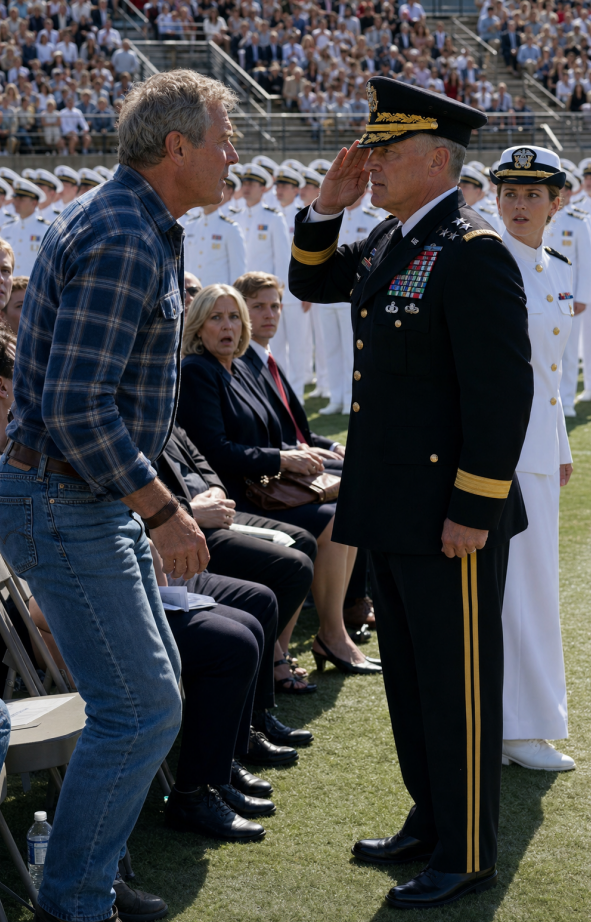
Katie’s fiance’s family did not think I looked fine. His father runs some kind of investment group, and his mother had spent the welcome brunch the day before looking at my hands like she was trying to figure out what I’d touched. When the ushers were seating people, one of them — coached, I’m sure — steered me back to the rows they’d set aside for drivers, groundskeepers, and support staff. “You’ll have a great view from here, sir,” he said. The fiance’s family sat up front in the reserved section, in the sun, in their pale linen.
I didn’t argue. I’ve been underestimated by better-dressed people than them. I sat down between a bus driver and a woman who ran the stadium concessions, and honestly they were better company than the linen section would’ve been.
Then they read the names, and Katie took her oath, and I cried the way fathers cry when they’re trying not to, and I figured that was the whole day. The best day of my life, spent in the back row. That was fine. I got to see it. That was enough.
Except then the ceremony paused, and a voice on the loudspeaker asked General Harmon to say a few words, and instead of speaking the general looked down at a card in his hand, looked out at the support-staff rows, and started walking.
I didn’t understand at first. Nobody did. Five hundred people turned to watch this man cross the field toward the back, and I looked behind me to see who he was coming for, because it sure wasn’t going to be me.
He stopped in front of my folding chair.
He looked at my face for a second, and then he looked at my right wrist — at the cracked leather band I’ve worn every day for thirty-one years, the one I don’t take off, the one Katie used to chew on when she was a baby without ever knowing what it was. And this three-star general, in front of the whole stadium, came to attention and rendered me a slow, deliberate salute.
I want to tell you I stood up smoothly. I didn’t. My knees didn’t work right. The bus driver next to me actually put a hand under my elbow.
“Sergeant Dolan,” the general said, quiet, just for me, though the whole field had gone silent enough to hear it. “I have been trying to find you for a very long time.”
Here is what the linen section didn’t know. What Katie only half knew, because I never told her the details, only that I’d “been in, a long time ago.” Thirty-one years back, on a night I still don’t talk about, I carried four men out of a place I’m not going to name, one at a time, under fire, because I was the medic and that was the job. The leather band on my wrist was cut from a strap one of those men wore. He gave it to me in the aid station before they flew him out. I never learned if he made it.
He made it. He was standing on the dais that morning with three stars on his shoulders.
Harmon told the stadium the short version — that as a young lieutenant he’d been one of the men a nineteen-year-old medic had refused to leave behind, that he’d spent a career rising through the ranks and never once managed to find the kid who’d saved him, until a records clerk matched a name on a family list for this exact commissioning. My daughter’s commissioning. He’d come to honor a class of new officers and found the man he owed his whole life to sitting in the back in a flannel shirt.
I looked for Katie. She’d broken formation — you’re not supposed to, but no one was going to correct her — and she had both hands over her mouth, tears running straight down over her brand-new officer’s uniform, staring at her father like she was seeing me for the first time.
The fiance’s family, up in the reserved rows, sat very still. His mother’s face had gone a color I don’t have a name for. Nobody offered me a better seat after that. It was too late to, and they knew it.
Katie asked me that night, in the parking lot, why I never told her. I said there wasn’t anything to tell. You don’t do a thing like that for a story to hand your kid later. You do it because the man’s alive if you carry him and dead if you don’t, and then you go home and drive a truck and raise a daughter and button your good flannel to the collar for her big day.
She wears the leather band now. I gave it to her that night in the lot. She says she’s going to wear it every day she serves, so that whoever’s in the back row of her life — the drivers, the staff, the quiet ones in work shirts — she’ll remember to go find them.
That’s my girl. That was always my girl. It just took a three-star general walking across a field for a stadium full of strangers to see what I already knew.
Comments are closed.