I have catered close to four hundred events in my life, and I have learned to read a room the way other people read a book.
I know which host is going to argue about the bill before the night is over. I know which mother of the bride is one glass of wine from tears. I know, from thirty feet away, whether a party is happy or only pretending to be. It is a quiet kind of knowing, and it comes from spending your whole working life being invisible in beautiful rooms, watching people who never once look at your face.
The Cole christening was the most beautiful room I had worked in years. A stone church up in the hills, private, the kind an oil family builds a wing onto and then acts like their grandfather laid every brick himself. Candles everywhere. Real ones. White lilies banked around a stone font that was older than the state. I had been hired to run the reception in the hall next door, and my instructions had been very clear, delivered by a event coordinator who never learned my name: stay out of the sanctuary, keep the staff invisible, and do not, under any circumstances, be seen during the ceremony itself.
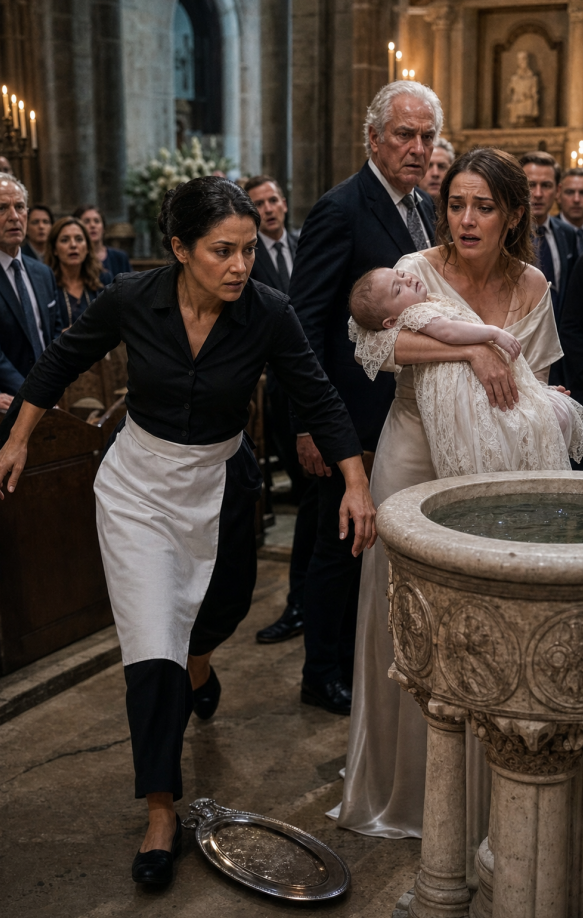
So I stayed at the back. I stood in the shadow of a stone arch with a tray of untouched champagne, waiting for the priest to finish, and I watched the Cole family cluster around the font in their tailored suits and silk dresses.
And I watched the baby.
He was maybe four months old, in a lace christening gown that had probably dressed six generations of Coles, held in his mother’s arms right at the front. And somewhere in the middle of the priest’s long, gentle words, I saw the baby’s color change.
I have three children of my own and I trained as a nursing assistant before I ever picked up a catering tray, back when I was young and thought I’d wear scrubs my whole life. I know what a healthy baby looks like. And I know what it looks like when a baby stops looking healthy — when the pink drains out of the lips and the little face goes slack and gray and too, too still.
Nobody else saw it. That is the part I still can’t get over. Thirty people were standing three feet from that child, looking right at him, and not one of them saw it, because they were all looking at the ceremony, at the priest, at each other. They were looking at the idea of the baby. I was the only one actually looking at the baby.
I had about one second to decide.
Because here is what runs through your head when you are the hired help and you think — you’re not sure, you’re only almost sure — that something is terribly wrong. You think: what if I’m wrong. What if I drop this tray and shove through this family and rip their grandson out of his mother’s arms in the middle of a sacrament, and he’s fine, and I’m just the hysterical caterer who ruined the Cole christening and will never work in this county again.
That thought lasted exactly as long as it took me to look at his lips one more time.
Then I set the tray down — I don’t even remember setting it down, they told me later it hit the stone and the glasses shattered — and I crossed that aisle faster than I’ve moved in twenty years.
“He’s not breathing,” I said. “Give him to me. Now.”
The mother didn’t. She clutched him tighter, the way any mother would, and she looked at me with pure animal confusion — who are you, why are you touching us. It was the patriarch, Walter Cole, an old man with silver hair who had not so much as glanced at me all evening, who reacted. Something in my voice, maybe. He barked one word — “Give her the baby” — and the mother’s arms opened and the child was in my hands.
He was limp. He was cold in a way a baby should never be. There was no rise in that little chest at all.
I went down onto the stone floor with him because there was nowhere else, and I did the thing my hands remembered even though my mind was screaming. Two fingers on the center of his chest. Small, careful compressions — a baby is not an adult, you do not hammer on them, you press like you’re pressing a secret into them. Tip the head, cover the nose and mouth, small puffs of air, just the air in your cheeks, no more. Compress. Breathe. Compress. Breathe.
The church had gone completely silent above me. I could hear my own voice counting. I could hear the mother making a sound I never want to hear again.
Compress. Breathe.
And then — I will feel this in my hands until the day I die — the baby jerked. His whole little body convulsed, and he pulled in a breath, a huge, ragged, furious breath, and he screamed. He screamed the loudest, angriest, most beautiful scream I have ever heard in my life, and the pink came flooding back into his face like someone had turned a light on inside him.
I sat back on the cold stone with a howling, living baby in my arms and I realized I was crying.
What Walter Cole did next — over the loud objections of relatives who, ninety seconds earlier, hadn’t been able to pick my face out of a crowd of staff — is the part I still tell people about when they ask why I keep my old nursing card in my wallet after all these years.
Full story in the first comment.
Comments are closed.