The chaplain was a young man, younger than my husband had been, and I could see his hands shaking a little as he held the envelope.
I had come to the chapel expecting to be nobody. That sounds bitter, and maybe it is, but it’s also just the truth of the last eighteen months of my marriage. Somewhere in his final year, my husband David had gone quiet in a way I couldn’t reach. He worked late. He flinched at his phone. He told me it was the pressure of the command, and I believed him because I loved him and because the alternative — that he was keeping something from me — was too big to hold. When he died, that quiet became a wall I couldn’t see around, and into the silence stepped a woman named Vivian.
I did not know Vivian. That was the first strange thing. She arrived at the memorial in black that cost more than my car, she moved through the officers and the widows like she belonged at the center of them, and she had somehow arranged — I still don’t fully understand how — to be the one called forward to receive David’s last letter. His final written words, prepared and sealed the way the men in his line of work sometimes do, to be delivered if the worst happened.
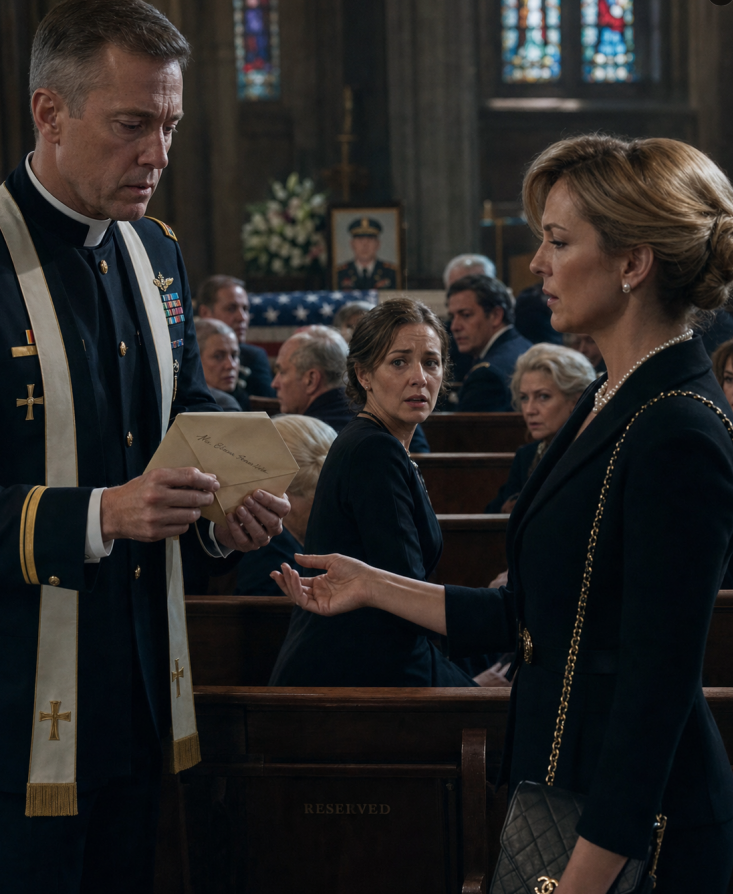
They called her name, not mine. Vivian Croft. And I sat in my pew in my plain black dress and felt the whole chapel quietly decide that I must have been the lesser thing in my husband’s life. The first wife, maybe. The one who didn’t understand him. Nobody said it. They didn’t have to. I could feel it settle on my shoulders like a coat I hadn’t asked for.
Vivian stood. She smoothed her skirt. She walked to the front with her chin up and her hand already half-extended, and the chaplain lifted the envelope to give it to her.
And then he stopped.
I have gone over this moment more times than I can count, because everything in my life divides into before it and after it. The chaplain looked down at the envelope in his hands — really looked, the way you look at something for the first time even though it’s been in front of you the whole while — and a small line appeared between his eyebrows. He turned the envelope a few degrees toward the light from the stained glass. And I watched his lips move, silently, reading a name.
“I’m sorry,” he said. His voice carried in that stone room the way voices do. “Before I hand this over, I want to be certain I’m honoring Commander Hayes’s wishes correctly.” He paused. “This envelope is addressed. In his hand. And it is not addressed to Vivian.”
You could hear the whole chapel stop breathing.
“It’s addressed,” the chaplain said, and he lifted his eyes and found me in the middle pews, “to Eleanor. To his wife.”
I don’t remember standing. People told me later that I stood. What I remember is Vivian’s face, the way the practiced sorrow slid straight off it and left something underneath that I had never seen on her but recognized instantly, because I’d felt it myself in nightmares — the look of someone whose story has just come apart in public.
The chaplain asked me, gently, whether I wanted the letter read aloud or handed to me privately. And here is a decision I will answer for the rest of my life: I asked him to read it. I don’t know why. Maybe because I had been made small in that room and some hard part of me needed the room to hear whatever David had to say. Maybe because I already sensed, watching Vivian, that the truth in that envelope was bigger than my grief.
He opened it. He read it.
David’s letter was not a goodbye to a lover. It was a confession and a warning and an apology, all in the cramped handwriting I’d know anywhere. He wrote that a woman named Vivian Croft had come to him a year and a half earlier with photographs — doctored, he swore, staged from a single meeting that was nothing — and had used them to bleed him. Not for love. For money, and for access, and for silence about a procurement matter she was tangled in. He wrote that he had paid and paid to keep her from bringing her lie to me, because he could not bear for me to see the pictures and doubt him even for a night. He wrote that the quiet I’d felt in him was shame, not distance. He wrote: If you are hearing this, then I ran out of time before I found the courage to tell you myself. She has no claim on me. She never did. You are my wife. You have always been the only one.
And then, at the end, the line I keep framed by my bed: Don’t let her stand where you should stand. Not at the end.
The chapel was utterly silent when the chaplain lowered the page.
Vivian did not stay to explain. She walked out fast, heels sharp on the stone, and two men in uniform who I later learned were investigators walked out right behind her. It turned out David had, in his last months, quietly started documenting everything — every payment, every message — and had left a second copy of it with a lawyer. The letter was not just a love note. It was the thread that unraveled her.
I have thought so much about that young chaplain who paused. He could have handed the envelope over. It was extended, she was reaching, the whole momentum of the room wanted him to. Every social force in that chapel was pushing him to just complete the motion and let the wrong woman take my husband’s last words. Instead he stopped, and he read the name, and he trusted what was written over what was staged.
“Something made me check,” the chaplain told me afterward. “I’ve never been so glad I did.”
I keep David’s letter in a simple frame on my nightstand. Not the whole thing — just the last lines, in his handwriting. Some nights the grief is still enormous and the anger at what that woman stole from his final year is worse. But I am no longer the lesser woman in that story. I never was. It just took a stranger reading a name aloud for the whole room, and me, to finally know it.
He fought to protect me from a lie right up until the end. The least I can do is let the truth stand where he wanted it to stand.
Comments are closed.