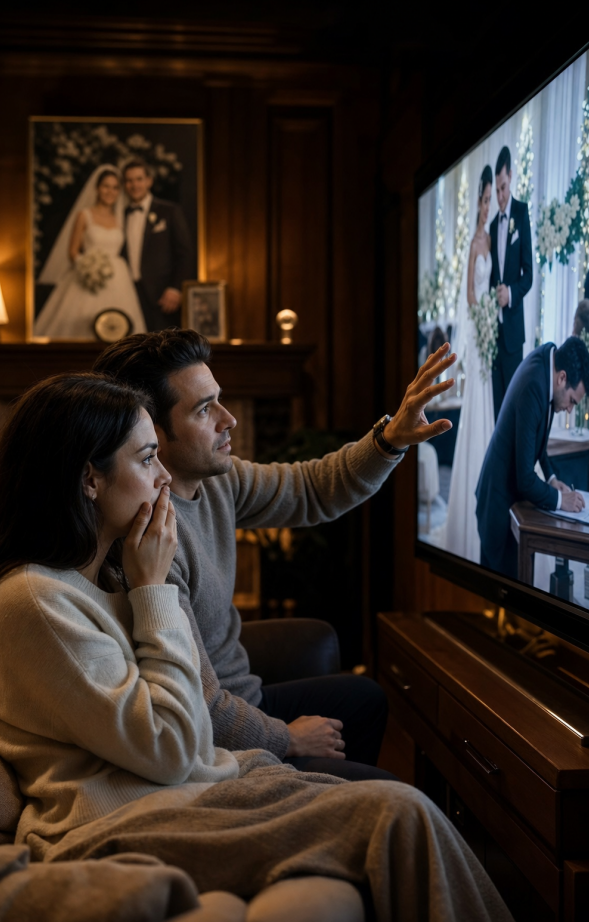
The wedding video had been playing on a loop in that sitting room for months. It was Tobias’s mother’s idea — a “tribute,” she called it, a way of keeping the day alive. I had come to hate it. It played our vows over and over, my nervous smile, his still face, the applause of a hundred guests I didn’t know, and I would sit in that dim, lamplit room at night and watch the version of me who had signed her life away without understanding what she was signing.
I need to explain how I got there. Fourteen months ago I married Tobias Vane, the only heir to a family that measures its worth in bloodlines and holdings. The marriage was arranged in the weeks after his stroke — that’s what they told me it was, a stroke — when he could no longer speak or, they said, decide anything for himself. I was told it was a mercy. That the family needed a “steady presence” at his side to manage his affairs, that he’d once admired me, that this was what he would have wanted.
I was twenty-seven, alone, and easily led. I signed the marriage documents his cousin Marcus slid across the table. I signed the papers that made Marcus the “co-administrator” of Tobias’s estate. I signed and signed, and I moved into that enormous house, and I became the silent wife of a silent man, watched at every turn by relatives who spoke about me as if I couldn’t hear.
But here is the thing they got wrong. They decided Tobias was gone, and so they stopped watching him. And I — because I was lonely, because he was the only one in that house who never sneered at me — started spending my evenings with him. I read to him. I told him about my day. I learned the small tells of his face, the flicker in his eyes when he understood something, the way his hand tightened when he was afraid.
He was not gone. He was trapped. And slowly, over months, I realized that the man everyone was speaking over was listening to every word.
That night, I sat beside him in the lamplight with the wedding video droning on, and I felt the loneliness rise up in me so hard I could barely breathe. I leaned close to him and I whispered the truest thing in me: “I wish I knew the real you. I wish I knew what you’d say if you could.”
And Tobias moved.
His hand, which for fourteen months had mostly lain still, rose from the armrest. His eyes — urgent, alive, more awake than I had ever seen them — fixed not on me but past me, at the screen. He was pointing. His whole arm trembled with the effort of it, and he was pointing at the wedding video.
I turned to look.
The video was at the part where the guests mingled at the reception, the camera drifting across the room. And there, at a side table in the background, half out of frame, was Marcus. I’d seen this footage a hundred times and never looked at the edges. But Tobias was pointing, and so I looked at the edges, and I saw Marcus bent over a stack of documents with a pen, and beside him a notary I didn’t recognize, and Marcus was signing — signing something, fast, at the exact time the ceremony footage was timestamped, when he should have been seated as a guest.
I got up. I crossed to the screen. I paused it. And I zoomed in the way you fumble with a remote when your hands are shaking.
It was the consent papers. The documents that had made our marriage “legal,” that had named Marcus co-administrator, that had required Tobias’s signature — a signature Tobias could not possibly have given, because he was at the altar, because he could not hold a pen, because he was the groom. Marcus was signing them himself, in the background of my own wedding, while everyone watched the front of the room.
Tobias had been telling me, in the only way left to him, where the proof was.
I did not sleep that night. I sat with him and I held his hand and I told him I understood, and I watched him weep without a sound, and I understood something else, too: that pointing at that screen was the bravest thing a trapped man could do, because if I’d been one of them, if I’d gone to Marcus with it, it might have been the last thing he ever managed.
The next morning I did not go to Marcus. I went to a lawyer — a real one, mine, found through a nurse I’d befriended who’d seen too many families like this one. I brought the video. I brought the paused frame. I brought the marriage documents and the administration papers with their forged signature.
It took months. Marcus fought. The family closed ranks and called me exactly what you’d expect — a gold-digger, a manipulator, a girl who’d married a sick man for his money and was now inventing stories. But a forged signature is a forged signature, and a timestamp is a timestamp, and a notary, once subpoenaed, will save herself before she saves a man like Marcus.
The consent was void. The marriage, built on fraud, was annulled — and I did not fight that, because I had never wanted to be married to a man who couldn’t choose me. Marcus’s control of the estate collapsed. The forgery went to the district attorney.
Tobias is in real rehabilitation now — the kind his family had quietly declined to pursue, because a recovering Tobias was inconvenient. He has regained some speech. It is slow and it is hard and the first full sentence he managed, months in, he saved for me.
He said, “You looked.”
That’s all. You looked. Everyone else in that house had decided what he was and stopped looking. I leaned close one lonely night and wished I knew the real him, and he turned my eyes to the one frame that told the truth.
We are not married anymore, and we are not in a hurry to be anything with a name. But I visit him every week, and I read to him, and now, sometimes, he reads to me.
Comments are closed.