The recording was still playing when the room finally understood what it was hearing. My own voice, eighteen years younger, saying words I had spent my whole adult life pretending I’d never said.
Let me tell you who I was back then, because the man in that voicemail and the man half-rising from the head of that table are supposed to be the same person, and the whole point of my life had been to make sure no one could ever prove it.
At twenty-six I was hungry and broke and furious about being broke. I was clawing my way into real estate development in a city that eats people like me for sport. And there was a woman — her name was Teresa — who loved me when I had nothing, who waited tables and covered my rent the month a deal fell through, who believed in me in a way I have never let anyone believe in me since.
When she told me she was pregnant, I did the math the only way I knew how back then. A baby was an anchor. A baby was the end of the version of myself I was killing to become. So I left her a voicemail. I told her it “wasn’t happening.” I told her to “handle it and never call this number again.” And then I changed the number, and I changed the city, and I built a wall around that year so high that I almost convinced myself the girl on the other end of that message had never existed.
She had the baby. Of course she did. She named her Emma, and she raised her alone, working doubles, telling her daughter only that her father was “a man who chose a different life.” She never came after me for money. She never posted about me, never called my office, never showed up at a groundbreaking with a lawyer. She just quietly built a life for her daughter out of the wreckage I’d left, and she kept one thing.
She kept that voicemail. Eighteen years, through three phones and one cassette transfer, she kept my voice saying the cruelest thing I ever said, and she told Emma: “When you’re grown, if you ever need to know who he really is, this will tell you. Not my word against his. His own.”
Teresa died last spring. Cancer, fast, the kind that doesn’t give you time to fix anything. And in the weeks before she went, she gave Emma the recording and one piece of advice — that she should meet me not to ask for anything, but to be seen, once, by the man who’d decided she wasn’t worth existing.
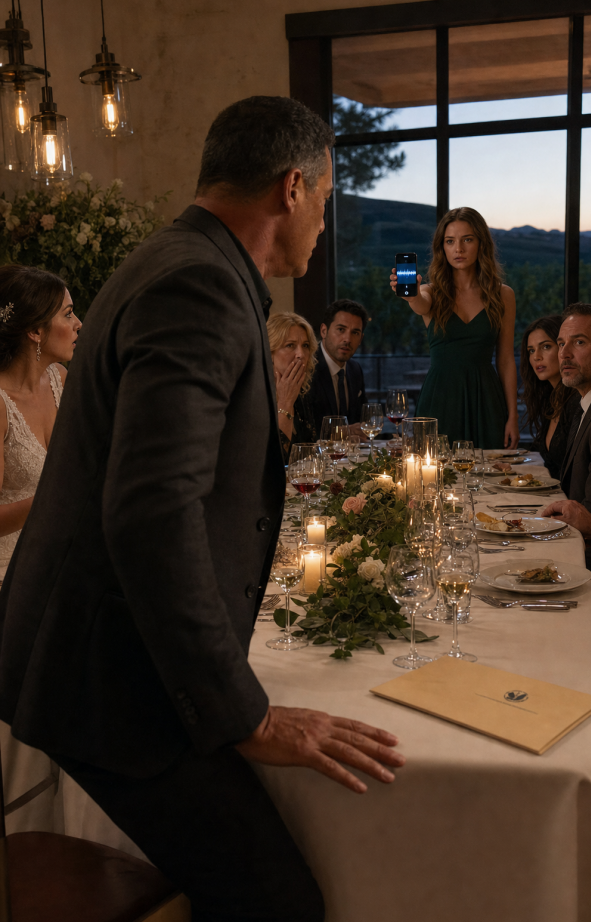
Emma found me the way you find anyone now. My engagement announcement was in a business magazine. The rehearsal dinner venue was tagged in a dozen photos. She put on the plainest dress she owned, walked into a country club full of my investors and my bride’s family, sat quietly at the far end of the table through the salad and the toasts, and waited for the room to be full and warm and certain of who I was.
Then she stood up and pressed play.
I want to tell you I handled it with grace. I didn’t. My first instinct — God forgive me, it’s the truth — was to get her removed. I actually caught the eye of the maître d’. And then my own voice hit the words “never call this number again,” and I saw my bride’s face, and I saw the faces of the men whose money I’d been courting for two years, and I understood that there was no version of this where I came out clean, because I wasn’t clean. I never had been. I’d just been well-dressed.
So I did the only thing left that wasn’t another lie. I stopped reaching for the maître d’. I stood up all the way. And in front of forty people holding their breath, I said, “That’s me. That’s my voice. I said that to your mother, and I have been a coward about it for eighteen years.”
The room did not gasp with relief. Nobody applauded. That’s not how it goes in real life. My bride, Vanessa, set down her napkin very slowly and would not look at me. Her father’s jaw was working. My investors were suddenly very interested in their wine.
But Emma looked at me for the first time — really looked — and something in her face unclenched. She hadn’t come to ruin me. She’d said it herself: she came to be seen. And by admitting it out loud, in front of everyone, instead of having her dragged out, I’d finally done the one thing her mother had wanted. I’d stopped pretending she was nobody.
The wedding did not happen. Vanessa and I talked until three in the morning and she said something I’ll carry forever: “I’m not leaving you because of what you did at twenty-six. I’m leaving because I watched you reach for the maître d’ before you reached for the truth. That’s who you still are.” She wasn’t wrong. That’s the part that keeps me up.
Emma and I are not a fairy tale. She doesn’t call me Dad. She may never. But we have coffee now, once a month, in a diner halfway between our cities. She showed me a photo of Teresa I’d never seen, and I told her every good thing I could remember about her mother, because Emma deserved to hear that her mom was loved once, even by a coward.
I paid for the years I owed — not because Emma asked, she never has, but because it was the one apology that meant anything. And I keep that voicemail now, transferred to my own phone. I listen to it sometimes. Not to punish myself. To remember exactly how easy it is to decide a person doesn’t count, and how long the bill takes to come due.
Eighteen years. It came due at a candlelit table in front of everyone I was trying to impress, in a voice I couldn’t deny, because it was mine.
Comments are closed.