I need to start with my son, because none of the rest of it makes sense without him.
His name was Mateo. He lived for nine days. He was born early, like the baby this story is really about, but his early was a bridge too far, and after nine days of me living in a plastic chair beside an incubator, he died in the gray hour before a morning I don’t remember. I went home to an apartment with a crib in it and a body that didn’t know he was gone. My milk came in anyway. It kept coming. There is no grief quite like your own body preparing, faithfully, to feed a child who isn’t there.
I went back to work because I couldn’t afford not to, and because staring at that crib was killing something in me. The agency I nanny through had a placement ready: the Frost family, a newborn not yet home from the hospital, generous terms, discretion required. I took it. I thought caring for a living baby might be a kind of medicine.
She was failing to thrive. That’s the clinical phrase, and it’s a gentle-sounding cover for something terrible: a baby who is quietly not making it, who won’t feed, won’t gain, slips a little each day. She rejected formula after formula. Her tiny system, born too soon, couldn’t tolerate what they offered, and every substitution bought a day, then lost two. The doctors were kind and thorough and running out of road.
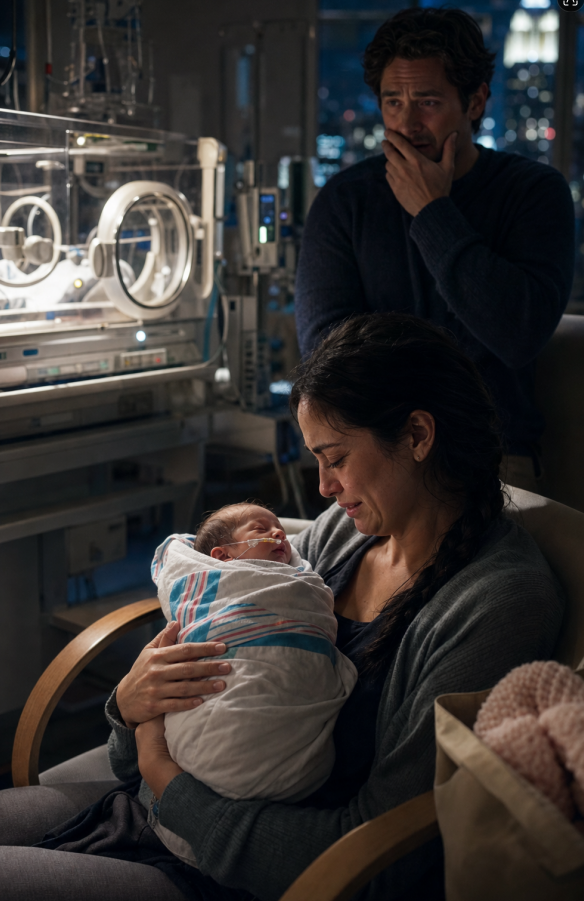
I sat in that NICU on my third visit and I watched a nurse try to feed her and the baby turn away, and my whole chest ached — the specific physical ache of a nursing mother near a hungry child. And I thought: I can help her. I might be the only person on earth in this exact building who can. Then I thought of all the reasons I couldn’t. I was staff. A stranger. Offering to nurse a dead woman’s child, a billionaire’s child, was so far outside the lines of my job I could imagine the lawyers assembling before I finished the sentence. What if he was disgusted. What if I was wrong and I’d exposed my rawest grief for nothing.
She lost weight again that night. I heard the nurse say, low, that they were running out of options, and I heard something in the doctor’s voice I recognized from Mateo’s ninth day.
So I found Julian in the family room, and I sat down across from that exhausted, guarded man, and I said the hardest sentence I’ve ever said out loud. I told him about my son. I told him my milk hadn’t stopped. And I told him that if he would allow it, I believed I could feed his daughter, and that mother’s milk is sometimes tolerated when nothing else is, and that I would understand completely if he said no.
He stared at me for a long time. And then this very controlled man put his face in his hands and wept, and said, “Please. Please. I don’t care about anything except her living. Please.”
She fed. She kept it down. Her numbers, over the next hours, stopped falling. By morning, for the first time in her short life, she had gained instead of lost.
I nursed her through the following days and she came back from the edge. She turned into a baby who fought and rooted and gained and, eventually, cried like a healthy furious infant, which is the most beautiful sound in the world when you’ve been afraid a child would be too weak to make it.
I did not do it to be repaid. I did it because I was a mother with milk and no baby, sitting three feet from a baby with no mother and no milk, and the math of that was the truest thing left in me. Feeding her gave my grief somewhere to go. She saved me as much as I saved her. Maybe more.
But Julian Frost did something anyway, and he did it that first night, before the sun was even up.
He called his attorney. And he changed his will. I didn’t know until later; he didn’t tell me to influence me. He named me — a nanny he’d known for weeks — as his daughter’s sole legal guardian in the event of his death, and established a trust for her care with me at its center. When I found out and tried to refuse, overwhelmed, he said something I’ve never forgotten. He said: “Every person I pay is doing a job. You crossed every line a paid person is supposed to stay behind, and you did it in the middle of the worst grief a person can carry, for a child who isn’t yours. I finally understand the difference between the people who work for my daughter and the person who would die for her. I’m not going to pretend I don’t know it now that I’ve seen it.”
He named the baby, too, that week. He’d been too afraid before. He named her, and he asked me to be there when he did.
That was three years ago. I’m still in their lives — not as the nanny anymore; the word was never big enough. She’s a wild, healthy, talking little girl now who calls me a name that isn’t “mother” and isn’t “nanny” either. Something in between, something we made up, something ours.
I keep one thing in my bag still. A small knitted blanket, blue, made for a baby named Mateo who lived nine days. I brought it to the NICU every night I nursed her. Maybe so the milk that was meant for him didn’t feel like a betrayal when it saved someone else.
They hired me to be the nanny. What I actually became was proof of a thing I don’t hear said enough: that the most valuable thing a person can offer is almost never the thing they were paid for. It’s the thing they give when no one could ever have required it of them.
My son couldn’t stay. But because he existed, another mother’s daughter lived. I have made my peace with a great deal by believing that isn’t an accident. It’s the only sacrifice I’ve ever been glad to have been able to make.
Comments are closed.