In school hallways where the morning bell once signaled discipline and purpose, a deeply troubling experiment is quietly taking over American classrooms. Across the country, public school administrators are turning to direct cash payouts, prepaid debit cards, and lavish gift raffles just to get students to walk through the front door.
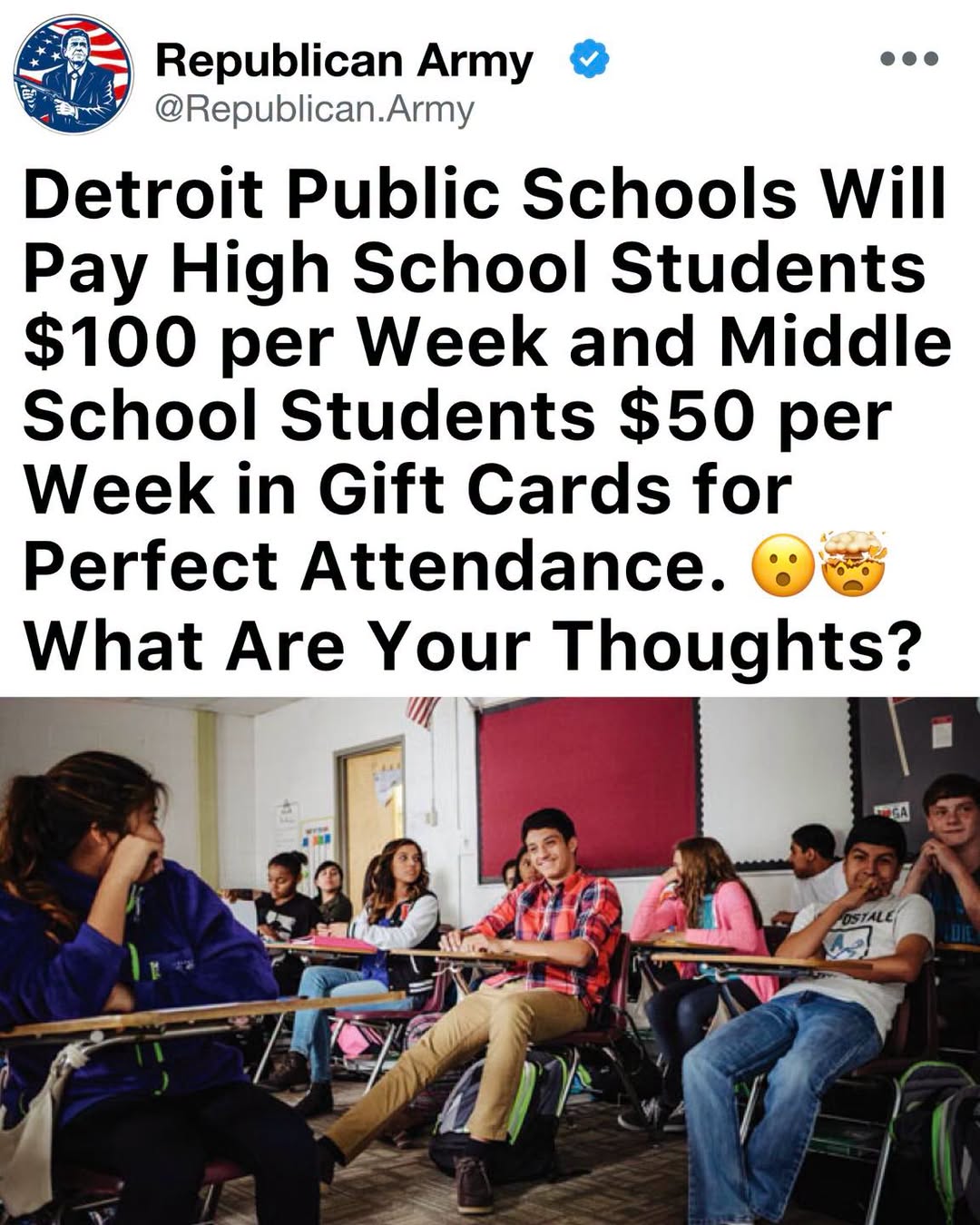
What was once universally understood as a child’s fundamental duty to their own future has been warped into an expensive transactional game. Showing up on time is no longer treated as a non-negotiable baseline, but as an extraordinary service that taxpayers must compensate on a weekly basis.
The city of Detroit has become the epicenter of this misguided philosophy, pouring millions of taxpayer dollars into programs specifically designed to incentivize attendance. District officials have rolled out gift cards, electronics giveaways, and cash prizes, desperate to move the needle on a chronic absenteeism crisis that continues to paralyze urban education.
Yet behind the flashy announcements and well-funded marketing campaigns lies a glaring failure of governance and common sense. Despite the millions flushed into these attendance lotteries, Detroit’s chronic absenteeism rates remain stubbornly, shockingly high, exposing the fatal flaw in the strategy.
Throwing money at students does not build character, instil grit, or foster a genuine love for learning. Instead, it sends an insidious message to the next generation: you should only fulfill your basic societal obligations if someone cuts you a check first.
The numbers coming out of Michigan paint a damning portrait of modern educational bureaucracy run amok. Years after massive federal and local funding influxes were directed into public school districts, tens of thousands of students across Detroit are still missing catastrophic amounts of classroom instruction.
District data reveals that while attendance incentives may cause brief, artificial spikes on designated reward days, they completely fail to produce sustainable, long-term habit changes. Students quickly learn how to game the system, showing up just enough to claim their payouts before vanishing back into truancy.
Hardworking local taxpayers, many of whom work grueling shifts to provide for their own families without government hand-outs, are rightfully outraged. They are watching their hard-earned dollars get funneled into what amounts to a state-sponsored bribery scheme that produces virtually zero academic return.
When public systems begin paying children for the bare minimum, they fundamentally erode the moral authority of the educational institution. School is supposed to prepare young people for the demands of the real world, where employers do not hand out bonus checks simply because a worker arrived on time.
By replacing personal accountability with financial incentives, school systems are actively conditioning children to embrace a culture of entitlement. It strips away intrinsic motivation and replaces it with a shallow, mercenary mindset that will inevitably backfire the moment these students transition into adulthood.
The Real Costs of Erasing Personal Responsibility
For generations, the bedrock of American education was built on high expectations, strong family involvement, and a culture of mutual respect. Parents took pride in ensuring their children were dressed, fed, and seated at their desks ready to learn each morning.
When a child failed to attend, the responsibility rested squarely on the home, with schools and communities reinforcing that essential duty through discipline and accountability. Today, progressive education bureaucrats have effectively severed that connection, treating parents as helpless bystanders while attempting to parent by government checkbook.
“Temporary bribes may pad short-term numbers, but they do nothing to build the lasting habits of discipline, hard work, and civic duty that define a thriving society.”
This approach directly undermines the vital role of family values in raising responsible, self-sufficient young men and women. When the state steps in to offer material bribes for basic behavior, it implicitly signals to parents that their authority is secondary to a municipal cash payout.
 Forced to the Brink: The Tragic Loss of China Record and the Chilling Reality Behind Her Family’s Fatal Punishment
 Pennsylvania cop charged with manslaughter in fatal shooting of unarmed student: ‘Mr. Pysher was not a threat’
 Twist in case of 73-year-old Verna Stafford convicted in Oklahoma Sirloin Stockade massacre after parole board vote
Furthermore, it penalizes and insults the millions of dedicated students and families who already show up every single day out of self-respect and commitment. While responsible students follow the rules without fanfare, their truant peers are publicly rewarded simply for doing what was expected of them all along.
Veteran teachers across the country are quietly sounding the alarm over the chaotic classroom dynamics these policies create. Educators are increasingly pressured to act as administrative carnival barkers, managing prize distributions and attendance trackers rather than delivering rigorous academic instruction.
When students are taught that attendance is optional unless sweetened by a financial prize, classroom management inevitably collapses. The culture of the classroom deteriorates from one of academic ambition into an exhausting negotiation between teachers and disengaged pupils.
The broader economic implications are equally devastating for struggling urban communities that desperately need real educational revitalization. Detroit cannot afford to raise another generation unprepared for high-skilled jobs, yet its current policies lower the bar precisely when it needs to be raised.
Relying on cash incentives treats the symptoms of disengagement while ignoring the rot beneath the surface. It is a lazy administrative shortcut designed to produce artificial data points for bureaucrats rather than true, transformative reform for children.
If millions of dollars in payouts cannot convince a child to value their own education, then money is clearly not the core problem. The root cause lies in a total breakdown of standards, fractured homes, and an educational establishment that refuses to hold anyone accountable.
A Return to Core Principles and Parent Empowerment
True educational reform will never be bought with supermarket gift cards or municipal debit cards. Real, lasting progress requires a courageous return to foundational principles: enforcing strict standards, holding families accountable, and restoring pride in achievement.
The path forward demands sweeping structural change that puts power back where it belongs—in the hands of American parents. When families are given total educational freedom through universal school choice, failing districts are forced to compete, innovate, and demand excellence.
Expanding school choice allows parents to rescue their children from failing, incentive-obsessed public school bureaucracies and place them in environments that uphold discipline and high expectations. Charter schools, classical academies, and private institutions consistently demonstrate that high standards—not cash handouts—foster true student engagement.
We must also empower educators to enforce real consequences for chronic truancy rather than coddling it with taxpayer-funded gifts. Accountability is not cruelty; it is the highest form of compassion, because it refuses to abandon young people to a life of underachievement.
Communities must rally around traditional family values, encouraging mothers and fathers to take active, non-negotiable ownership of their children’s daily attendance and academic progress. Government programs can never substitute for the loving, firm guidance of an engaged parent who demands excellence from their household.
Every dollar currently wasted on attendance bribes should be immediately redirected into rigorous curriculum development, classroom safety, and performance-based rewards for exceptional teachers. Public funds must invest in building excellence, not in subsidizing chronic mediocrity.
The crisis in our schools is ultimately a test of our national resolve and our commitment to the American character. We must decide whether we will continue sliding toward a low-expectation welfare model in our classrooms or fight to restore the standards that made our nation great.
Our children deserve better than to be patronized with pocket change for simply walking through the schoolhouse door. They deserve an education system that believes in their potential, demands their very best, and prepares them to stand on their own two feet.
It is time for lawmakers, parents, and community leaders to stand up and say that enough is enough. We must stop bankrolling failure, end the bribery culture in public education, and rebuild a system anchored in duty, family, and unapologetic excellence.
No Comments yet!