When the clock struck 8:00 PM on election night in Florida, millions of Americans tuned in to witness something that has become almost foreign in modern politics. Within a matter of hours, nearly eleven million ballots were securely tabulated, verified, and delivered to the public with razor-sharp precision. It was clean, decisive, and entirely transparent.
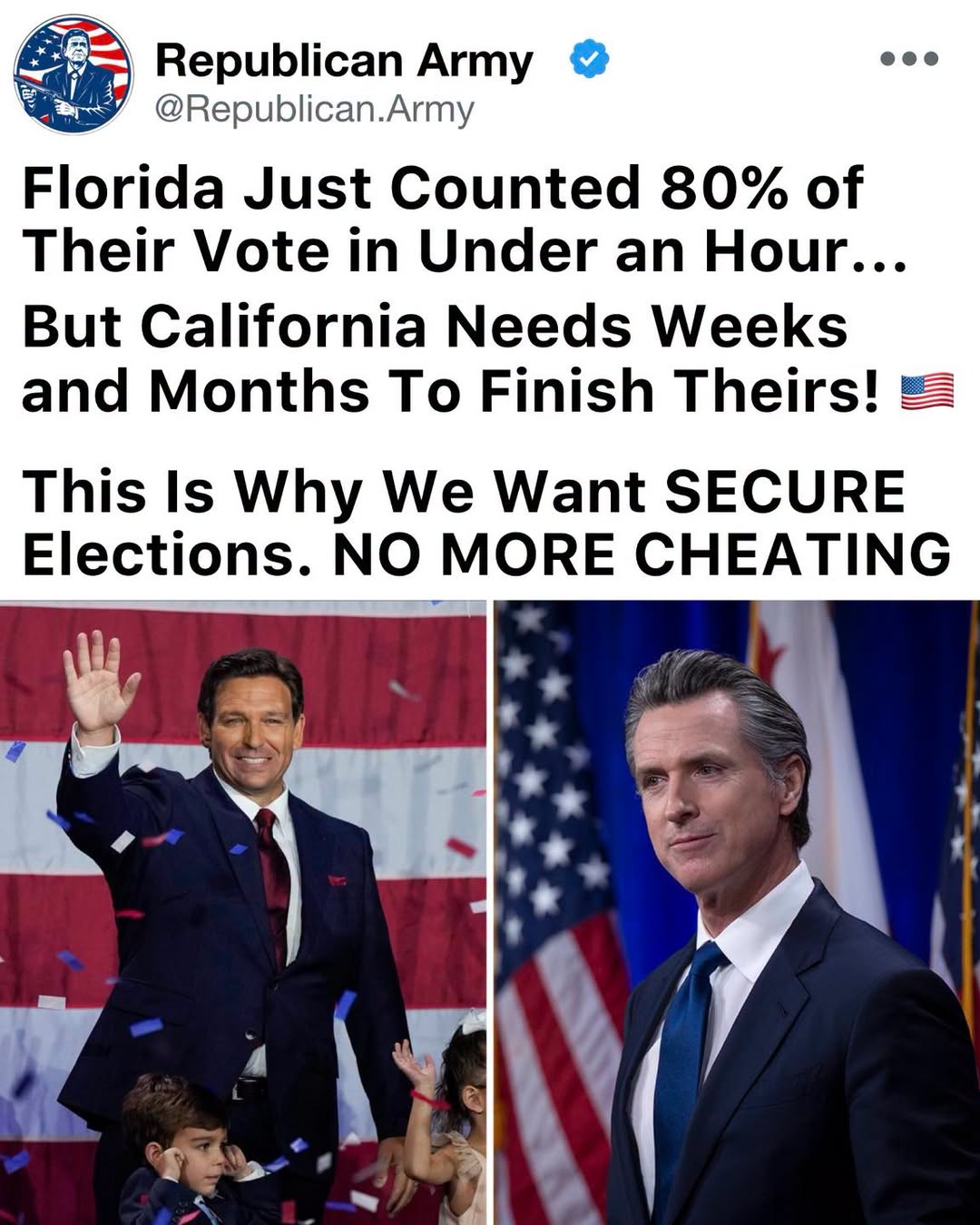
There were no mysterious midnight ballot dumps, no agonizing multi-week delays, and no shifting goalposts behind closed doors. Florida proved beyond any shadow of a doubt that when a state prioritizes security and administrative competence, election integrity is not just a slogan—it is a functional reality.
Yet on the exact same evening, across the country in California, the contrast could not have been more jarring or alarming. As Florida delivered final results before most citizens went to bed, Golden State officials announced that counting would drag on for days, if not weeks. In the self-proclaimed tech capital of the world, democracy ground to a bureaucratic crawl.
This stark divergence is not an accident of geography, nor is it simply a byproduct of population size. It is the direct consequence of two fundamentally opposing philosophies regarding the sacred nature of the ballot box. One system is engineered for accountability and swift certainty, while the other breeds suspicion through endless procedural fog.
For decades, the American tradition rested on a simple, comforting standard: citizens cast their votes, the polls closed, and the nation learned the outcome on election night. That decisive closure allowed communities to accept the results, unite behind the winners, and move forward. When that closure is stripped away, the bedrock of public trust immediately begins to crack.
To understand how Florida became the undisputed national benchmark, one must remember where the state started. Following the infamous recount chaos of the 2000 presidential race, state lawmakers made a deliberate, bipartisan choice to overhaul their entire electoral machinery. They refused to let their state remain a punchline of administrative failure.
Over the subsequent two decades, Florida implemented rigorous standards that balanced broad access with uncompromising security. Lawmakers mandated clear voter identification laws, modernized voting machines, banned controversial ballot harvesting practices, and established strict deadlines for processing mail-in ballots prior to Election Day.
Because county election supervisors are permitted to pre-canvass and verify mail-in ballots weeks in advance, those tallies are ready to be published the exact second the polls close. Signature verification is conducted under the watchful eyes of bipartisan observers, maintaining an unbroken chain of custody. By the time physical precincts report their totals, the vast majority of the work is already complete.
This is why Florida officials can process more than ten million votes in a few hours with complete transparency. It demonstrates administrative excellence backed by political will, proving that swift reporting does not compromise accuracy—it enhances it. When the public sees results materialize in real time, confidence surges.
Critics frequently attempt to dismiss Florida’s success as an outlier, but their arguments collapse when held against the operational realities of other mega-states. Florida boasts a massive, diverse population spread across multiple major media markets and two time zones. If the Sunshine State can execute a flawless election night, every single state in the union possesses the capability to do so.
The California Breakdown: Why Endless Counting Breeds Distrust
Now look west toward California, where election officials routinely treat vote counting not as an urgent civic duty, but as an open-ended administrative marathon. Weeks after voters make their choices, county workers are still sifting through postmarks, provisional slips, and curing signatures behind locked doors. It is an excruciating process that turns every competitive congressional race into an agonizing waiting game.
California possesses resources that dwarf most sovereign nations, boasting immense tax revenue and the most advanced technological infrastructure on Earth. Silicon Valley can process trillions of secure financial transactions every single second. Yet the state government claims it needs thirty days simply to tally pieces of paper.
The prolonged timeline in California is the direct result of deliberate policy choices designed to weaken safeguards and dilute standards. Mass-mailing millions of unsolicited ballots to outdated voter rolls creates an administrative nightmare from day one. When combined with loose postmark deadlines and legal ballot harvesting, the entire process invites logistical gridlock.
When ballots are allowed to arrive days after the election has concluded, the integrity of the deadline itself is completely destroyed. A deadline that shifts is not a deadline at all—it is merely a suggestion. This structural sluggishness naturally invites skepticism from voters across the political spectrum.
 Jefferson City father allegedly shook 4-month-old daughter to toughen her, leaving broken bones: cops
 Disturbing admission by Utah man Daniel Ruesga accused of fatally shooting mother of four in garage
 Chilling past of Zachary Babitz revealed after carjacker gets life for killing 83-year-old outside Best Buy
“Prolonged counting only fuels doubts and erodes public confidence in the final outcome. America deserves results we can trust on election night, not weeks later.”
Human nature is predictable: when citizens are forced to wait three weeks to find out who won their local congressional district, they naturally ask questions. Why does the lead constantly fluctuate long after the polls have closed? Why are uncounted ballots consistently discovered days after the official deadline?
These lingering questions are not born out of conspiracy; they are born out of basic human logic and an expectation of administrative competence. When authorities refuse to provide rapid, transparent answers, they create a vacuum that is instantly filled by doubt. Prolonged counting is the single greatest catalyst for public cynicism in modern American governance.
This is precisely why states like Texas are aggressively taking notes and fortifying their own legal frameworks. In Texas, conservative lawmakers have recognized that protecting the integrity of the vote is essential to preserving the state’s economic strength and constitutional foundation. Keeping Texas red requires an ironclad commitment to transparent, secure elections.
Recent legislative reforms in Texas have focused on cleaning up voter rolls, mandating standardized paper trails, and ensuring poll watchers have meaningful access to every step of the tabulation. Texas leaders understand that a secure election is not about suppressing valid votes, but about ensuring that every legal vote is accurately counted and shielded from fraud.
The lessons from Florida and California present two entirely different visions for the future of American self-governance. One model views elections as a structured, secure, and definitive event that concludes with decisive transparency on election night. The other views elections as an amorphous, rolling process where the rules are continually bent and outcomes remain uncertain for weeks.
Across kitchen tables and community halls nationwide, everyday citizens are demanding an end to the excuses. Working-class Americans manage strict deadlines in their jobs and personal lives every day, and they expect their government to operate under the exact same standard of accountability. There is no legitimate excuse for administrative incompetence at the ballot box.
Restoring the Standard of Election Night Decisiveness
Restoring faith in American democracy does not require complicated, unconstitutional federal takeovers or experimental software overhauls. The blueprint already exists, and it has been tested and proven under the highest possible stakes in Florida. All it takes is the courage of state leaders to enforce common-sense rules.
First, mail-in ballots must have strict receipt deadlines, requiring them to be in the hands of election officials by the time polls close on Election Day. Pre-canvassing must be standardized across every jurisdiction so that mail tallies are ready the instant voting concludes. Allowing ballots to trickle in days after the fact must be permanently retired as an acceptable practice.
Second, robust voter identification must be non-negotiable across all forms of voting, whether cast in person or via absentee ballot. Photo identification is required to board an airplane, cash a paycheck, or enter a government building, and voting is vastly more consequential. Verifying the identity of the voter is the fundamental cornerstone of any credible election system.
Third, third-party ballot harvesting must be strictly outlawed nationwide to prevent political operatives from interfering with vulnerable citizens. Ballots should be delivered directly by the voter or an immediate family member, preserving an unbroken and verifiable chain of custody. When paid activists handle votes, the risk of coercion and fraud multiplies exponentially.
Finally, bipartisan observers must have unobstructed access to every stage of the counting process without intimidation or physical barriers. Transparency is the ultimate disinfectant, and nothing builds public trust faster than open, observable procedures. When the tallying process is fully visible, doubts evaporate and credibility is cemented.
The strength of our constitutional republic depends entirely on the consent of the governed, and that consent requires absolute faith in election outcomes. We cannot allow our elections to degenerate into weeks of bureaucratic uncertainty and lingering legal battles. The American people deserve clarity, speed, and uncompromising integrity.
Florida demonstrated that efficiency and ironclad security are not mutually exclusive—they reinforce one another. California’s broken, sluggish system should serve as a stark warning to every legislature in the country of what happens when standards are abandoned. The path forward is crystal clear.
It is time for every state in the union to step up, adopt the Florida standard, and restore the tradition of election night decisive victories. America deserves an election system that inspires unwavering confidence, delivers unquestionable results, and protects the sovereign voice of the people when the polls close.
No Comments yet!