A high-stakes political storm has erupted in Michigan as intense scrutiny falls upon the background and associations of prominent political figure Abdul El-Sayed. The brewing controversy centers on grave national security concerns raised by conservative watchdogs and concerned citizens across the state.
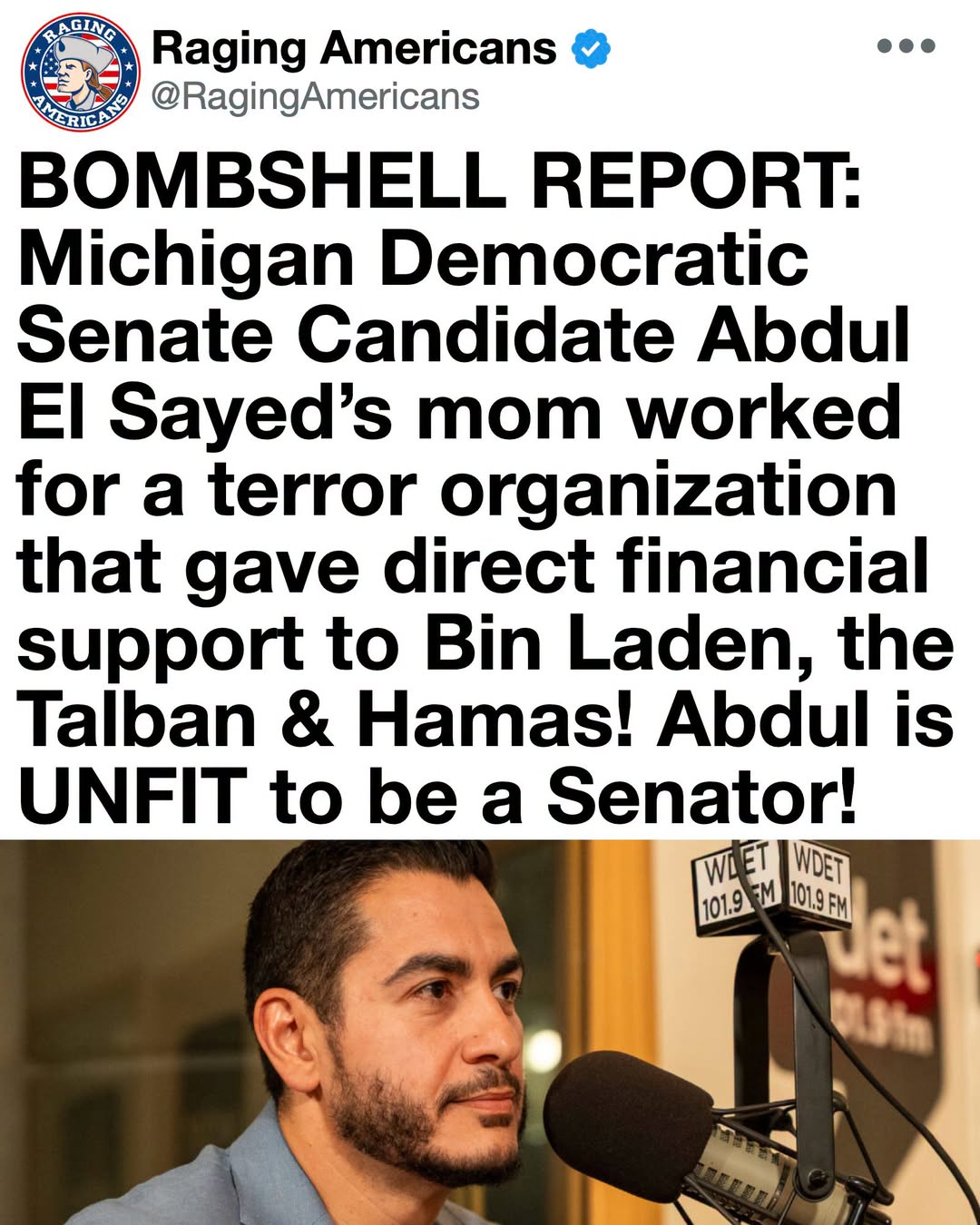
According to newly resurfaced reports and opposition dossiers, deep questions are being asked regarding past familial affiliations with international charity networks that federal authorities previously flagged for terror financing. The allegations have ignited a firestorm over vetting standards for high federal office.
For millions of voters across Michigan and the broader American heartland, national security and unwavering loyalty to the United States remain the absolute gold standard for public service. When questions of this magnitude emerge, they immediately reshape the political landscape.
The core of the dispute involves records detailing past employment ties linked to organizations accused of funneling material support to hostile entities, including historical ties to networks supporting the Taliban and Hamas. Critics argue that such proximity represents an unacceptable risk for anyone seeking a seat in the United States Senate.
Grassroots organizers and national security advocates are now mobilizing, insisting that voters deserve complete transparency regarding the backgrounds and personal networks of those who wish to craft American foreign policy.
In a world defined by escalating global instability and hostile foreign adversaries, the vetting process for the upper chamber of Congress has never been more vital. The Senate holds exclusive power over treaty ratification, military confirmations, and sensitive intelligence oversight.
Because senators routinely handle top-secret intelligence briefings, any potential conflict of interest or ideological entanglement is seen by critics as an immediate disqualifier. The debate is no longer merely about policy differences, but about fundamental trust.
Conservative leaders throughout Michigan have been quick to draw a line in the sand, demanding answers and calling on voters to reject candidates whose personal histories carry unresolved questions. They argue that protecting American sovereignty requires uncompromising vigilance at every level of government.
The reaction among local grassroots activists has been both swift and resolute. Town halls and digital forums across the state have seen a surge in engagement from citizens who view these revelations as a major turning point in the race.
Many voters emphasize that character, associations, and accountability matter profoundly when determining who is entrusted with safeguarding constitutional freedoms. For these constituents, family backgrounds and organizational allegiances cannot simply be brushed aside as political noise.
National Security and the Stakes in Michigan
Michigan has long stood as a crucial battleground state where local elections carry massive national implications. With the balance of power in Washington hanging by a razor-thin margin, every single Senate seat represents a decisive lever over the country’s trajectory.
National commentators have pointed out that the scrutiny facing El-Sayed reflects a broader demand from the electorate for rigorous vetting of progressive figures. When candidates position themselves to represent an entire state, their complete record naturally becomes public domain.
Security analysts note that federal agencies have spent decades tracking complex illicit financing networks that operated under the guise of humanitarian relief. The legacy of those investigations continues to cast a long shadow over political discourse today.
 The Great American Turnaround: How Decisive Leadership and Unyielding Law Enforcement Sparked the Largest Crime Drop in History
 South Carolina cop Frederick Payne paid $203 for sex then filed fake $276 fraud claim: cops
 DA Gulluni addresses families as taxi record solves 1978 double murder: ‘I admire and respect you for your patience’
Opponents insist that when foreign policy platforms intersect with contentious institutional histories, the American public has an inherent right to ask tough, uncompromising questions. Silence or deflection, critics argue, only compounds public skepticism.
Meanwhile, campaign trail discussions in key counties like Macomb, Oakland, and Kent are increasingly focusing on the fundamental principles of national defense and border security. The issue has become a rallying cry for patriotic coalitions demanding absolute fidelity to the republic.
Community leaders who prioritize defense preparedness argue that the United States cannot afford ambiguity in its leadership, especially given rising tensions in the Middle East and beyond. They maintain that candidates must demonstrate an unblemished commitment to American security interests.
The controversy has also reignited wider conversations regarding the ideological direction of modern political campaigns. Voters are scrutinizing not just campaign promises, but the foundational worldview of those who seek the highest corridors of power.
Supporters of strong national defense policies argue that candidates with controversial ties should be held to the highest standard of accountability. In their view, public office is a privilege that demands total clarity and unimpeachable alignment with national priorities.
As the debate intensifies, civic groups are urging voters to conduct their own research and closely examine the public records of all candidates vying for federal representation. Transparency remains the cornerstone of a functional constitutional republic.
Social media channels and political forums have seen an outpouring of commentary from residents demanding that the national security track record of prospective leaders be placed front and center during upcoming debates.
The Path Forward for Michigan Voters
The clash highlights a profound cultural and political divide over what constitutes acceptable criteria for public leadership. While some political defenders attempt to dismiss these associations, conservative activists maintain that national security admits no room for compromise.
Veteran political strategists acknowledge that issues of loyalty, heritage, and institutional association frequently serve as powerful motivators at the ballot box. When security concerns resonate with everyday citizens, they often become defining electoral themes.
For working-class families across Michigan who send their sons and daughters to serve in the armed forces, safeguarding the homeland is an intensely personal priority. They expect their elected representatives to share that unwavering devotion without reservation.
The call to action echoing across conservative networks is straightforward: scrutinize every record, challenge every narrative, and demand total fidelity to American values. Activists are urging a complete rejection of candidacies marked by radical or controversial ties.
With campaign season accelerating, the spotlight on Abdul El-Sayed and his historical network is only expected to intensify. Opponents have pledged to keep the issue at the forefront of public awareness until full accountability is achieved.
As Michiganders prepare to make their voices heard, the debate over who is truly qualified to protect the state and the nation stands as a central pillar of the political season. The choice facing voters will resonate far beyond state borders.
In the final analysis, the mandate from grassroots patriots remains crystal clear: national security and unyielding loyalty to the United States must always come first. The defense of American integrity requires leaders whose dedication to the republic is beyond all shadow of doubt.
No Comments yet!