A fierce debate over national identity, immigration policy, and the preservation of constitutional liberties has erupted into the center of American public discourse. Commentator and activist Erika Kirk has delivered an uncompromising assessment of cultural integration, arguing that Islamification stands fundamentally incompatible with the founding framework of the United States. Her statements have instantly energized conservative grassroots movements while forcing a long-overdue national conversation out of the shadows.
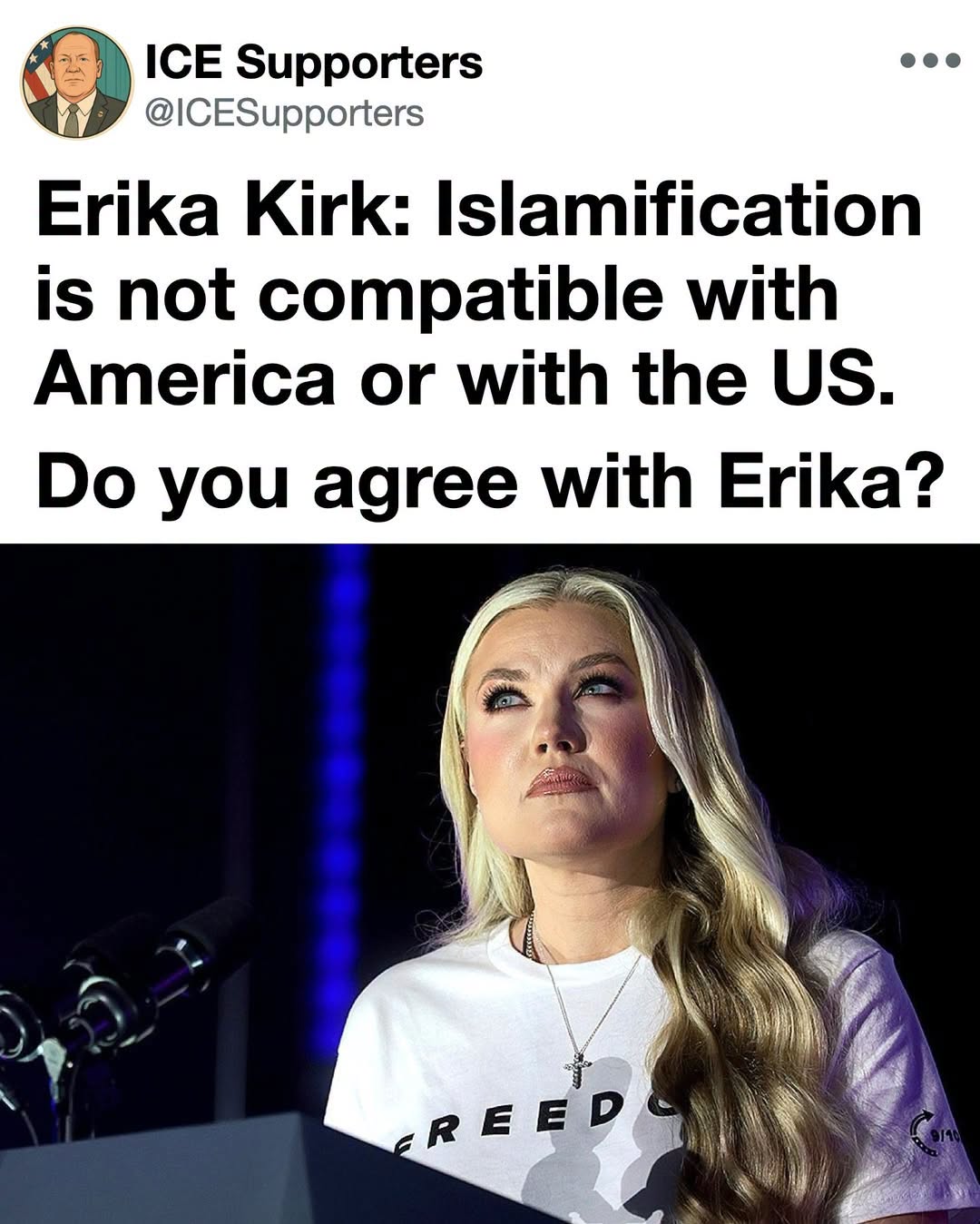
Kirk’s core argument centers on the undeniable friction between a governance system rooted in religious legal frameworks and the foundational architecture of the American Republic. A constitutional system built on the separation of religious authority and civil government cannot effortlessly absorb ideologies that reject that very division. For decades, political leaders have sidestepped this reality, but growing cultural fault lines are making silent avoidance impossible to maintain.
At the heart of the controversy is the principle of constitutional supremacy, which demands equal individual rights under a secular rule of law and uncompromised free inquiry. When incoming cultural norms elevate religious doctrine above statutory and constitutional protections, the baseline of American civic life begins to fracture. Kirk argues that recognizing this fundamental tension is not hostility, but rather a vital prerequisite for any honest debate on immigration.
Across social media platforms, broadcast networks, and community forums, the reaction to her remarks has been instantaneous and intensely polarized. Supporters argue that Kirk is merely articulating what millions of everyday citizens have observed while watching cultural shifts across the Western world. Meanwhile, establishment commentators have rushed to label the commentary controversial, exposing the deep ideological divide between Beltway elites and working-class communities.
The conversation is no longer confined to academic symposiums or theoretical policy briefs; it has become an urgent grassroots issue touching towns and cities across the country. Citizens are increasingly asking whether a nation can sustain its unique heritage of individual liberty if it refuses to defend the cultural boundaries that produced it. As the debate accelerates, the demand for unambiguous leadership on assimilation is reaching a historic fever pitch.
To understand the depth of Kirk’s intervention, one must examine the specific mechanics of Western constitutional governance and how they contrast with theocratic systems. The American experiment is anchored in the revolutionary ideal that rights are granted by the Creator and secured by a secular, limited government. Under this design, no religious authority holds the power to override civil statutes, enforce blasphemy codes, or restrict individual conscience.
When communities establish parallel legal frameworks or prioritize foreign religious mandates over the U.S. Constitution, the foundational compact that binds our society erodes. History consistently demonstrates that a nation cannot survive as a patchwork of competing legal traditions operating under entirely separate moral codes. A society must possess a unified standard of justice where every citizen is subject to the exact same laws.
Kirk emphasized that the preservation of free inquiry and robust public speech represents one of the most critical battlegrounds in this ongoing cultural struggle. In a traditional free society, no belief system, political ideology, or religious doctrine is immune from public debate, rigorous scrutiny, or candid criticism. Systems that demand legal or social shielding from critique directly undermine the First Amendment principles that make American freedom possible.
The consequences of failing to enforce strict assimilation standards are not hypothetical theories; they are currently playing out in real time across several European nations. Over the past three decades, large-scale demographic shifts in Western Europe occurred without a corresponding institutional insistence on cultural integration. Today, countries like the United Kingdom, France, and Sweden are grappling with entrenched parallel societies, localized sectarian tensions, and strained civil institutions.
In many European urban centers, local authorities have struggled with enclaves where secular legal norms are openly contested by self-appointed religious arbitration panels. These developments have produced widespread social friction, decreased institutional trust, and created deep political volatility across the continent. American observers watching these international developments are increasingly determined to ensure that the United States does not duplicate the exact same policy errors.
“The United States has the absolute right and the sovereign duty to insist that those who settle here adopt its constitutional order rather than seek to transform it.”
The lesson from abroad is unambiguous: mass settlement without deep, uncompromising assimilation produces fractured societies rather than unified commonwealths. When a nation abandons the expectation of cultural cohesion, it inevitably invites the balkanization of its public sphere. The American melting pot was never designed to be an uncritical repository for legal systems that fundamentally reject Western civil liberties.
For more than two centuries, the United States successfully integrated millions of immigrants from every corner of the globe through a clear, shared civic covenant. Immigrants arrived with the explicit understanding that they were leaving old systems behind to embrace American liberty, the English common law tradition, and constitutional governance. This historic formula succeeded precisely because assimilation was treated as an essential national duty rather than an optional suggestion.
 Wisconsin woman Sara Pientka gets 120 days after failing to call 911 during sister’s murder: authorities
 Lufkin couple Savannah Francis and Twitch Herrera rebuild life after harrowing addiction: ‘Sometimes there’s purpose in the pain’
 Two Boyd High School 17-year-olds arrested over an alleged field house hazing now face adult felony charges
In recent years, however, the rise of radical multiculturalism within academia and governance has actively discouraged assimilation into traditional American norms. Progressive doctrine has pushed the narrative that demanding allegiance to Western values is somehow oppressive or obsolete. This institutional retreat has created an ideological vacuum, allowing competing and often hostile governance models to take root within domestic communities.
Kirk’s public commentary directly challenges this reigning multicultural orthodoxy by reasserting the sovereign right of the American people to establish boundaries. She argues that national defense extends beyond physical borders to include the preservation of the legal and moral principles that define the country. Without a shared philosophical baseline, the constitutional protections that safeguard individual freedom cannot endure for future generations.
The debate touches directly on the Fourteenth Amendment and the principle of equal protection under the law, particularly regarding individual rights and protections. Western legal traditions have spent centuries dismantling institutional inequalities, ensuring that women, religious minorities, and political dissidents enjoy total legal parity. Importing or tolerating foreign legal concepts that compromise these hard-won protections represents an unacceptable regression for modern civil society.
The Cost of Silence and the Imperative of Leadership
Across the country, grassroots organizations, civic leaders, and constitutional scholars are rallying around the call for strict, transparent immigration standards. Many point out that sovereignty is entirely meaningless if a nation lacks the legal authority or cultural willpower to protect its foundational principles. Polling continues to indicate that a decisive majority of voters favor policies that prioritize cultural compatibility and constitutional loyalty over raw demographic volume.
The pushback from corporate media outlets and progressive organizations was swift, framing Kirk’s defense of American constitutionalism as divisive rhetoric. These critics argue that any criticism of foreign religious systems conflicts with broad interpretations of global pluralism and international inclusion. However, this pushback has largely failed to suppress the momentum of the discussion among everyday citizens who live with the practical consequences.
Public policy analysts note that the current discourse marks a pivotal turning point in how conservative leaders approach the immigration debate. For years, establishment politicians restricted their focus purely to economic metrics, labor numbers, and border enforcement logistics. Today, the conversation has expanded to encompass the deeper, existential questions of cultural preservation, constitutional fidelity, and national survival.
Local community organizers in several states have begun demanding that state and federal lawmakers enact explicit statutory safeguards against parallel legal codes. Several state legislatures have previously passed legislation reaffirming that no foreign law or religious tribunal may supersede state or federal constitutional protections. Kirk’s remarks have reignited interest in these legislative measures, with grassroots activists calling for expanded protections across all fifty states.
The core question facing the nation is whether it possesses the moral confidence to unapologetically defend its unique civilizational heritage. A country that apologizes for its own founding ideals cannot expect newcomers to respect, adopt, or defend them. Clear, fearless leadership that speaks plainly about the limits of multiculturalism performs a vital and indispensable service to the public interest.
Prominent cultural commentators have reinforced Kirk’s stance, pointing out that true diversity cannot exist at the expense of national survival. If the fundamental values that allow diverse individuals to live peacefully under a single standard of liberty are dismantled, pluralism itself collapses. Protecting the foundational architecture of the American Republic is the only way to ensure that freedom survives for anyone.
In town halls, digital forums, and independent media broadcasts, citizens are expressing profound gratitude for voices willing to confront these difficult truths. The era of polite silence and political correctness on sensitive cultural questions is rapidly coming to an end. Americans from all walks of life are recognizing that the stakes are simply too high to allow ideological timidity to dictate the nation’s future.
The geopolitical reality of the twenty-first century demands an unwavering commitment to the principles that made the United States the freest nation in human history. From the rule of law to freedom of speech, these historic achievements are remarkably fragile and require active, generational defense. Allowing them to be compromised in the name of unvetted diversity represents a dangerous dereliction of constitutional duty.
Kirk’s intervention has firmly placed the issue of cultural assimilation back at the top of the national political agenda. Candidates running for federal, state, and local offices are now being forced to take a public stand on whether they support constitutional supremacy or parallel legal tolerance. The answers to these questions will inevitably shape the trajectory of American jurisprudence and immigration policy for decades to come.
As the debate continues to unfold across the American landscape, one undeniable reality remains crystal clear to the millions watching closely. The strength of the United States has never derived from an uncritical acceptance of every foreign political or religious system that arrives at its shores. America’s strength has always come from its unyielding dedication to individual liberty, constitutional order, and the enduring principles that make this nation distinct.
Preserving the soul and character of the American Republic requires clear standards that place cultural compatibility and constitutional fidelity above all else. Those who stand up to defend these foundational truths are not dividing the country; they are working to ensure its survival. The time has come to boldly champion the American way of life and ensure that government of the people, by the people, and for the people remains unbroken.
No Comments yet!