The unmistakable sound of defiance that echoed through New York was more than just a fleeting moment of frustration; it was an undeniable declaration from the frontline. When police officers collectively drowned out the name of the state’s top executive, they shattered the illusion that rank-and-file law enforcement would quietly tolerate the continuous erosion of their profession. It served as a stark reminder that respect cannot be demanded by leaders who consistently work to undermine the very mission of public safety.
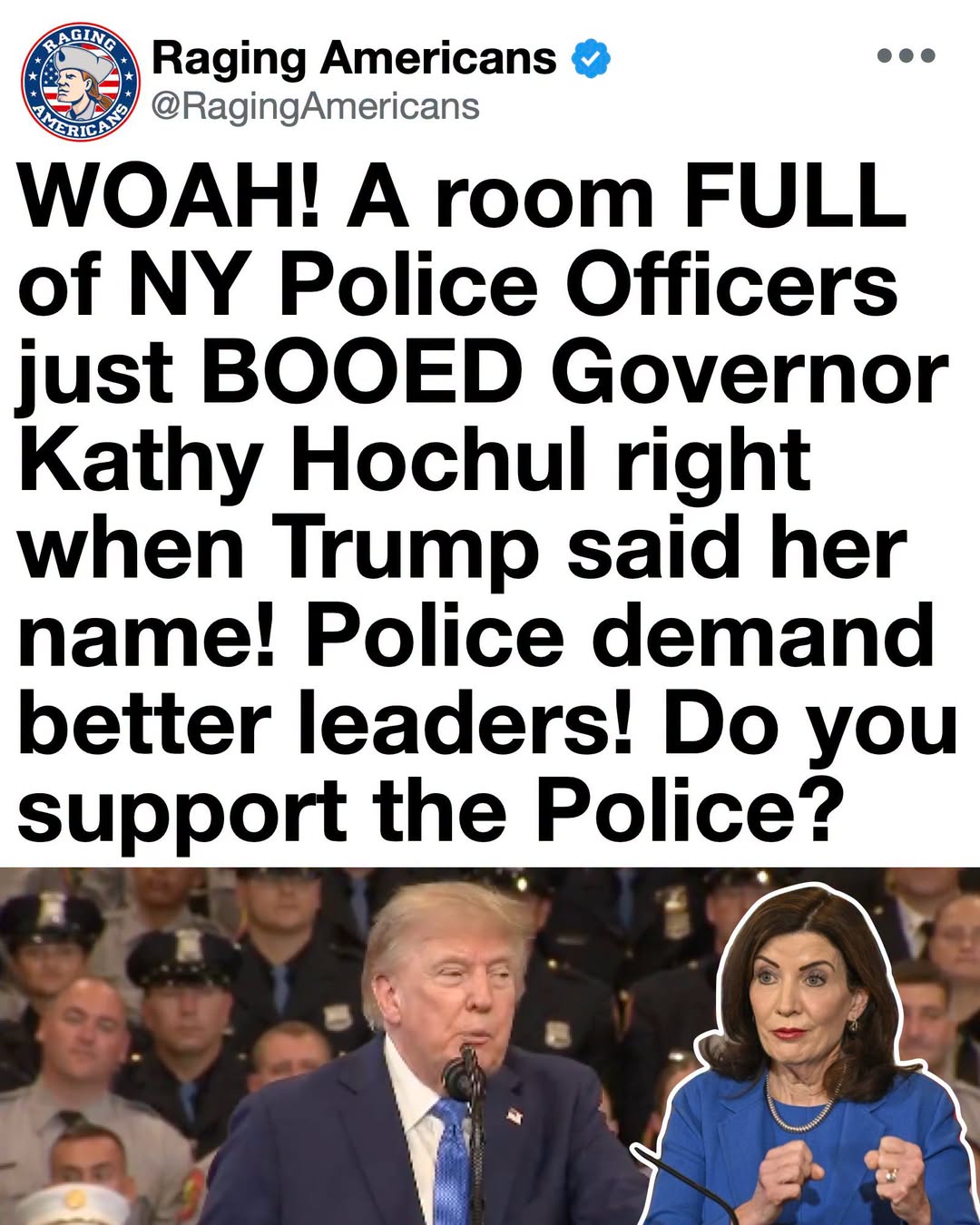
That thunderous roar of disapproval was not mere background static or coincidental unrest. It was a pointed, direct rejection of a governing philosophy that has systematically handcuffed those sworn to protect while granting unprecedented leeway to those who break the law. For years, the men and women walking the beat have watched their authority get dismantled piece by piece.
The message delivered on that floor was impossible to misinterpret. Officers are drawing a firm line in the sand against progressive experiments that treat criminals with leniency while leaving law-abiding citizens and street cops to deal with the fallout. When a room full of dedicated public servants refuses to let a governor’s name be spoken without overwhelming protest, it signals a complete collapse in administrative trust.
For too long, political leaders have operated under the false belief that law enforcement would silently endure whatever misguided mandates were handed down from above. That era has officially come to an abrupt end. The spontaneous reaction showed that the officers who put their lives on the line every single day have reached their absolute breaking point.
When the very people tasked with maintaining basic civilization publicly reject executive leadership, the entire state is forced to take notice. This was not an act of routine political venting, but an urgent alarm bell sounded by those who see the true state of our streets up close. The reality of rising disorder can no longer be masked by carefully crafted talking points.
At the center of this profound discontent sits Governor Kathy Hochul, whose tenure has become a textbook case study in prioritizing radical ideology over basic public protection. Instead of standing shoulder to shoulder with law enforcement, her administration has presided over an agenda that routinely sidelines practical crime prevention in favor of fashionable political narratives. The results of this disastrous shift have been as destructive as they were entirely predictable.
Chief among these destructive policies is the disastrous framework of bail reform, which has turned the justice system into an open revolving door for dangerous offenders. By stripping away essential judicial discretion and eliminating meaningful pretrial detention, state leadership has effectively created a system where arrests carry almost zero immediate deterrent effect. Frontline officers find themselves apprehending the same repeat offenders hour after hour, only to watch them walk free.
Compounding this issue is the systematic reduction of enforcement powers, which restricts an officer’s ability to maintain public order before chaos escalates. When everyday enforcement is discouraged and micromanaged by bureaucrats who have never worn a badge, the rule of law inevitably begins to crumble. Communities are left feeling unprotected, while bad actors grow increasingly bold in their daily defiance of the law.
Furthermore, the relentless second-guessing of officers’ split-second decisions has created an environment of impossible standards and unprecedented vulnerability. Instead of being granted the benefit of the doubt, those who risk everything to protect strangers are routinely treated with suspicion by their own state government. This toxic dynamic places frontline personnel in constant legal and professional jeopardy simply for carrying out their sworn duties.
The direct byproduct of this sustained administrative failure is an exhausted, demoralized police force that feels utterly abandoned by executive leadership. Morale across the ranks has plummeted as officers realize that the politicians in power view them as a political liability rather than an indispensable shield. When dedicated officers are continually told they are the problem, it poisons the foundation of public safety.
The Nationwide Battle for Law and Order
The unrest witnessed in New York is far from an isolated grievance confined to state borders; it represents a broader crisis spanning the entire country. Law enforcement officers in major cities and suburban communities nationwide are locked in the exact same struggle against hostile political climates. Across multiple jurisdictions, local and state officials have embraced identical soft-on-crime playbooks that paralyze their police departments.
 Suspected Oregon serial killer Jesse Calhoun indicted in death of sixth woman, Elizabeth Gibson: prosecutors
 Florida life coach Alexander Harrington stabbed his mother to death hours after posting forgiveness video: cops
 Robert Robbins allegedly cut ex’s hair with machete in Columbus: ‘No man will look at you the same again’
When governors and municipal leaders actively dismantle the legal tools required to keep streets peaceful, chaos predictably follows in their wake. Observers note that the pattern is remarkably consistent: first comes the softening of penalties, followed by the restriction of officer discretion, culminating in widespread community vulnerability. Law-abiding citizens are ultimately the ones who pay the heaviest price for these theoretical policy experiments.
In the face of such relentless institutional sabotage, open defiance from the ranks becomes not only understandable, but completely rational. Law enforcement personnel cannot remain compliant when their safety and the security of their neighborhoods are traded away for political expediency. The loud rejection of failed leadership is an essential act of self-preservation for the entire profession.
Police officers are entirely finished with being used as convenient photo opportunities during election cycles, only to be cast aside when hard policy decisions arise. True public service requires genuine commitment, not shallow lip service delivered from behind a podium. When leaders consistently enact policies that make an officer’s job more dangerous, empty words of gratitude ring completely hollow.
Many critics have rightly pointed out the glaring hypocrisy of politicians who demand heavy security details for themselves while stripping away safety measures for regular citizens. While political elites operate safely behind secure perimeters, working-class neighborhoods are left to shoulder the brunt of unchecked criminal behavior. It is this fundamental disconnect that fuels the righteous anger boiling over within police ranks.
Restoring Real Authority and Public Safety
Transforming the current crisis requires an immediate and uncompromising return to the core principles of effective law enforcement. Real support for our police cannot be measured in polished speeches or empty press releases; it requires tangible, concrete policy changes that restore operational authority to the streets. Leaders must demonstrate their backing by giving officers the legal backing they need to execute their duties without fear.
Foremost among these changes is the urgent restoration of real legal consequences that actually deter criminal activity and keep repeat offenders off the streets. A criminal justice system that refuses to punish lawlessness is not progressive; it is fundamentally broken and inherently unjust to victims. Meaningful bail reform rollbacks and swift judicial accountability are the only proven methods to regain control of disordered streets.
In addition, executive leadership must unequivocally champion police authority rather than constantly seeking opportunities to undermine it in the public square. When an administration signals that it stands firmly behind its officers, it restores confidence to both the force and the general public. That solid backing is the bedrock upon which stable, thriving, and secure communities are built.
The thin blue line is not an abstract slogan; it is the vital, indispensable barrier that holds civilized society together against rising disorder. When that line is weakened or neglected by reckless political maneuvering, the fundamental structure of community safety begins to unravel. Protecting that barrier must always be the paramount duty of any legitimate governing authority.
Communities cannot flourish when their protectors are treated as political props to be manipulated for partisan gain. The public deserves safe neighborhoods, quiet streets, and the certainty that laws will be enforced fairly and without hesitation. None of these essential standards can be achieved until leadership fully recognizes that law enforcement is the ultimate solution, not the problem.
The resounding roar that drowned out the governor’s name was a watershed moment that will not easily be forgotten. It marked the definitive moment when law enforcement officers collectively refused to participate in the charade of supporting an administration that actively harms their profession. The era of silent patience has vanished, replaced by an urgent demand for genuine accountability.
True reform will only occur when citizens and officers unite to replace leaders who put ideological vanity ahead of community survival. The men and women who put their lives on the line every single day have made their stance unequivocally clear for the world to see. It is now up to the public and the political establishment to listen to that roar and restore real law and order.
No Comments yet!