On May 4, 2020, Christopher Bailey was doing what millions of working people do every single evening: driving home from work through Inglewood, California. He had no reason to believe that a routine drive along familiar city streets would end in a catastrophic, life-altering encounter with law enforcement. Within moments of being pulled over by Los Angeles County sheriff’s deputies, his life was violently and permanently derailed.
The justification for the initial traffic stop was minor: deputies claimed Bailey was allegedly straddling the road’s traffic lanes. What should have been a standard, procedural encounter over lane positioning instantly transformed into a chaotic and brutal scene. There was no de-escalation, no measured roadside inquiry, and no calm request for routine documentation before physical force was initiated.
According to Bailey’s federal civil rights lawsuit, the two initial deputies pulled him directly from his vehicle and launched a relentless physical assault without warning. Before Bailey could even comprehend what was happening, the situation escalated into an unprovoked blitz of violence right on the asphalt. The initial stop had completely devolved from a mundane traffic inquiry into an outright beatdown.
Within minutes of the initial takedown, four additional deputies arrived at the scene and immediately joined in the ongoing assault. As Bailey lay on the pavement, multiple law enforcement officers kicked and struck him repeatedly while he was trapped beneath their combined weight. Six sworn deputies were now actively engaging a single, stranded motorist on the side of the road.
The sheer scale of the violence inflicted upon Bailey is staggering when broken down into cold, documented numbers. His legal team determined that deputies struck him between 64 and 86 times across his body and face during the encounter. It was not a brief struggle to gain control; it was a sustained barrage of physical trauma.
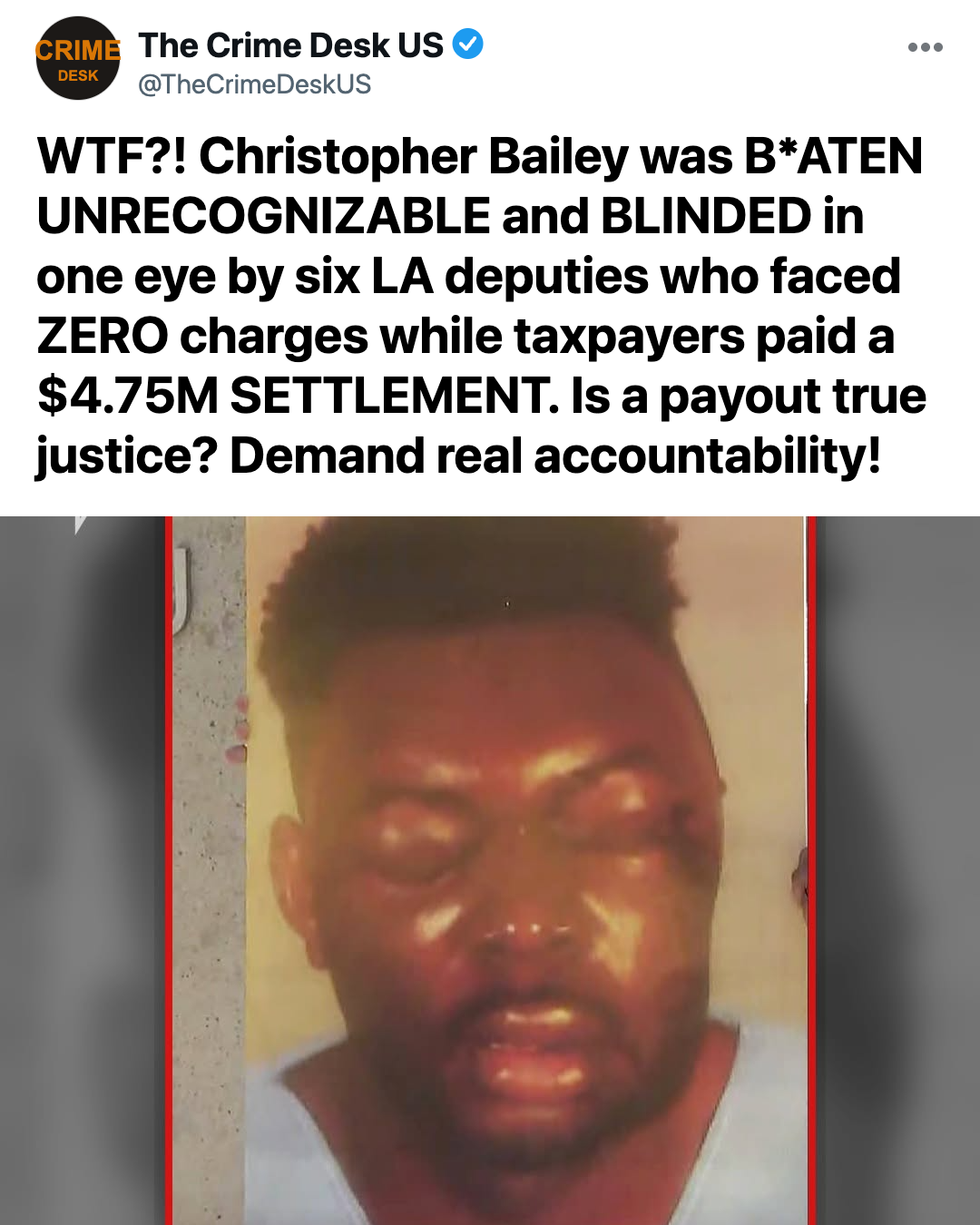
Even more horrifying is where the overwhelming majority of that physical force was concentrated during the stop. Attorneys documented that between 35 and 44 separate blows landed directly on Bailey’s face alone while he was on the ground. The physical aftermath was devastating, leaving his facial features completely battered, swollen, and unrecognizable to those who knew him.
The permanent toll of those dozens of facial blows altered Bailey’s physical health and daily life forever. He suffered extensive facial fractures, had several teeth violently knocked out, and suffered irreversible damage resulting in the complete loss of sight in one eye. A commute home from work had cost him his vision and his physical well-being.
In an era where digital evidence is critical to uncovering roadside conduct, there was a glaring void in official police records. Neither of the initial deputies involved in the stop was wearing a body camera because LASD patrol units did not carry them at the time. Without dashboard or body-worn cameras, the official narrative stood completely unmonitored by department technology.
The only reason the public ever saw what happened on that Inglewood street is thanks to two civilian bystanders. These independent “police watchers” were monitoring law enforcement radio chatter, rushed to the location, and immediately hit record on their own devices. Their independent camera lenses captured the brutal reality that official department equipment failed to document.
When prosecutors later reviewed the bystander video, the visual evidence told a completely different story than typical claims of violent suspect resistance. Officials examining the independent footage explicitly noted that Bailey did not appear combative at all during the recorded encounter. The footage did not show a dangerous aggressor; it showed a man being severely beaten on the ground.
Yet, in the immediate aftermath of the incident, the criminal justice system did not move to hold the six deputies accountable. Instead, the legal apparatus turned its full weight against the severely injured victim lying in a hospital bed. Bailey was formally charged with three felony counts of resisting arrest alongside two misdemeanor marijuana offenses.
Many observers note that this aggressive charging strategy is a familiar pattern in severe law enforcement misconduct cases. By hitting a battered civilian with heavy felony charges, authorities often attempt to establish an official record of resistance to justify extreme force. The victim is instantly cast as the criminal defendant, shifting the narrative away from the violent actions of the officers.


Bailey was forced to navigate the terrifying prospect of felony convictions and prison time while coping with sudden, permanent blindness. The very system tasked with protecting the community was actively prosecuting a man whose face had just been fractured by six sworn officers. It was a crushing institutional response to an alleged traffic violation.
The Disconnect Between Financial Settlements and Genuine Accountability
Eventually, the prosecution’s case against Bailey completely unraveled under the weight of the bystander evidence and public scrutiny. Prosecutors formally dropped all three felony counts of resisting arrest and the accompanying misdemeanor charges against him. Bailey was cleared of the criminal allegations, but the legal battle for genuine justice was only just beginning.
While the bogus charges against the victim were rightfully abandoned, the six deputies involved faced no such legal reckoning. In formal court filings submitted during the civil litigation, every single deputy involved completely denied any wrongdoing whatsoever. They maintained that their actions were justified, refusing to accept personal or legal culpability for Bailey’s catastrophic injuries.
When the evidence was presented to the District Attorney’s office to evaluate potential criminal charges against the officers, prosecutors completely declined to move forward. Not a single one of the six deputies who struck, kicked, and blinded Bailey faced an indictment, a courtroom trial, or a criminal record. The criminal justice system simply closed the door on prosecuting its own.
Furthermore, the internal administrative response within the department remained entirely shielded from meaningful public transparency and oversight. To this day, it has never been made clear whether any of the six deputies faced internal reprimands, suspensions, or disciplinary consequences. The public was left with zero clarity regarding whether these officers were ever held administratively responsible.
Accountability finally arrived in the only way the legal system seems designed to deliver it: through a massive taxpayer-funded financial payout. In September 2023, the Los Angeles County Board of Supervisors officially approved a $4.75 million settlement to resolve Bailey’s federal civil rights lawsuit. The county acknowledged the magnitude of the harm by writing a multi-million-dollar check.
However, that $4.75 million sum did not come from the bank accounts, pensions, or personal assets of the six deputies involved. Every single cent of the massive settlement was paid directly by the taxpayers of Los Angeles County. The public was forced to foot the multi-million-dollar bill for an egregious display of roadside violence.
Critics frequently point out that multi-million-dollar civil settlements do not constitute true justice or systemic reform when officers walk away untouched. When the financial consequences of brutal misconduct are outsourced entirely to the public, there is zero direct deterrent for the individuals who actually used the force. The officers remain protected while the community pays the price.
A $4.75 million settlement check cannot restore the vision in Christopher Bailey’s blinded eye or replace his knocked-out teeth. It cannot erase the psychological trauma of being swarmed and beaten by six deputies on a dark street while driving home from work. Money can cover medical bills and legal fees, but it cannot repair a shattered life.
This case exposes the profound double standard embedded at the core of the modern criminal justice apparatus. If a regular citizen assaulted a person, fractured their face, and took their eyesight, they would face immediate felony prosecution and severe prison time. Yet, when six badge-wearing deputies inflict the exact same violence on video, they receive complete immunity from criminal charges.
The presence of civilian “police watchers” was the only barrier standing between Christopher Bailey and a wrongful felony conviction. Without their cameras, the official narrative likely would have prevailed, leaving an innocent man imprisoned while his attackers went unquestioned. Civilian oversight proved to be the only real shield against total institutional erasure.
If the public accepts multi-million-dollar taxpayer payouts as a substitute for criminal accountability, nothing about police culture will ever fundamentally change. County governments will continue writing massive settlement checks, law enforcement agencies will continue denying wrongdoing, and victims will continue carrying permanent scars. The cycle of state-sanctioned violence remains unbroken when perpetrators face zero personal consequences.
Christopher Bailey survived a horrific beating that should have never occurred over an alleged lane straddle on an Inglewood street. His charges were dropped, his lawsuit was settled, but the six men who beat him walked away completely uncharged. If that reality bothers you, it is time to ask whether a settlement check is justice, or merely the price of maintaining impunity.
No Comments yet!