A decisive breakthrough in international commerce is reshaping the economic landscape as a new agreement with Canada eliminates tariffs on American agricultural products. This major development delivers immediate financial relief while opening up unprecedented market access for hardworking producers across the country. It represents a massive stride toward ensuring domestic growers get the fair treatment they have long deserved.
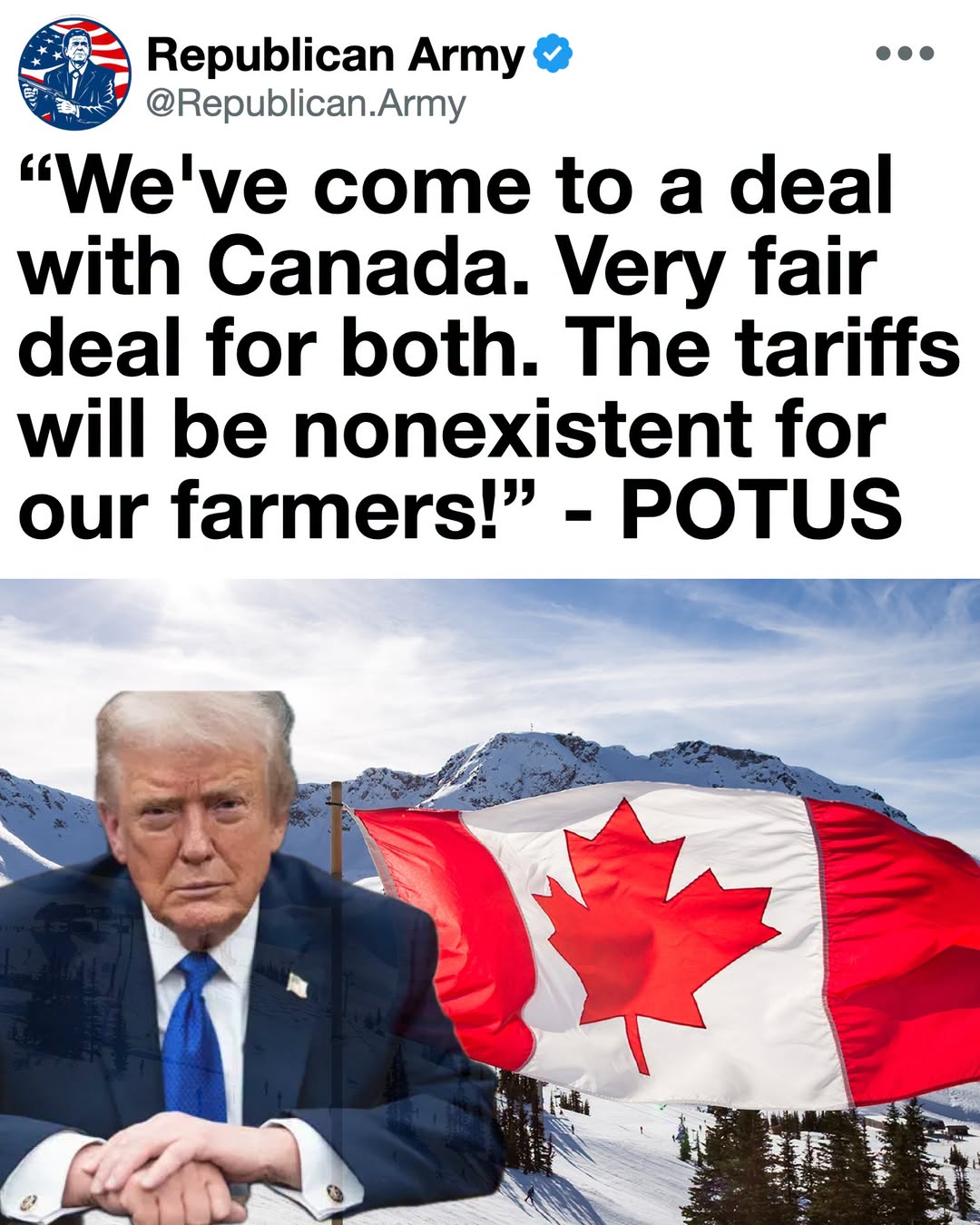
For generations, the agricultural backbone of the country has shouldered the burden of imbalanced trade agreements that tilted the board against domestic enterprise. This new agreement marks a dramatic departure from those failed arrangements, demonstrating what happens when domestic producers are placed at the center of the negotiating table. The result is an undeniable victory for the heartland.
Fair trade fundamentally begins with the complete removal of unnecessary obstacles that penalize domestic producers for simply doing what they do best. By tearing down Canadian agricultural tariffs, this agreement ensures that our farmers can sell their yields across the northern border without facing artificial price hikes. It restores basic fairness to regional commerce in a decisive, practical way.
Strengthening rural economies is impossible without directly supporting and rewarding the men and women who dedicate their lives to growing the nation’s food supply. When export pathways are clear and unrestricted, the economic benefits flow straight back into local farming communities, fueling vitality where it matters most. Reliable market access provides the certainty that farming families need to thrive.
For far too long, domestic agricultural producers were forced to navigate a deeply unfair and asymmetric global trading system. While domestic markets remained welcoming and open to foreign commodities, American exports routinely ran into high tariffs and restrictive foreign barriers. This one-sided dynamic placed an unjust burden on domestic growers who simply wanted a fair shot.
That structural imbalance consistently undercut the natural competitiveness of domestic agriculture, leaving world-class producers at an artificial disadvantage. It meant that even the highest-quality goods struggled to find footing against competitors shielded by foreign trade barriers. The playing field was distinctly skewed, leaving American growers to absorb the consequences of flawed trade paradigms.
By dismantling these barriers once and for all, the new Canada deal finally levels the playing field across the entire agricultural sector. American farmers can now compete strictly on merit, allowing the superior quality and efficiency of domestic production to speak for itself. When the rules are fair, domestic agriculture is positioned to outperform any competition.
This landmark outcome exposes the persistent failures of abstract free-trade theory, which for decades prioritized academic talking points over real-world consequences for workers. Those outdated philosophies often accepted foreign trade barriers as inevitable costs, sacrificing domestic interests in pursuit of vague global ideals. In contrast, this agreement proves that tangible results require direct, pragmatic action.
Real economic progress is measured by the prosperity of working families, the stability of local businesses, and the health of rural towns. Prioritizing domestic producers over bureaucratic trade theories has delivered immediate, measurable wins that will be felt directly across the heartland. It is a powerful reminder that trade policy must serve the people on the ground.
 21-Year-Old Man Stabbed Near St. Patrick’s Cathedral and Saks Fifth Avenue as Assailant Flees in BMW, Police Say
 Houston Attorney Faces Felony Bestiality Charge After Wife Allegedly Catches Disturbing Footage on Home Security System
 Alabama Man Sentenced to Life in Prison for Murder of Girlfriend Outside Florida Apartment
Delivering Tangible Results Through Reciprocal Leverage
The success of the Canada deal underscores an essential truth about international negotiations: strong, unwavering leverage produces better terms. When a nation enters trade discussions with clear boundaries and a refusal to accept one-sided deals, foreign partners take notice and adjust. Reciprocal terms are the only reliable safeguard for protecting domestic economic interests over the long haul.
One-sided arrangements that asked domestic producers to make all the compromises while receiving little in return are officially a thing of the past. Firm negotiation establishes clear expectations of mutual benefit, ensuring that market access is a two-way street rather than an unbalanced giveaway. That standard of reciprocity is vital for safeguarding national prosperity.
Crucially, this agreement illustrates that trade policy can successfully expand commercial opportunities for American workers and farmers without eroding national sovereignty. A country does not need to compromise its independent economic authority in order to secure lucrative, highly beneficial cross-border export agreements. Sovereignty and economic expansion can, and must, advance hand in hand.
When trade frameworks respect sovereignty, they ensure that domestic rules, standards, and producer protections remain entirely intact. True economic expansion elevates the nation’s standing on the global stage while preserving the freedom to govern domestic industries without external interference. This balance is the exact definition of a winning trade strategy.
In past decades, agricultural exports were all too frequently treated as a secondary priority or an afterthought during high-stakes multinational negotiations. Key domestic sectors were routinely sidelined in favor of broader diplomatic concessions that left rural communities struggling to find viable export markets. That disregard for the nation’s core producers created decades of economic frustration.
This agreement fundamentally reverses that trend by elevating agricultural exports into an undeniable strategic priority. Recognizing the nation’s food producers as critical assets ensures that trade negotiators fight aggressively for their economic interests at every single turn. The message is unmistakable: rural America will no longer take a back seat in foreign trade discussions.
When government policy champions the heartland, the resulting economic ripple effects strengthen the foundational resilience of the entire country. Expanding international demand for domestic agricultural goods keeps local operations profitable, creates dependable employment, and sustains multi-generational family farms. An energized agricultural sector is vital for national economic stability.
With Canadian agricultural tariffs now eliminated, domestic farmers are uniquely positioned to maximize their productivity and seize new commercial opportunities across the border. They have the skill, the work ethic, and the operational excellence required to lead the global market when given a fair and unhindered path forward. The artificial barriers that once held them back are officially gone.
The lesson from this historic breakthrough is undeniable: unapologetic negotiation and clear reciprocity are the keys to lasting economic strength. When trade agreements put domestic producers first, defend national sovereignty, and demand mutual respect, the entire nation flourishes. The elimination of these tariffs stands as definitive proof that prioritizing the American heartland yields real, enduring victory.
No Comments yet!