For generations, Baylor University has stood as a monumental pillar in American higher education, proudly recognized as the largest Christian university in the world. Its historic mission was never ambiguous, anchored deeply in an explicit Christian heritage that guided its academic programs, campus culture, and foundational identity. Yet, a major operational shift is now raising serious questions about where the university’s deepest loyalties truly lie.
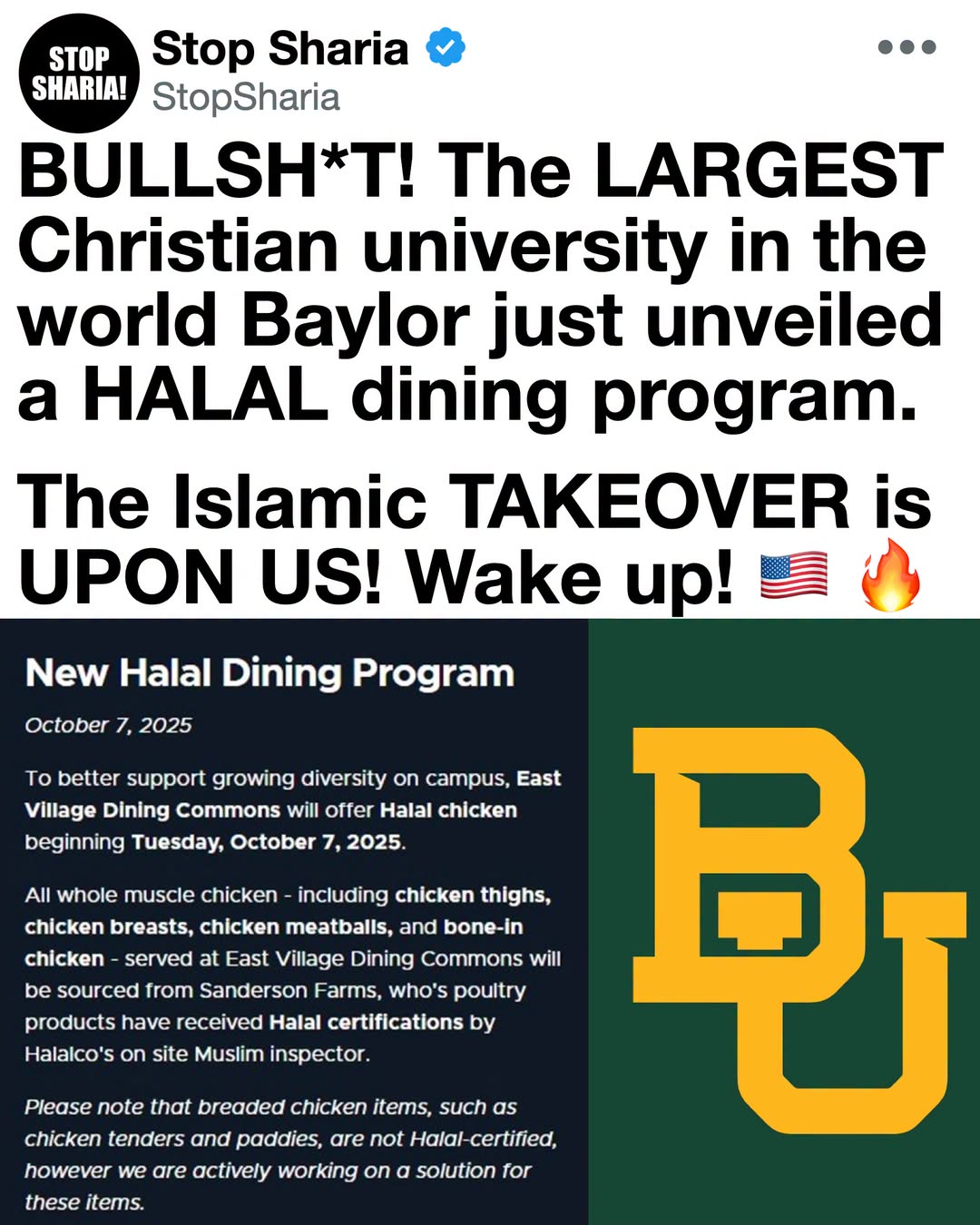
The university has officially rolled out a comprehensive Halal dining program across its campus facilities, complete with specialized certified food suppliers and dedicated on-site religious inspection. This is not merely an expanded menu option tucked away in a corner of the cafeteria. It is a fully institutionalized initiative that integrates external religious dietary governance into the heart of everyday student life.
Campus administrators have framed this sweeping change under the familiar banner of diversity and inclusive accommodation. On the surface, the rhetoric sounds modern and welcoming, tailored to fit the administrative trends sweeping across higher education. But beneath the polished public relations messaging lies a profound transformation in how a storied Christian institution chooses to operate.
By establishing certified supply chains and inviting formal religious oversight to verify compliance with non-Christian standards, the institution has made a deliberate administrative choice. A university explicitly founded to advance Christian truth is now dedicating operational resources to uphold the ritual requirements of an entirely different faith framework. That reality cannot be brushed aside as a routine logistical update.
Every private institution inherently retains the fundamental right to define its own character, values, and daily practices. However, when an institution built on Christian convictions begins restructuring core campus services around outside theological mandates, it sends an unmistakable signal. It suggests a subtle but undeniable realignment of priorities at the highest institutional levels.
Across the country, thousands of students and their families choose Baylor specifically because they desire an unapologetically Christian environment. Parents invest significant resources, and alumni contribute substantial donations with the clear expectation that the university will stand firm in its founding identity. Now, many of those faithful supporters are left wondering whether that heritage is being steadily compromised.
The central question being asked by observers and community members is as straightforward as it is urgent. Has the historic Christian mission of the university remained the paramount standard for institutional decisions, or has it become secondary to the demands of demographic accommodation? When core functions are modified to reflect competing religious standards, the guiding compass inevitably begins to waver.
There is a vast and consequential difference between offering basic hospitality and creating an official system of religious certification. Providing varied food choices to accommodate individual personal preferences is a standard practice on almost any modern campus. Inviting external religious authorities to oversee and inspect institutional operations, however, elevates those practices into formal policy.
This critical distinction is precisely where many believe the line has been crossed. Reorienting primary dining operations to satisfy ritual standards changes the institutional posture from simple accommodation to active structural validation. It represents a tangible shift in how the campus environment is governed and experienced by the entire student body.
When an explicitly faith-based school takes this path, it sets a precedent that extends far beyond the dining hall. It signals to the broader culture that traditional commitments are negotiable whenever contemporary pressures demand a gesture of inclusion. Over time, these incremental compromises accumulate, gradually reshaping the very soul of the institution from within.
 Twist in case of 73-year-old Verna Stafford convicted in Oklahoma Sirloin Stockade massacre after parole board vote
 South Carolina Woman Charged with Attempted Murder After Man Shot in Spartanburg County
 The Red Wave Delivers a Brutal Reckoning: Why Cory Mills Was Sent Packing and What It Means for Washington
The Real Cost of Mission Drift
Preserving the distinct character of a faith-based university requires unwavering clarity about the foundational traditions that govern its practices. A Christian university derives its purpose, its strength, and its moral authority from an uncompromising devotion to its founding beliefs. When those beliefs are diluted in the name of administrative convenience or cultural approval, the entire institutional framework begins to weaken.
Critics of this shift point out that true pluralism does not require a Christian institution to surrender its distinctive character. A university can be gracious, hospitable, and welcoming to all individuals without formally institutionalizing the religious rituals of another tradition. When an institution blurs that boundary, it risks undermining the very identity that drew its core community together in the first place.
Throughout the history of higher education, mission drift rarely happens overnight through a single dramatic proclamation. Instead, it occurs through a series of quiet administrative adjustments, each framed as a harmless step toward modernization and inclusivity. Little by little, the original mandate is pushed to the margins until the university becomes virtually indistinguishable from its secular peers.
Universities that dilute their core convictions inevitably find themselves struggling to maintain institutional coherence. When an institution tries to be all things to all worldviews, it ultimately stands firmly for none. The unique identity that once set the institution apart gets smoothed away in favor of a homogenized, risk-averse model of corporate governance.
The concerns voiced by long-standing supporters are rooted in a legitimate desire for institutional integrity and honesty. If a university claims to be the premier Christian institution in the nation, its policies and daily operations should reflect that calling without apology. When core services are remodeled to align with external theological frameworks, that bold claim becomes increasingly difficult to sustain.
Higher education is currently facing an unprecedented crisis of purpose, with countless institutions drifting far from their original charters. In such a cultural climate, clarity and conviction are more valuable than ever. Families seeking a distinctively Christian education are looking for institutions with the courage to remain grounded in their historic roots, rather than bending to every prevailing wind.
The implementation of certified Halal dining with on-site religious inspection is not an isolated event; it is a telling case study in institutional trajectory. It forces a fundamental reckoning about what it truly means to maintain a Christian mission in the twenty-first century. As administrators continue on this path, they must confront the long-term consequences of prioritizing external accommodation over historic coherence.
Students, alumni, and donors are watching closely to see how far this institutional transformation will go. They understand that once an institution begins redefining its daily operations around different religious systems, reversing course becomes nearly impossible. The integrity of the university’s original mission depends entirely on its willingness to defend its distinct purpose before it is entirely eroded.
An institution’s legacy is defined by what it chooses to protect when cultural trends push in the opposite direction. Baylor University has arrived at a defining crossroads where its operational choices speak far louder than its promotional mottos. The decision to restructure central campus operations around external religious certification marks a significant turning point that will shape the institution for decades to come.
Ultimately, a faith-based university cannot thrive if it is hesitant to boldly center its own founding principles. The strength of any historic institution lies in its distinctiveness, its convictions, and its fidelity to the mission upon which it was established. Diluting that foundation in the pursuit of demographic accommodation does not strengthen a university; it only ensures that its historic identity will slowly fade away.
No Comments yet!