Nathan didn’t move. That was the first thing I noticed. A groom is supposed to do something when two strange children walk out of the hedges at his wedding — laugh, frown, ask a question. My groom just stood there with his champagne frozen in his hand and every drop of color gone from his face, and he looked at those two kids like they were ghosts who’d finally caught up with him.
The boy and the girl stood at the edge of the lawn in their little garden-party clothes, holding hands. And in the hard afternoon sun I saw it — the same small crescent birthmark at each child’s temple. The exact mark Nathan has at his own temple. The one I used to trace with my thumb and call his lucky moon.
Two of them. Matched. Unmistakable.
The garden had gone completely silent. A hundred and forty guests in their pastels, glasses raised for a toast that would never finish. And into that silence, from behind the children, a woman stepped out from between the roses.
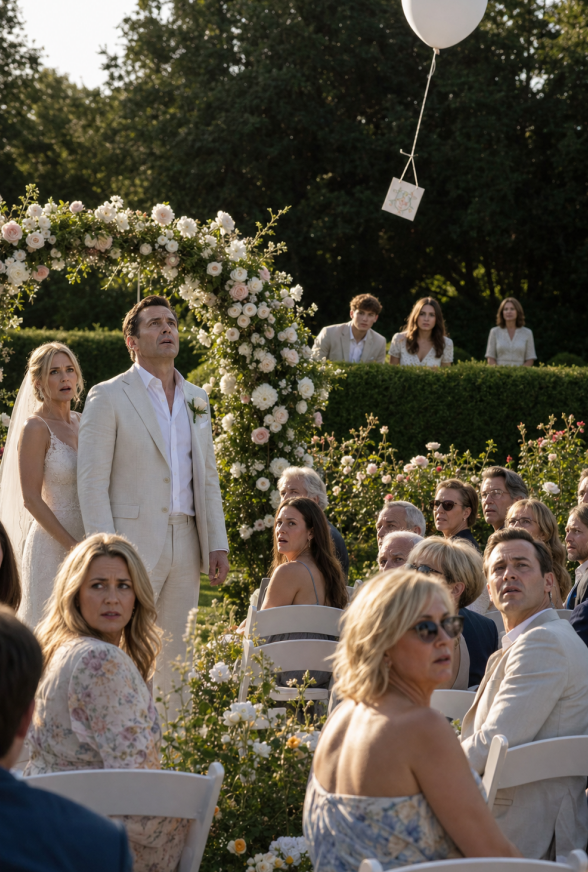
I knew who she was before anyone told me. Nathan kept a photo in a drawer he thought I’d never opened — his first wife, Rachel. The woman he’d described to me, sadly, over candlelight, as “broken.” The one who “couldn’t give him children,” whose grief over it had supposedly poisoned the marriage until it died. He’d told that story so gently, so much like a man carrying someone else’s pain, that I’d loved him more for it. I’d thought: here is a good man who stayed kind after being denied the one thing he wanted.
Rachel walked across my wedding lawn in a plain linen dress, and she was holding a folder.
“I’m sorry to do it like this,” she said, and her voice didn’t shake at all. “I tried every other way. He wouldn’t answer a lawyer. He wouldn’t answer me. So.” She looked up at the balloon still drifting overhead, its paper tag turning in the light. “The twins wanted their father to know they exist. On a day he couldn’t pretend he didn’t hear it.”
She held the folder out. Not to Nathan. To me.
I should have refused it. I was the bride. Every instinct said close your eyes, finish the toast, deal with it later. But my hands took it the way your hands take something in a dream, and I opened it, and I read the top page in front of all those frozen guests.
It was a paternity result. Court-ordered. Nathan Cole, listed as the biological father of both children, to a probability that left no room anywhere for doubt.
Under it were the other pages. A hospital record from eight years ago. A restraining order. A police report I only skimmed before my stomach turned over.
Rachel wasn’t broken. Rachel wasn’t barren.
Rachel had gotten pregnant with twins and then gotten frightened — frightened enough of the man I was about to marry that she had run while she was still carrying them, changed the locks, changed her number, and raised those two children eight years without a cent from him, letting his family and his friends and eventually his fiancée believe she was the tragic, defective woman who’d failed to give him a family. She let them blame her. It was safer than the truth. The truth had a temper, and she knew exactly what it was capable of, and she’d chosen her children’s safety over her own name.
She’d only come forward now because the twins were old enough to ask, and old enough to be told, and because a public wedding was the one place a man who ignored every private summons could not simply refuse to be seen.
I looked up from the folder at Nathan.
He was still not moving. But his face had done something I’ll never forget — it had stopped performing. For one second, before he could catch it, I saw the real thing underneath the easy smile I’d fallen for. Something cold and calculating and caught. And I understood, all at once, that every tender story he’d ever told me about his “broken” first wife had been him rehearsing a lie until it sounded like grief.
I put the folder down on the little table beside the untouched cake.
“I think,” I said, and my voice came out steadier than I felt, “the toast is over.”
I don’t remember all of what happened next. I remember his mother trying to take control of the room and finding there was no room left to control. I remember Rachel crouching down between her two children and murmuring that they’d done a brave thing and now they could go get ice cream. I remember taking off the ring — right there, in front of everyone — and setting it on top of the folder, because I did not want to carry one more thing that was his.
People asked me afterward if I was heartbroken. I was. Of course I was. But not the way they meant.
I wasn’t heartbroken over losing Nathan. I was heartbroken for the woman who’d spent eight years being called broken by a whole world of people, including me, so that two children with little crescent moons at their temples could grow up somewhere safe.
I found Rachel in the parking area before she left. I didn’t know what to say. “I believed him,” is what came out. “I’m sorry. I believed every word.”
She looked at me for a long moment, and then she did something I did not deserve. She reached out and squeezed my hand.
“Everybody did,” she said. “That was the whole trick of him. Go home. You got out on the right day.”
The balloon was still up there when I finally left, a small pale dot drifting east over the rooftops, its little tag too far away to read now. But I knew what it said. Everyone in that garden knew what it said.
Daddy, we’re here.
And for the first time in eight years, he couldn’t pretend he hadn’t heard.
Comments are closed.