The boy couldn’t have been more than nine, and he lit that candle with the seriousness of someone twice his age.
I almost didn’t notice him. It was the charity gala for the cathedral’s new wing — the wing my foundation had paid for, my name on a discreet brass plaque near the entrance — and I was doing what I do at these things: shaking hands, accepting thanks, being the generous David Rourke everyone had come to admire. The chandeliers were warm, the champagne was cold, and I was very good at the performance.
Then I saw the child at the votive rack.
He was in a navy blazer a size too big for him, standing apart from the crowd of tuxedos and gowns as if he’d wandered in from another world. He fed a coin into the box, took a long taper, and touched it to a fresh candle. I heard him say it under his breath, not to anyone, just to the flame.
“For the dad who never came.”
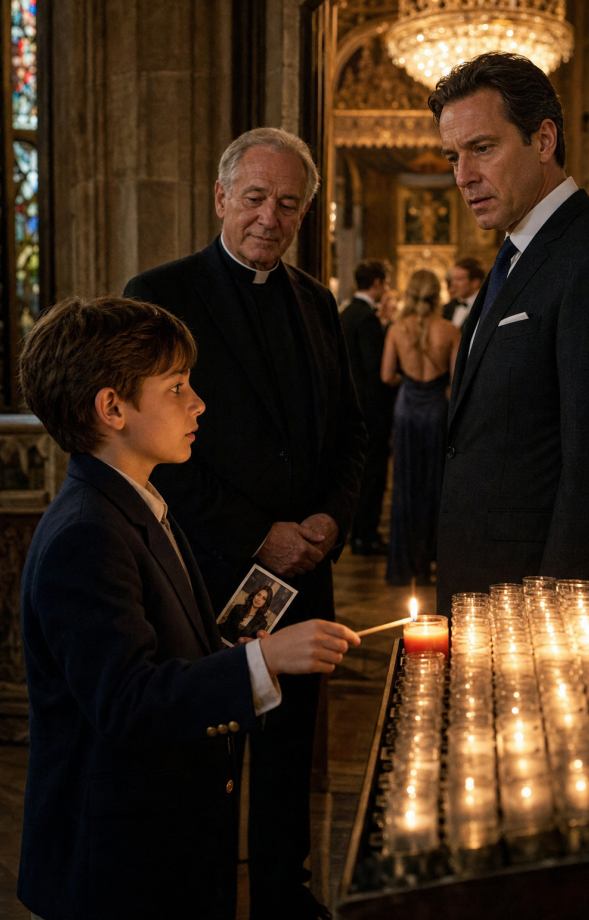
I don’t know why it stopped me. Children say sad things sometimes. But something about his face — the set of his jaw, the particular line of his brow — snagged on something in me I couldn’t name. I found myself walking toward him before I’d decided to.
Father Malone reached him first.
The old priest had been moving through the gala all evening, and he came to stand beside the boy at the candles. But he wasn’t looking at the child. He was looking at me. Back and forth, slow and deliberate, from the boy’s face to mine and back again, and I watched something settle in his expression that made my stomach drop before a single word was spoken.
“David,” he said gently. “Do you know this young man?”
“No,” I said. “Should I?”
Father Malone was quiet for a moment. Then he asked the boy his name.
“Ellis,” the child said.
“Ellis,” the priest repeated. “And your mother’s name?”
The boy told him. And the room, all its warmth and noise and clinking glasses, seemed to tilt away from me and go very far off.
I knew that name. I had spent years not letting myself think that name.
Her name belonged to a woman I’d walked away from a decade ago — cleanly, coldly, the way I did everything back then, before the money and the plaques and the carefully built reputation for generosity. We’d been together briefly. She’d wanted more than I was willing to give. I told her it was over, and I never looked back, and I certainly never knew — never let myself wonder — whether I’d left anything behind.
Father Malone had baptized Ellis. He’d known the boy’s mother for years, through the parish. And a few months ago, when she’d learned how sick she was, she had come to him. She was entering hospice. She was making arrangements for her son. And she had told the priest the truth she’d carried alone for nine years: who Ellis’s father was. A man she’d never told, because she’d been too proud to chase someone who didn’t want to be found, and because by the time she might have, that man had become someone whose name was on buildings, and she hadn’t wanted her son to feel like a debt being collected.
She hadn’t sent the boy to the gala to expose me. That was the part that undid me. Ellis was there because the parish youth group had been invited to help, and he’d slipped away to light a candle the way he apparently did everywhere they went. His mother didn’t even know he’d come. The candle was just something a lonely boy did, over and over, in every church he entered. For the dad who never came.
I looked at that child, really looked, and I saw my own face looking back at me from nine years ago.
I didn’t make a scene. I don’t think I could have spoken loudly if I’d tried. I crouched down to his level, there by the candles, and I asked him what he’d wished for.
“I didn’t wish,” he said. “You’re not supposed to wish on those. You’re supposed to remember someone.”
“And who are you remembering?”
He shrugged, a small embarrassed shrug. “Somebody I never met.”
I have built my life on being unreachable. On writing checks instead of showing up, on funding a wing so I’d never have to sit in a pew. And a nine-year-old boy dismantled all of it with one honest sentence, in the one building I’d paid for precisely so I could feel like a good man without ever being one.
I went to the hospice that same night. She was very weak, but she was awake, and when she saw me in the doorway she didn’t look angry. She looked relieved. We talked for a long time, in low voices, about a boy who liked to light candles.
She passed ten days later. Ellis lives with me now. It is the hardest and most undeserved thing that has ever happened to me, and every single day I am aware that I did nothing to earn it except finally, nine years too late, walk toward the child instead of away.
I kept the plaque on the wing. But I go inside now. I sit in the pew, next to my son, and some evenings he still lights a candle. Only now the words are different.
For the dad who finally came.
Comments are closed.