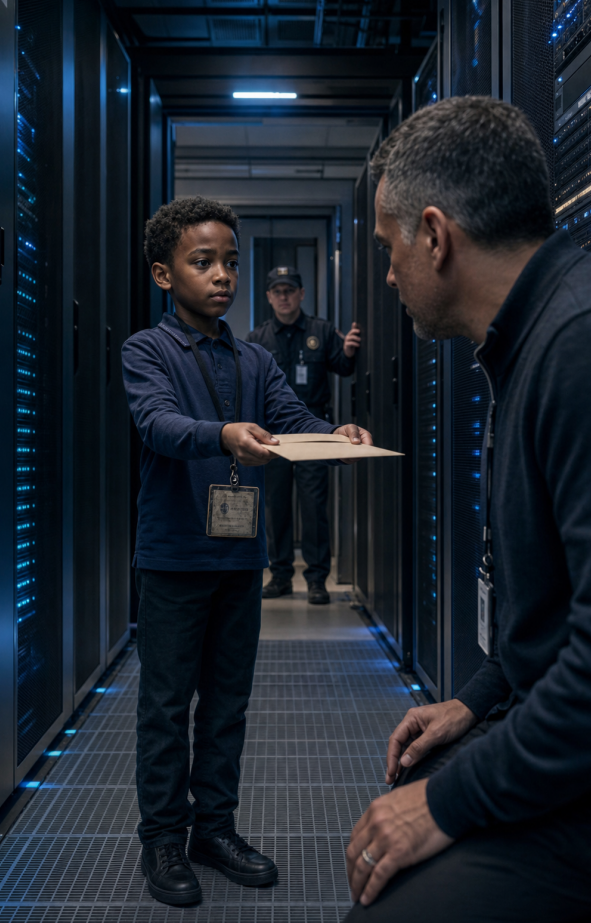
The envelope wasn’t sealed the way business letters are sealed. Someone had pressed the flap down by hand and run a thumb along it, the way you close something you’re not sure you should be sending. I noticed that before I noticed anything else, because noticing small things is the whole of what I do, and I had spent ten years telling myself that skill had never once failed me.
Inside was a single folded page and a photograph, and I read it standing up despite what the boy had said, because men like me do not sit down when a child tells them to.
The handwriting was hers. I knew it before I read a word. Sana Okafor wrote her sevens with a slash and her lowercase g’s like a musician’s clef, and I had signed off on a thousand of her design docs without ever once thinking I’d see that hand again.
“David,” it began. Not Mr. Reyes. Not the title I’d made everyone use by then. “David, if Amani is standing in front of you, then I finally lost the argument I’ve been having with myself for nine years.”
I made myself keep reading.
She wrote that the leave I killed her for was real. That the week I stood in a glass conference room and called her request a fraud, a woman gaming the system, I’d said, a performance, she had been sitting in an urgent-care parking lot two miles away, six weeks pregnant and shaking, trying to decide whether to tell me before or after the review.
She’d decided after. She never got the chance. I fired her on a Thursday and had security walk her out by noon, and I remember being proud of how clean it was. No drama. No one plays David Reyes.
She wrote that she didn’t fight it because she believed me. That was the part that took the floor out from under me. She believed that a man who could look at her and see a liar could destroy her, could make sure she never worked in the field again, could turn a pregnancy into a scandal. So she left. Not the company. The country. She took a contract overseas under her mother’s maiden name and she raised him.
I looked up. The boy, Amani, was watching me with a stillness no nine-year-old should own. He had her jaw. He had, God help me, my hairline, the same stubborn cowlick I’d been fighting since I was his age.
“She said you’d need to be sitting down,” he said again, quiet, almost apologetic. “There’s a chair by the rack. I saw it.”
I sat.
The photograph was an ultrasound, dated the Monday of that same week. The week I called a fraud. In the corner she’d written a time and the name of a clinic I could have called, could have verified in ninety seconds, if I had ever once considered that the story might be true.
I had built an entire reputation on a single sentence. I don’t get played. I said it in interviews. I said it to my own kids. I ran the floor we were standing on by that cred: trust nothing, verify everything, never let the emotion of a story override the data. And the one time it mattered, I had looked at the truth and called it a lie, because the lie was cleaner and it made me the smartest man in the room.
The guard shifted by the door. I’d forgotten he was there. “Sir,” he said, “the boy came alone. There’s a woman downstairs who signed him in. She wouldn’t come up.”
Of course she wouldn’t. She’d sent our son to hand me the badge I’d stripped from her, the retired lanyard with her name gone soft and gray behind the laminate, so that I would have to read it against a boy’s chest and understand exactly what I’d retired.
I asked Amani if he knew who I was.
He thought about it. Careful, that kid. “Mom said you’re someone who used to work with her. She said I should give you the letter and then it was up to you.”
Up to me. Nine years too late, and she was still handing me the choice she’d never been given.
I don’t remember standing. I remember the cold blue of the status lights and the hum of ten thousand machines doing exactly what they were told, and I remember thinking that I had spent a decade in this temperature congratulating myself on being un-foolable, and the only person I had ever successfully fooled was me.
I took him downstairs. I didn’t run the numbers on it first. For once in my life I did not verify before I moved.
She was standing by the security desk in a coat too thin for the lobby’s air, older, tired, her chin up in the exact way it had been the day I walked her out. She didn’t smile. She didn’t have to. She just watched me come, and I saw her decide, second by second, whether the man crossing the floor was the one she’d been afraid of or someone who’d finally read the file.
I stopped in front of her. I’m not a man who says he’s sorry easily. I’ve made whole quarters run on my refusal to.
“I read it wrong,” I said. “All of it. I read it wrong.”
She let out a breath she’d been holding, I think, for nine years.
Amani looked up between us, from her face to mine, doing the math a child does, and I realized that the son I erased before he was born was standing in the one building I’d built to make sure I was never wrong, teaching me the thing I’d spent my whole career refusing to learn.
That certainty is the easiest lie of all. And I’d bought it from myself, for ten years, at full price.
We didn’t fix anything on that floor. You don’t. But I asked her to sit, finally, in the chair the boy had found, and I listened, and for the first time in ten years I let a story change my mind before I’d decided how it ended.
Comments are closed.