The woman staring at the box was Grant’s sister, Colleen. I hadn’t invited her; she’d come as the plus-one of a mutual friend I hadn’t the heart to cut. She’d spent the whole reception being coolly polite, the way you are to a woman your family decided was defective. And now she was white-faced, looking at two tiny onesies spilling out of a battered parcel like they’d reached up out of the ground.
I need to explain the box, because it’s the saddest small thing in this whole story. The winter Grant threw me out, before I knew what was happening inside me, I had already, in some hopeful corner of my grief, bought two newborn outfits. I don’t fully know why. I think part of me was mourning the family I thought I’d never have. When I finally understood I was pregnant — and pregnant with twins — I was so frightened of Grant and his lawyers that I packed those outfits into a box and mailed them to our old address, addressed to no one, in a fog I can’t really reconstruct. A goodbye to a life, maybe. The house had already changed hands. The box went nowhere and everywhere for eight years, and then a postal clerk did their job and sent it home to the name written inside.
It found me on my wedding day. You couldn’t script it. I’ve stopped trying to explain the timing.
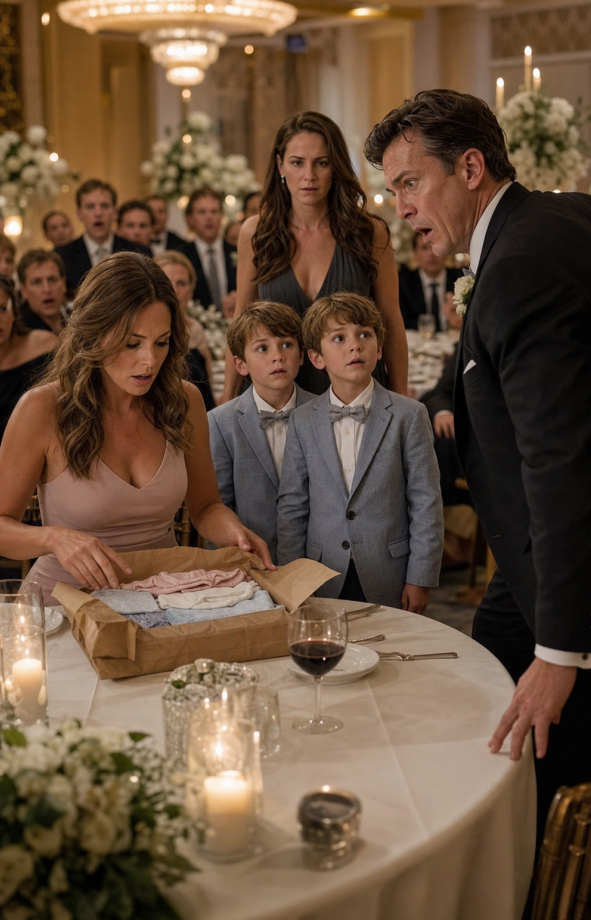
So I stood at the head table in my ivory gown, my new husband Daniel’s hand on my back, and I lifted out those little clothes in front of two hundred people. And at the far end of the room, the coat-room doors opened.
I hadn’t planned this part either — but my sister had. My twins, Noah and Grace, were supposed to be with her at home. She told me later she’d brought them “just in case the day needed them,” which is the kind of thing my sister says. When they saw the box, when they saw me crying, they simply walked in. Two eight-year-olds in matching pale-blue outfits, dark-haired, with a chin I know very well.
Grace was holding a folded piece of paper. She’d found it, my sister confessed, in my keepsake drawer weeks ago, and had been carrying it around like a treasure without understanding it. It was a medical letter. From the fertility specialist I’d finally seen, years after the divorce, when I needed to understand my own body after everything Grant’s family had told me about it.
The letter said, in clinical language, what I’d learned too late to matter: there had never been anything wrong with me. My twins were proof enough of that. The infertility in that first marriage — the “barrenness” Grant had branded me with at every holiday table, the story his mother wore out repeating — had not been mine.
It had been his.
He’d known, I’m fairly sure. Somewhere in himself he’d known, and rather than face it, he’d built a whole public story out of my supposed defect, because it was easier to have a broken wife than a broken pride. He’d thrown me out for the one thing that was actually true of him.
Colleen crossed the room. I braced for cruelty; it’s the reflex her family taught me. Instead she knelt down in front of Noah and Grace, looked at their faces — her brother’s face, unmistakably — and started to cry. “You have children,” she said to me, not accusing, just wrecked. “All this time he said — he told everyone —”
“I know what he told everyone,” I said.
The room had gone very quiet, the way rooms do when a story everyone thought they knew turns inside out in front of them. There were people at those tables who’d heard, over the years, that I was the woman who couldn’t give a good man a family. Now they were watching that woman lift her twins into her arms at her own wedding, holding a letter that named the truth.
I want to be careful about what I felt, because it wasn’t triumph. Grant wasn’t even there to be humiliated; he’d faded out of my life once I disappeared, and I’d made sure he stayed faded. What I felt was closer to release — the specific relief of a lie you’ve half-believed about yourself finally, publicly dying.
Daniel, my husband, was extraordinary. He didn’t flinch at a wedding that turned into a reckoning. He crouched down with me and met the twins and shook Noah’s small hand very seriously, and then he stood up and told the room, simply, that he’d known about the children from our first date, that he’d been waiting to be their father as much as my husband, and that the box had just saved us the trouble of a longer announcement. People laughed, the good kind of laugh, the kind that lets a room breathe again.
Colleen asked, before she left, whether she could ever know them. I told her the truth: that door was open, but it opened toward me and my children, not toward her family’s version of us. She understood. She’s been careful and kind since, which is more than I expected.
I kept the onesies. They’re in a frame now, next to a photo from the wedding of Noah and Grace in their matching blue, and the medical letter folded behind it where I don’t need to read it but always know it’s there.
For eight years I carried a lie about my own body, mailed in a box to an address that no longer existed. It took a postal clerk, a stubborn sister, and two kids with a familiar chin to bring it back and set it down, opened, in a room full of people — and finally send it, at last, to the right sender.
Comments are closed.