He turned the coin over with two fingers, slow, like it weighed more than it did, and set it face-up on the table between us so I could read it.
Engraved on the back, worn soft by decades of a thumb rubbing the same spot, was a name. My father’s name. Sergeant First Class Raymond Bell.
I had to sit down. I actually sat down in the booth across from a stranger at two in the morning because my legs stopped agreeing to hold me.
“You’re his girl,” the old man said. It wasn’t a question. “You’ve got his hands. I’ve been looking at your hands the whole time you were pouring my coffee.”
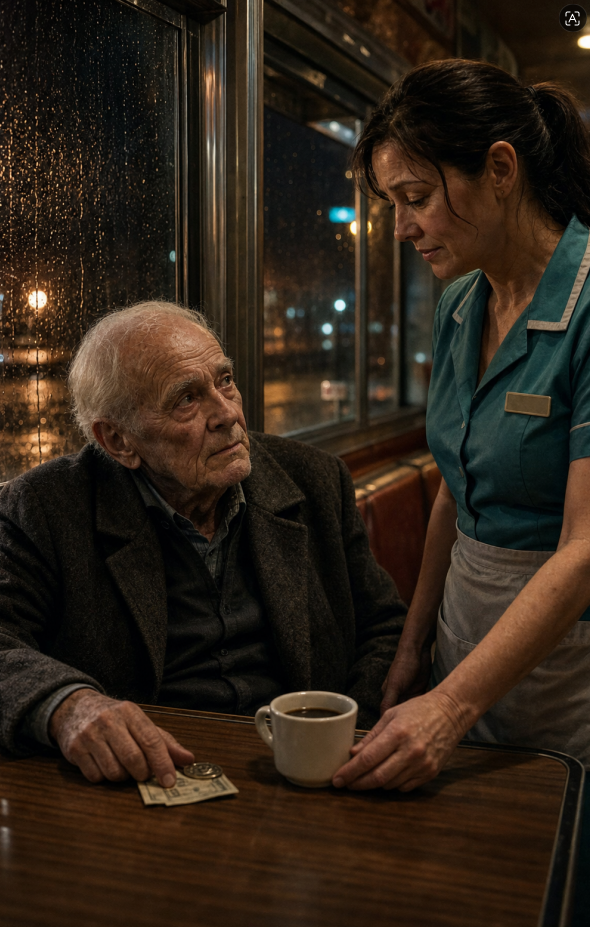
His name was Walter Honce, and over the next hour, in a diner empty except for the cook and the rain, he told me who he was and why he had been sitting in my section for three nights running, never ordering more than coffee and toast, watching me work.
Fifty-one years ago, Walter said, he was a nineteen-year-old private who did something stupid under fire and got himself pinned down in a place he had no business being. He was going to die there. He had made his peace with dying there. And a sergeant he barely knew — my father — came back for him. Carried him four hundred meters under fire with a shattered ankle, put him down behind cover, pressed that challenge coin into his hand, and said, “You keep breathing, you keep this, and someday you do something with the life I just handed back to you.”
Then my father went back out for the next man. And did not come back.
Walter kept breathing. Walter kept the coin. And Walter, it turned out, did quite a lot with the life he’d been handed. He built a logistics company out of nothing, then another, then a holding company that owned the first two. Somewhere along the way “private Honce” became one of the wealthiest men in the state, the kind whose name is on a hospital wing. He never married. He said the coin was the only family heirloom he had, and he’d spent thirty years — thirty years — quietly trying to find the family of the man who gave it to him, and hitting dead end after dead end, because military records were a maze and my father’s people had scattered and my mother had remarried and changed our name.
Until a private investigator he’d kept on a slow retainer for a decade found a waitress named Nora Bell, née Nora Raymond, working night shifts at a diner off the interstate.
He didn’t want to scare me. So he came, and he sat, and he watched to see what kind of person Ray Bell’s daughter had grown up to be. And what he saw, he said, was a woman drowning quietly and still comping coffee for a shabby old man counting out coins, on a night when she clearly could not afford to give away a dime.
“You didn’t know who I was,” he said. “You had no reason to think you’d ever get anything back. And you did it anyway. That’s your father. That’s exactly your father.”
I told him about the debt then. I hadn’t meant to. It just came out — the medical bills from my late husband’s long illness, the house I was one bad month from losing, the doubles I was working to hold it all together with tape and prayer. I wasn’t asking. I want to be clear that I was not asking. I think I just hadn’t said any of it out loud to another human being in a very long time.
Walter listened. And when I was done, he picked up the coin, folded my fingers around it, and said, “Ray gave this to me to make sure I did something with my life. I’ve decided what the something is.”
He paid off the house. Not loaned. Paid. He set up a fund for my kids’ education “from Ray, fifty years late.” And he did not disappear afterward, which is the part that still gets me — he comes in on Sunday mornings now, orders the same coffee and toast, and lets me refuse to let him pay, because it turns out the giving was never really about the money for either of us.
The consequence I didn’t see coming was smaller and bigger than any of that. I grew up thinking of my father as an absence. A folded flag, a name I was too young to remember the sound of. Walter gave me a father who ran back into fire for a stranger and told him to make it count. He gave me the man, not just the loss.
I keep the coin on a chain now. When a shift is brutal and a table stiffs me and my feet are screaming, I press my thumb to the worn spot on the back, the same spot Walter wore smooth over fifty years, and I keep breathing. And I keep it. Just like they both told me to.
Comments are closed.