The folder had been sitting in the bottom drawer of my nightstand for four months, and every night I looked at it I felt like a woman holding a lit match over something she’d built with her own two hands.
My lawyer, Priya, had put it together after I came to her with a single suspicion. Craig had never been careful with money he thought was his, and when he suddenly agreed to sell the house — the house we bought when I was pregnant with our older boy, the house with the pencil marks on the pantry door frame charting eight years of my children growing — I knew something was wrong. He didn’t fight me on custody. He didn’t fight me on the cars. He fought me, quietly and viciously, on the value of that house.
“Two hundred and ninety,” his appraiser had written. In a market where the neighbors’ smaller place had gone for four hundred and forty the summer before.
Priya pulled the appraiser’s other recent work. She found a pattern. She found an LLC that Craig’s business partner controlled, and she found that same LLC had wired the appraiser a “consulting fee” three days before he walked through my kitchen with a clipboard and a bored expression. And then she found the emails. The appraiser, it turned out, kept everything, the way careless people do, and a subpoena to his firm’s server had turned up a thread where Craig wrote, in his own words, “make it come in low, we’ll settle before she gets her own guy.”
Priya had printed it all and sealed it in that folder and said, “Dana, I need you to understand what this is. This isn’t just leverage in a divorce. This is fraud on the court. If you open this in that room, it doesn’t stay in that room. It goes to the judge, and the judge is obligated to act on it. Craig could be looking at a referral to the DA. Your kids’ father. I need you to be certain.”
I wasn’t certain. That was the honest truth I carried into the courthouse. I sat in the sedan in the parking structure that morning with Marcus, eleven, in the front seat pretending to read, and Lily, eight, in the back braiding the fringe of her scarf, and I thought: they still call him Dad. They still light up on his weekends. Whatever else he is, he is that to them.
And then I walked into that courtroom and I listened to him lie.
He didn’t just let the low number stand. He performed it. He told the judge, with a sorrowful little shake of his head, that the market had “turned,” that he was “trying to be fair,” that he only wanted “what was best for the children.” He said the word children the way you’d hold up a shield. And I watched his attorney slide the settlement across the table with that number on it, the number that would have taken almost eighty thousand dollars out of what my kids’ home was actually worth and put it in his pocket, and I felt the certainty arrive all at once, clean and cold.
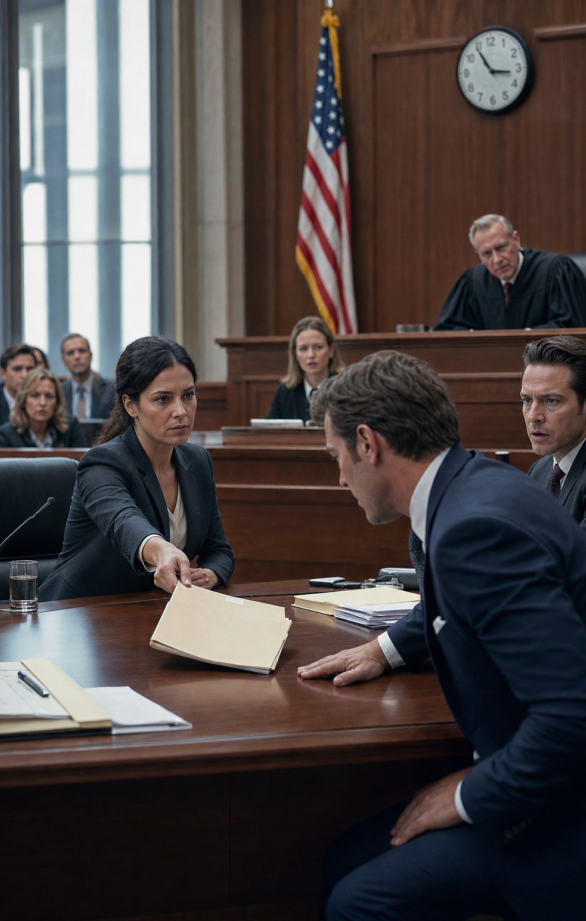
I slid the folder across the table.
I said, “Your Honor, before anyone signs anything, I’d like to submit an exhibit.”
Craig’s smirk didn’t fall right away. It curdled slowly, the way milk turns, as the judge opened the folder and read the first page, and then the second, and then looked up over her glasses — not at me. At Craig.
She read the email thread aloud. She read the wire transfer. She read the appraiser’s own note confirming he’d been instructed to lowball the number, and with every line, the room got quieter, until the only sound was Craig’s attorney whispering something urgent that Craig wasn’t hearing.
The judge set the folder down very deliberately. She said the appraisal was stricken. She ordered a new one from a court-appointed appraiser at Craig’s expense. And then she said the sentence that changed the shape of my ex-husband’s next several years: “Counsel, I’m referring this matter to the district attorney’s office. Mr. Reyes, you’ll want to speak with your attorney about that.”
The house came back at four hundred and thirty-one thousand. My share nearly doubled. But that isn’t the part I think about.
The part I think about is walking back out to the sedan, and Lily looking up from her scarf and asking, “Did it go okay, Mom?” And me buckling her in and saying, “It went the way it needed to.” Because someday they’ll be old enough to understand what their father did, and someday they may ask me why I opened that folder, and I already know my answer.
I didn’t do it to punish him. I did it because when a man teaches you that the truth is negotiable, the only thing you can do — for yourself, and for the two kids in the back seat — is refuse to negotiate.
The new appraisal is framed in my hallway now, next to the pencil marks on the pantry door. Not the number. The date. The day I stopped being certain and started being sure.
Comments are closed.