The nurse held the phone up in front of me, and I heard a voice I had spent nine years pretending I’d forgotten.
Let me tell you the kind of man I was that night, so you understand exactly what she was up against.
I am Victor Hale. I run three companies. I do not go to emergency rooms. When my assistant called me at a dinner meeting and said a hospital had been trying to reach me about a “personal matter,” my first instinct was that it was a scam, or a lawsuit, or someone with their hand out. I almost didn’t go. I went only because she used a name I hadn’t heard in almost a decade, and even then I told myself I’d be in and out in ten minutes.
The Boston ER at night is not a place that cares who you are. I walked in with my coat over my arm, already annoyed by the noise and the smell of it. There was a commotion down one of the curtained hallways — staff moving fast, a monitor alarm, the particular hush that falls over people who work around death. I remember thinking, with the cold detachment I’d spent years cultivating, that it wasn’t my problem.
That’s when the nurse stepped in front of me.
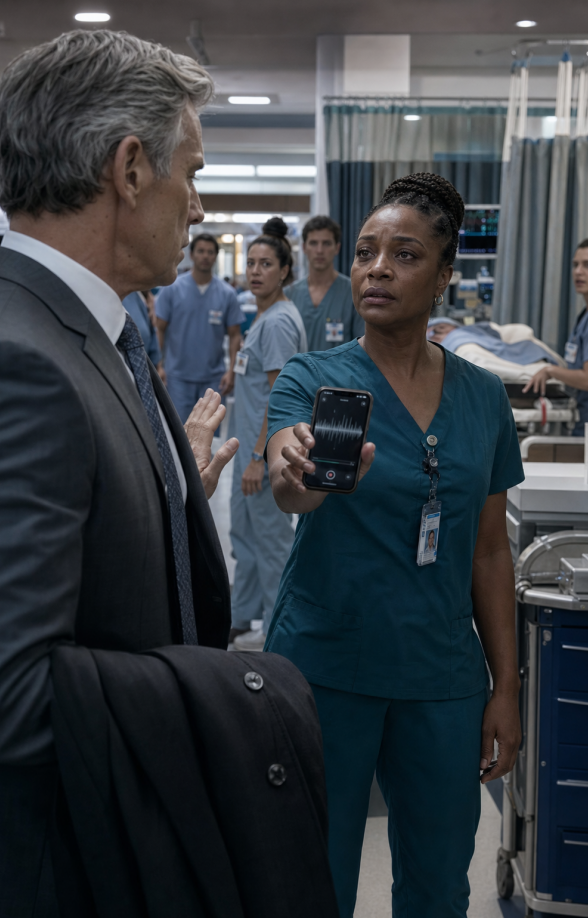
Her badge said Adaeze Bello. She had the kind of tired in her eyes that isn’t about one long shift — it’s about sitting with someone through the worst night of their life. She asked if I was Victor Hale. I said yes, impatiently, and started to explain that I was in a hurry.
She didn’t move. She just lifted her phone, pressed the screen, and held it up between us.
“She asked me to make sure you heard this,” she said. “She recorded it three weeks ago. In case you came.”
And then the voicemail played.
It was Rosa.
I hadn’t heard her voice in nine years, but it went through me like cold water. She sounded weak. She sounded like someone rationing her breath. And she said my name — not angry, not begging, just tired — and then she said the thing that made the entire ER tilt sideways around me.
“Victor. I’m not calling to ask you for anything. I stopped needing you a long time ago. I just need you to know one thing before I can’t tell you myself. His name is Samuel. He’s eight. He’s yours. And he is the best thing either of us ever did, even if you never knew he existed.”
The phone kept playing. I stopped hearing it.
Eight years old.
I did the math the way a drowning man grabs at anything. Nine years ago I had ended things with Rosa the way I ended everything back then — efficiently, coldly. She had come to me once after that, wanting to talk, and I’d had my office turn her away, assuming she wanted money. I never asked what she wanted to say.
She had wanted to tell me I was going to be a father.
And when I made it impossible to reach me, she had done the only thing her pride and her circumstances allowed. She’d walked away and raised him alone. No child support. No name on a form. No demands. She had carried the whole weight of it in silence rather than beg a man who’d already shown her exactly how little she was worth to him.
“Where is she,” I said. My voice didn’t sound like mine.
Nurse Bello’s face told me before her words did. “I’m so sorry, Mr. Hale. She passed about forty minutes ago. We kept trying to reach you. She held on as long as she could.”
Forty minutes. I had spent those forty minutes finishing my dinner and telling my driver to wait because I wanted to finish my wine.
I have negotiated deals that moved markets and felt nothing. And I stood in that hallway and could not make my legs work.
“There’s a boy,” I said. “She said there’s a boy.”
“Samuel is in the family room,” the nurse said. “His grandmother is with him. He knows his mother is gone.” She paused, and something in her hardened, just slightly, the way it does when a person has decided to say the true thing. “He doesn’t know about you. She never told him you didn’t want him. She told him his father was a man who worked very hard and lived very far away. She protected you, Mr. Hale, right to the end. Even from her own son’s anger.”
That was the part that broke me. Not the death. The mercy. She had every right to raise my son to hate me, and she had chosen instead to give him a father he could imagine loving.
I asked to see him.
Samuel was small for eight, with Rosa’s dark eyes and a cowlick exactly like the one I fight down every morning. He was sitting very straight in a plastic chair, the way children sit when they’ve been told to be brave. His grandmother looked at me and knew instantly who I was; I saw the recognition and the anger and the exhaustion move across her face all at once.
I didn’t know what to say to a child whose mother I had let die alone in the next room. So I told him the truth, which was the first honest thing I’d offered anyone in years.
“My name is Victor,” I said. “I knew your mom a long time ago. She was one of the bravest people I ever met, and I was too stupid to understand that until tonight.” My voice cracked. “I’d like to help take care of you now, if you’ll let me. However long that takes.”
He studied me with those eyes that were hers. “Are you my dad?” he asked.
I have never wanted to lie more, to spare us both. And I have never been more sure that a lie would dishonor the woman who’d protected me with the last message of her life.
“Yes,” I said. “I am. And I’m going to spend the rest of my life being sorry I wasn’t here sooner.”
That was two years ago. Samuel lives with me now. His grandmother is down the hall. I sold one of the companies. I go to the school plays.
And I kept the voicemail. I listen to it on the hard nights — to remember the sound of the woman who was better than me in every way that mattered, and who used her last breath not to curse me, but to hand me the son I hadn’t earned.
The coldest man in the room. That’s what they used to call me. I earned it. But it took a dying woman’s voicemail, played by a nurse who refused to let me leave, to teach me what that coldness had actually cost. Everything. And I never even knew I had it to lose.
Comments are closed.