My hand was already on the trackpad. I let it rest there a moment longer, watching the two of them on the camera tile, and then I began.
Let me back up, because the note is where this really starts.
My brother had died eight days earlier. Sudden, senseless, the kind of loss that hollows you out and leaves you moving through your own life like a guest in it. I was staying in our cramped city condo because I couldn’t yet bear the mountain lodge we’d built together — the Colorado place with the big windows and the porch where my brother and I used to sit. Weston knew all of that. He knew exactly where I was and exactly how broken.
So he chose that week to mail me a note.
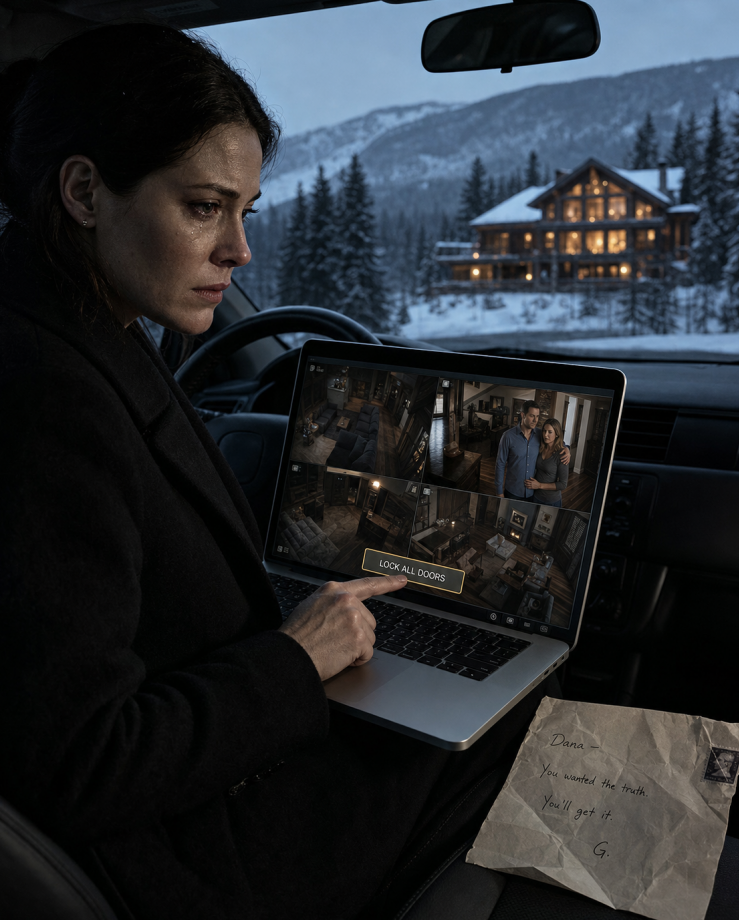
Not a text. A note, on paper, like a coward with time to plan. It said he’d be spending the season at the lodge with Camille, that I should “take the hint,” and that it would be “easier for everyone” if I stopped pretending the place was still partly mine. He signed it with his initial, the way he signed checks. As if I were a bill he was closing out.
He was very confident, my husband. Confident enough to install his girlfriend in our lodge and put it in writing. Confident because he thought he understood our marriage, our money, and our things.
Here is what he did not understand.
I built the security company that monitors that lodge. Not “worked for” — built. Fifteen years ago, before Weston, before any of this, I started a small firm that installs and remotely manages smart-security systems for high-end mountain properties. It grew. When Weston and I built the lodge, of course I wired it with my own company’s system — the best we offered. Cameras. Smart locks. Environmental controls. Full remote administration, and every bit of it registered, legally and technically, under my admin credentials. Not our joint account. Mine. The company’s.
Weston never thought about it. To him it was just “the app that unlocks the door.” To me it was a system I had root access to from any laptop in the world.
So on the night his note arrived, I opened my laptop, logged into the admin console, and watched my own cameras show me my husband carrying wine up the steps of a house I owned, for a woman who thought she was moving into her new life.
I did not scream. I didn’t call. I did something much calmer.
I checked the law first — I’m not reckless, and I wasn’t going to hand him a grievance. The lodge was marital property, yes, but the security system and its service contract were unambiguously my company’s, and I had every right to administer it. I documented everything: the note, timestamped photos of the feed, the account records showing sole admin rights. Then I made my decision.
I didn’t lock him out in the cold. I’m not cruel, whatever he’d become. What I did was quieter and, in the end, far more effective. I changed every access code on the property to codes only I controlled, disabled the credentials he’d been using, and set the system to require my authorization for entry. Then I called him — not to rage, but to inform.
“The lodge is on my company’s system,” I said. “Your codes have been deactivated. If you and your guest need to retrieve your belongings, you’ll schedule it through me, in daylight, with a witness present. This is documented. My lawyer has copies.”
There was a long silence. Then bluster. Then, when he realized I wasn’t bluffing and that every angle he reached for was already closed, something close to panic. The man who’d mailed a grieving widow a note telling her to “take the hint” discovered that the hint ran in the other direction.
The divorce came fast after that. It turned out the note — that smug little document he’d been so proud of — was a gift to my attorney: written, dated proof of his conduct and intent, in his own hand. Combined with the record of whose company secured and controlled the property, it did not go well for Weston. Camille, I’m told, moved on the moment the lifestyle she’d been promised evaporated.
I kept the lodge. I go up there now, sometimes, and sit on my brother’s porch, and it doesn’t hollow me out anymore. It steadies me.
People think power is money, or a good lawyer, or the nerve to shout the loudest. Sometimes it’s just knowing, quietly, that the doors of your own life answer to you. Weston spent our marriage certain he understood everything he owned. He never once considered that the thing he understood least was me. His cold little note was supposed to be the last word.
It was — just not his.
Comments are closed.