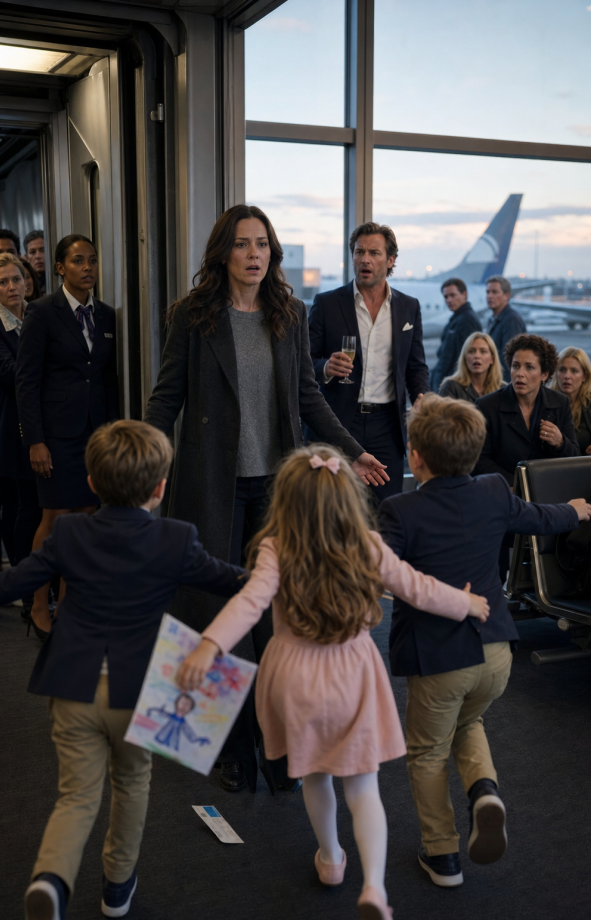
The eldest of the three children reached me first. She threw her arms around my waist and pressed her face into my coat and said the name — my name, the private one, the one only family ever used — and the whole jet bridge seemed to tilt beneath me.
I did not know these children. I had never, to my knowledge, laid eyes on them. And yet the little one, the four-year-old, was already reaching up with both arms in that trusting way small children have with people they’ve been taught to love, and the middle boy was crying, and the nanny was hurrying up behind them clutching a manila envelope and saying, over and over, “It’s her, it’s really her, we found her.”
Behind me, in the gold-lit cabin, Victor Crane’s toast died in his throat.
Let me go back, because you deserve to understand it the way I had to, in pieces, on that freezing jet bridge.
Two years ago I was married to a man I knew as David Hale. He was charming and generous and, I would learn far too late, entirely fictional. David Hale was one of several men that a person named Victor Crane had invented and then discarded as the law and his creditors got close. When the scandal broke — the funds that vanished, the investors ruined — David Hale “died.” A boating accident off the coast, a body conveniently never recovered. And in the wreckage of that faked death, Victor arranged for the story to settle on me: the reckless wife, the one who’d spent them into ruin, the woman who’d driven a good man to his grave and lost everything.
I believed a version of it myself. That is the thing about a lie told by someone who knows you: they build it out of your own worst fears. I spent two years apologizing to the world for a catastrophe I hadn’t caused, because the man who caused it had made sure his face was already in the ground.
What I did not know — what nobody told me, because I was the last person Victor wanted to have it — was that there were children.
Three of them. From an earlier life, an earlier woman, a marriage that predated me and that Victor had abandoned when it stopped being useful. When their mother died, custody did not go to Victor — a court had seen to that years before, when it emerged what kind of man he was. It went, by their mother’s own explicit instruction in a will Victor never thought to challenge, to the person she had named as guardian should anything happen to her.
Me.
She had chosen me. A woman she’d met exactly twice, in the brief window when Victor was pretending to be David and I was pretending along with him that we had a normal life. She had watched how I was with children at some forgotten backyard party, and she had gone home and written my name into the most important document of her life, because she trusted me with the thing she loved most and she did not trust him at all.
When she died, the estate’s lawyers began looking for me. And Victor — who had “died,” who was traveling now under yet another name, sitting in first class on this very red-eye toasting my ruin to a cabin of strangers — had spent months making sure they couldn’t find me, feeding them the same story he’d fed everyone: that I was unstable, unreachable, unfit. The nanny, who had loved those children and their mother, had finally tracked me to this flight through the guardianship attorney and simply gotten the children to the gate, praying I’d be on it.
So when Victor stood up in that cabin and pointed at me and called me “the woman who lost everything” — he did it because he’d just recognized me boarding, and panic makes cruel men theatrical. He was trying to make me small in front of witnesses before I could become dangerous. He did not know the nanny was already on the other side of that door with the children and the papers.
The eldest girl looked up at me on that jet bridge and asked, in the careful way of a child who has rehearsed a question, whether it was true that I was going to be the one to take care of them now.
I got down on my knees on that cold metal ramp, in front of a cabin full of people who had just laughed at me, and I said yes. I said yes before I understood a single legal detail, because some things you answer with your whole body before your mind catches up.
Victor was escorted off the plane by two very interested airport officers before I ever had to speak to him. The envelope the nanny carried had his newest alias in it, and a great deal more. The death he’d faked to escape a scandal turned out to be the thread that, once pulled, unraveled all of it — because a man cannot be legally dead and also fighting for custody, and the moment he tried to stop me from taking those children, he had to explain to a court how a dead man had opinions.
What the cabin did after I knelt down, and how three children who’d lost everyone came to call a stranger’s name across a jet bridge, and what it is to become a mother in an airport at dawn — that’s the rest of it, and I’ll tell all of it. But he called me the woman who lost everything, and he was so wrong it’s almost funny. I walked off that plane with more than I’d ever had.
Comments are closed.