Harlan Voss frowned when I met his eyes. Not alarm. Annoyance. The way you’d frown at a lamp that suddenly spoke.
“Something wrong?” he said, and the smirk was still there for his guests. “Did we run out of the good ice?”
I didn’t answer him in English.
I turned instead to the three men by the window — the partners who had flown eleven hours to be flattered, the ones who spoke to each other in low Italian when they thought no one at the party could follow. And in their language, clear and unhurried, I began to speak.
I told them about the account in the Caymans that did not carry Harlan’s name but carried his mother’s maiden one. I gave them the number. I told them about the shell company registered in a Delaware strip-mall address — the one that had “invested” in the luxury apartment two floors below us, the apartment no human being had ever lived in, the apartment that existed only to move money in a circle and call it revenue. I named the wire dates. I named the amounts. I told them which of the returns they’d been promised had never been earned by anything but paperwork.
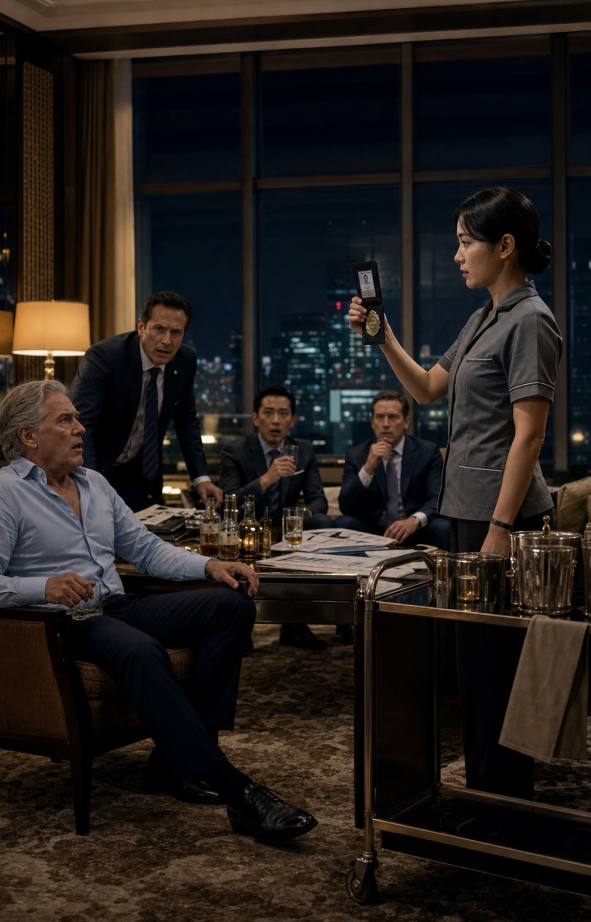
I watched their faces change. That is the part I will remember. Not Harlan’s face — his came later. Theirs. The slow understanding that the woman they’d been told was too dim to knock was reciting, from memory, in their own tongue, the exact architecture of the thing they’d nearly signed their fortunes into.
One of them set his scotch down very carefully, as if it had become fragile.
Harlan’s smile was gone now. “Who let this woman —”
“Ana Reyes,” I said, switching back to English so the whole room could hear it. “Thirty-four. Forensic examiner.” I reached into the pocket of the plain gray uniform he’d stopped seeing months ago and drew out the leather credential wallet. I let it fall open. The badge caught the light. The ID beside it had my photograph and a seal none of them had to squint at twice.
“Your auditors didn’t trust the numbers you were giving them,” I said. “So eight months ago they stopped asking you for numbers. They asked me to come get them.”
The silence in that penthouse was a physical thing. Forty floors up, you could hear the ventilation. You could hear one of the Italian partners exhale through his nose.
Harlan tried, the way men like him always try. He laughed — too loud. He said this was absurd, that I was some disgruntled hire, that he’d have me removed and sued and something else I didn’t listen to. He looked around the room for someone to laugh with him.
Nobody did.
That was the moment it turned, and I think he felt it. The men he’d spent the evening impressing were no longer looking at me like an intrusion. They were looking at him. They were doing math. They were remembering every word he’d said about the maid who couldn’t count, and they were understanding that the maid had counted everything, and that they were standing inside the record of it.
I didn’t gloat. I want to be honest about that, because the movies make these moments feel triumphant and it wasn’t, quite. It was mostly tired. Eight months of folding towels badly and smiling at nothing and carrying a phone with a second, locked life on it. Eight months of being nobody so that one night I could be exactly somebody, at exactly the right time.
The colleagues who’d been waiting in the lobby came up when I signaled. Quiet, polite, badges of their own. There was no shouting. Financial crime doesn’t end with shouting; it ends with laptops in evidence bags and a man being asked, courteously, to step away from the computer. Voss’s own laptop was still open on the sideboard, logged in, next to the tray of glasses I’d set down. He hadn’t thought to close it. Why would he? The maid was in the room.
By the time the sun came up, the shell company was frozen. Within the week, the apartment two floors down — the one nobody lived in — had a new kind of paper taped to its door. The overseas partners did not sign. They flew home and, I’m told, hired their own examiners to go through everything Voss had ever touched. The case my auditors had waited eight months to close, closed. Not with a bang. With a signature, on a form, in a beige office downtown.
Harlan Voss built his whole empire on one trick: he was very, very good at being underestimated in his youth, and so he spent the rest of his life underestimating everyone else. It worked for a long time. It works, mostly, until the day it doesn’t.
He asked me one thing, at the end, when the room had emptied and the polite men were packing the last of it away. He asked how long I’d known.
“Since the second week,” I said. “You told your assistant the towels didn’t matter because the maid was too simple to notice how many there were.” I picked up my cart out of habit, then remembered I’d never push it again. “I counted them every single day. I count everything. That was always the job.”
I took the elevator down alone — the private one, the one only three keycards could summon. I still had one. He’d handed it to me himself, months ago, without ever really seeing my hand.
I left it on the front desk on my way out, said goodnight to the doorman by name, and walked out into a perfectly ordinary morning, the folding finally, permanently, done.
Comments are closed.