The lawyer’s name was Mr. Okonkwo, and he’d drafted my father’s papers for thirty years. When I called him from that porch step, in my funeral coat, with my mother two hours in the ground and my key useless in my hand, he didn’t ask me a single question about my feelings. He asked me one thing: “Diane, are you standing on the property right now?”
I said yes.
He said, “Good. Stay there. Don’t argue with him. Don’t go inside even if he opens the door. Give me forty minutes.”
I want to explain how my husband got so bold, because it didn’t happen overnight. Marcus and I had been married eleven years. For the last three of them my mother was dying, slowly, of the kind of illness that eats a family’s time and money and attention until there’s nothing left over for anything else. I moved into her house to care for her. Marcus stayed in our condo across town, and somewhere in those long months of hospice and hospital beds, he decided that my absence was permission.
The woman worked in his office. I’d met her twice at holiday parties and thought nothing of it, because I was thinking about morphine schedules and whether my mother would know me the next morning.
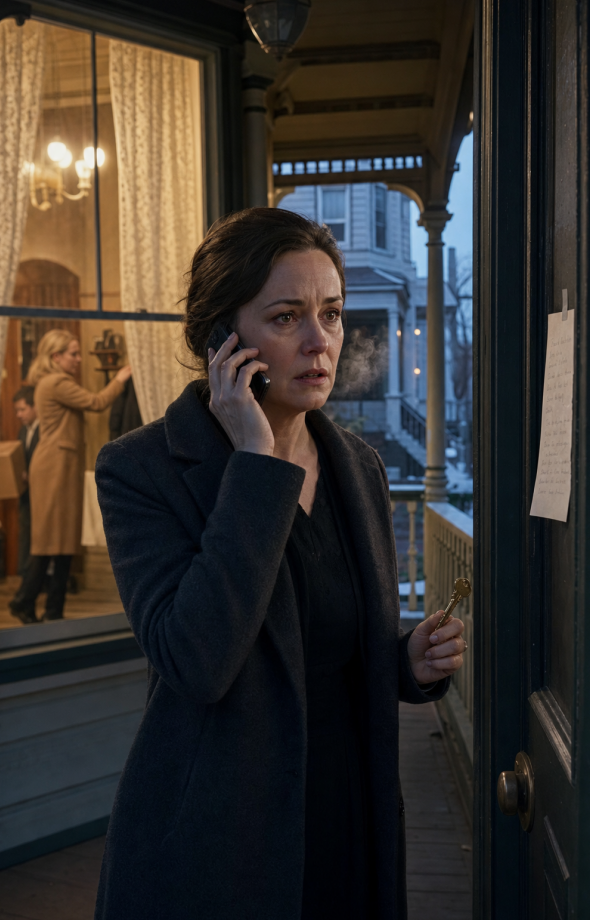
What Marcus knew, and assumed I’d forgotten, was that the Victorian belonged to my parents. What Marcus did not know, because he never once asked and I never thought to spell out, was the exact shape of how it belonged to me now.
My father was a careful man. He’d built a small contracting business with his hands and bought that house in 1978 a saved dollar at a time. He did not trust the idea of his life’s work slipping sideways into someone else’s hands through a marriage. Two years before he died, he sat me down at the kitchen table and told me he’d placed the house in a protective trust. My name was on it as the sole beneficiary and director. Not Marcus’s. Not “the couple’s.” Mine.
“A house like this,” he’d said, “people will try to take it. When they do, you call Okonkwo, and you let the paper do the fighting. You don’t have to raise your voice. The deed raises it for you.”
I’d nodded and half-listened, the way you do when a parent talks about the far-off unpleasantness of what happens after they’re gone. I never imagined the person trying to take it would be my own husband, and that the day I’d need those words would be the day I buried my mother.
So I sat on the step. Marcus came to the door at one point — not to open it, just to speak through it — to tell me that “this didn’t have to be ugly” and that I could “come get my things from the garage whenever.” Renata hovered behind him in my mother’s hall, under the light fixture my father had installed himself, and at least had the decency to look uncomfortable.
I didn’t say anything. Okonkwo had told me not to, and honestly, I didn’t trust my own mouth.
Forty minutes later, two things arrived at once. The first was Okonkwo himself, in a gray sedan, carrying a slim folder. The second was a marked security vehicle from the firm that monitored the neighborhood, because a protective trust like my father’s comes with instructions, and one of those instructions was who has authority over the property in a dispute.
It was me. It had always been me.
Okonkwo didn’t shout. He walked up the steps, helped me to my feet, and knocked on my own front door. When Marcus opened it, still wearing that expression of a man who believes he’s already won, Okonkwo handed him the top sheet from the folder and gave him ninety seconds to read it.
I watched my husband’s face change. I’d loved that face once. I watched it understand, line by line, that the house he’d changed the locks on was not his to lock, and that the woman sitting in the cold on the porch step was the only person on that block with the legal right to say who slept there that night.
“You can’t be serious,” he said. “We’re married.”
“You are married,” Okonkwo agreed pleasantly. “You are not, however, on this deed, this trust, or this title. Mrs. Keller is. She’d like her home back. Tonight.”
The security officer stepped forward. Not roughly. He didn’t need to be rough. He simply explained to Marcus and Renata that they had thirty minutes to gather personal belongings and vacate, and that anything they left could be collected later by appointment, and that the locks — the ones Marcus had so proudly changed — would be changed again before morning, this time by someone who worked for me.
Renata left first. She didn’t look at me. Marcus took longer, and made it ugly. He called me cold. He called the trust a trick. He said my father had always hated him, which was the first true thing he’d said.
When the porch light finally came on that night, it came on for me. I stood in my mother’s front hall, in the quiet, and I took down the camel coat Renata had hung there and set it outside the door, and then I locked it — with the old brass key that suddenly fit again, because a locksmith my family had used for forty years had come and made it fit.
I didn’t feel triumphant. I want to be honest about that. I’d buried my mother that morning and my marriage that evening, and the house was very quiet and very large around me. But I felt something steadier than triumph. I felt my father’s carefulness wrapped around me like a coat of its own.
He’d told me the deed would raise its voice so I wouldn’t have to. He was right. I didn’t have to say a word. I just had to sit on the step, and make one call, and trust the man who’d spent his whole life making sure that no one could ever take this from me — not even someone I’d promised to love.
The divorce was simple. There wasn’t much to fight over, because the one thing Marcus thought he was taking had never been his to take. He’d assumed the house was ours. He never checked. People like him never do.
I still live there. My father’s tools are still in the garage. And every time I turn that brass key, I think of him at the kitchen table, telling me exactly what to do on the worst day of my life.
Comments are closed.