He was looking at the photograph.
I’d woken up with my cheek against a stranger’s wool coat, a line of drool I will never fully live down, and the specific horror of a woman who has fallen asleep on someone she doesn’t know. I was already apologizing — I’m so sorry, thirty-hour shift, I never do this — and reaching to gather my things, when I realized he hadn’t moved. Not to shrug me off, not to shift away. He’d sat perfectly still the entire crossing so he wouldn’t wake me.
And now he was staring at the photo that had slipped out of my library book onto my lap. Two little girls on a wooden porch, squinting into an old summer sun.
“Where did you get this?” he asked. His voice was careful, like he was afraid of the answer either way.
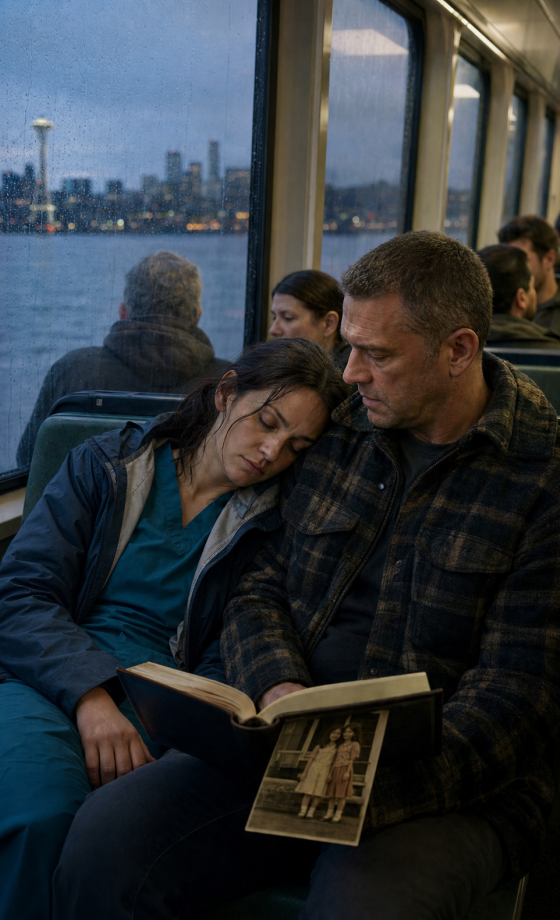
I told him the truth, because I was too tired to invent anything. The little girl on the left was Dana — my foster sister, the one good thing about a childhood I don’t talk about much. We’d landed in the same foster home when I was seven and she was six, two kids nobody had planned to keep, and we’d raised each other in the gaps the adults left. The photo was one of maybe three things I owned from that time. I used it as a bookmark so I’d see her every day.
The man — Grant, he told me his name was Grant — put his hand over his mouth and didn’t speak for a long moment. When he did, his voice had gone to pieces.
“The girl on the right,” he said. “That’s my sister.”
Here is what he told me on the rest of that crossing, and in the weeks after, as it all got confirmed by people whose job it is to confirm things.
Grant had been born into a family that fell apart before he could remember it. He and a baby sister had been separated in the system when he was small — different homes, different cities, and then the trail simply went cold the way trails did back then, before databases, when a caseworker’s retirement could erase a child’s history. He’d spent his whole adult life looking. He’d paid for searches. He’d sent DNA to every service that would take it. He’d made peace, the hard way, with the idea that he would die not knowing if she was even alive.
And the girl in my bookmark — the girl on the right, the one I’d never known the full story of, because Dana didn’t know it either — was her.
Dana had come into my foster home already a mystery, a little girl with almost no paperwork, a first name and a birthday and not much else. We’d never questioned it. Kids in the system don’t interrogate each other’s origins; you just close ranks and survive. I’d known Dana for thirty years. I’d been the maid of honor at her wedding. I’d held her firstborn. And I had never once known that the sweet gap in her history was a brother on the other side of it, still searching.
The photo did what a lifetime of official searches couldn’t. Grant recognized the porch — it was the last house they’d been in together, before they were split. He recognized the way his sister stood. And when I called Dana that night from the ferry terminal, shaking, and described the weathered man who’d sat frozen so as not to wake me, she went silent, and then she said a name — a name from a memory so early she’d assumed she’d invented it. A boy who used to carry her on his back. She’d told me about him once, years ago, and we’d both decided he was probably a dream.
He wasn’t a dream. He was on the 5:40 ferry, and he’d sat still for forty minutes because a photograph on a sleeping stranger’s lap had reached across fifty years and grabbed him by the throat.
They did the DNA. Of course they did the DNA — you don’t rebuild a family on a bookmark alone. It came back the way we all already knew it would.
Dana and Grant have a whole relationship now, the strange, tender, catching-up kind that people build when they’ve been handed back a person the world took from them. There are birthdays being attended. There’s a brother at the Thanksgiving table who spent decades not knowing if he’d ever have one to sit at.
And me? I’m the aide. The invisible one. The woman who cleans and lifts and disappears, who fell asleep on the wrong shoulder because her body finally gave out after thirty hours of caring for people who mostly forget my name.
Except I wasn’t invisible on that ferry. I was the bridge. The one overlooked person carrying, without knowing it, the single object that could lead a man back to the sister he’d lost.
He stayed frozen the whole crossing not to be kind, but because he’d already seen the girl in my photograph — fifty years ago, on that same porch, the day they carried her away.
Sometimes the person the world walks past is the one holding the thing everybody’s been searching for. I just happened to be asleep when I finally got seen.
Comments are closed.