I did not open the envelope at the funeral.
I waited until I was home, alone, sitting at the kitchen table where my husband used to leave his coffee ring on the same spot every morning. Then I broke the soft worn seal.
Inside was a single sheet in his handwriting, and a small brass key.
“If you’re reading this,” it began, “then it worked, and I’m sorry. I need you to trust me for about ninety more days. The woman at the funeral is not my wife. She was never my wife. You are. She’s part of how I stay alive long enough to finish this.”
I read it four times.
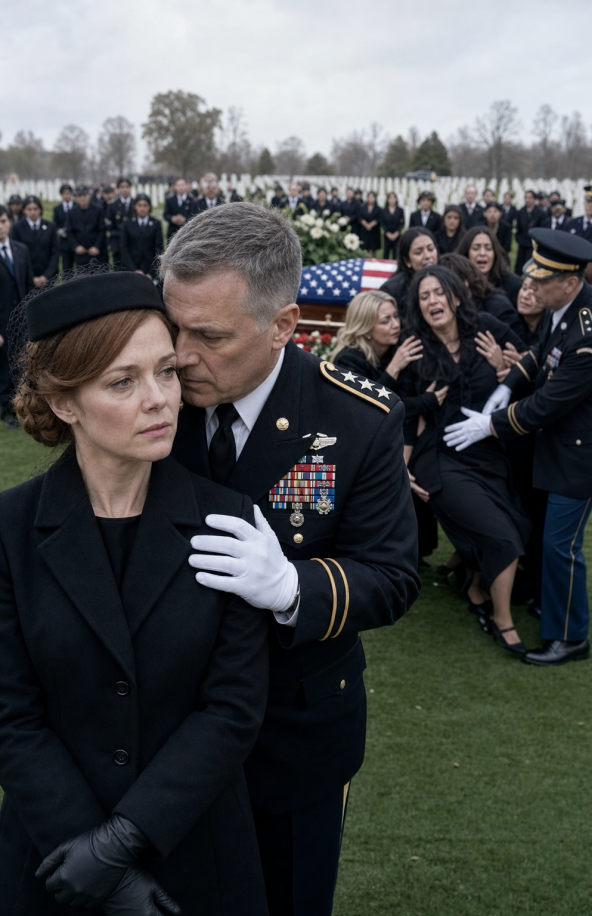
My husband, it turned out, had not been the logistics officer his paperwork claimed. For the last two years he had been cooperating with a federal investigation into a procurement network — people who sold falsified parts to the military and got men killed for margin. When they realized someone on the inside was talking, staying “dead” became the only way to keep breathing and keep testifying.
Vivienne wasn’t a mourner. She was a handler — placed to watch who showed up, who reacted, who might be a threat. The whole choreographed funeral, the couture grief, the empty casket, was a stage built to convince a very dangerous group of people that the leak had died and the trail had gone cold.
The brass key opened a safe-deposit box at a bank two towns over. The general’s instruction, relayed through the envelope, was simple: don’t run, don’t call anyone, live exactly like a grieving widow, and in ninety days someone would come to the door with the rest.
So I grieved in public for a man I now knew was alive.
It was the hardest thing I have ever done. Vivienne actually called me twice — sweet, probing calls, “just checking on you, you poor thing.” I let her hear a woman falling apart. I was good at it, because half of it was real. Missing him and pretending to bury him turned out to feel almost the same.
On the seventy-first day, the network’s indictments came down. I read the names in the newspaper over breakfast. On the eighty-eighth day, Vivienne’s calls stopped, and I learned later she’d been quietly detained crossing a state line.
On the ninetieth day, there was a knock at my door.
It wasn’t the general. It was him.
Thinner. Grayer at the temples. A scar near his eyebrow that hadn’t been there when I “lost” him. He stood on my porch in a plain jacket, holding nothing, because there was nothing left to hold up as proof except himself.
“I told you ninety days,” he said. His voice broke on the last word.
I did not run into his arms the way you’d think. I stood in the doorway and I cried — for the funeral I’d survived, for the flag I’d watched a stranger hold, for three months of being the woman no one would seat at the front.
Then I hit him once, hard, on the chest. And then I held on and didn’t let go.
There were consequences. The Army quietly corrected the record. The folded flag Vivienne had clutched for the cameras was, it turned out, never entered into any official ceremony — the real one, my husband told me, was still folded in a drawer at a base in Virginia, waiting for a day it would hopefully never be needed. The families of the men who’d died because of the falsified parts finally got names, trials, verdicts.
And me? The general came to the house one more time, in his dress uniform, and this time he did the thing he’d only been able to whisper at the back of the crowd.
He stood on my porch and he saluted me. Not my husband. Me. “For ninety days of holding a line most soldiers never have to hold,” he said. “Ma’am.”
We don’t talk much about that season now. My husband still flinches at bugles. I still can’t watch a folded flag on the news without my hands going cold. For a long time I kept the worn envelope in my nightstand, and some nights I’d take it out just to read his private spelling of my name, the one proof I’d had for ninety days that the man I loved was somewhere out there, choosing to come back.
But every so often, on a quiet evening, he catches me standing at the back of a room — a habit I picked up and can’t quite shake — and he crosses the whole floor, past everyone, and takes my hand, and walks me to the front.
Where I should have been standing all along.
Comments are closed.