The tail number was N-something I don’t need to write out here, but I had it memorized the way you memorize a phone number you dialed a thousand times as a kid. I’d read it off an accident report so many nights that the digits were burned behind my eyes. And there it was, stamped on a little placard by the galley of a jet I’d been sent to polish at three in the morning.
I stopped with the cloth still in my hand. I remember the hum of the cabin lights and the cold coming off the black hangar through the windows, and my own pulse suddenly loud in my ears.
Eleven years ago, my mother and my younger brother boarded a small charter flight out of a regional field. The plane never arrived. The official word was that it had gone down over water, that recovery was “inconclusive,” that sometimes small aircraft are simply lost. I was twenty-three. I spent years writing letters to agencies that answered with the same soft nothing, and eventually I did what people do when grief has no floor to stand on — I went quiet, took work I didn’t have to think about, and cleaned other people’s airplanes in the dark so I never had to sit still long enough to feel it.
I did not expect the plane itself to find me.
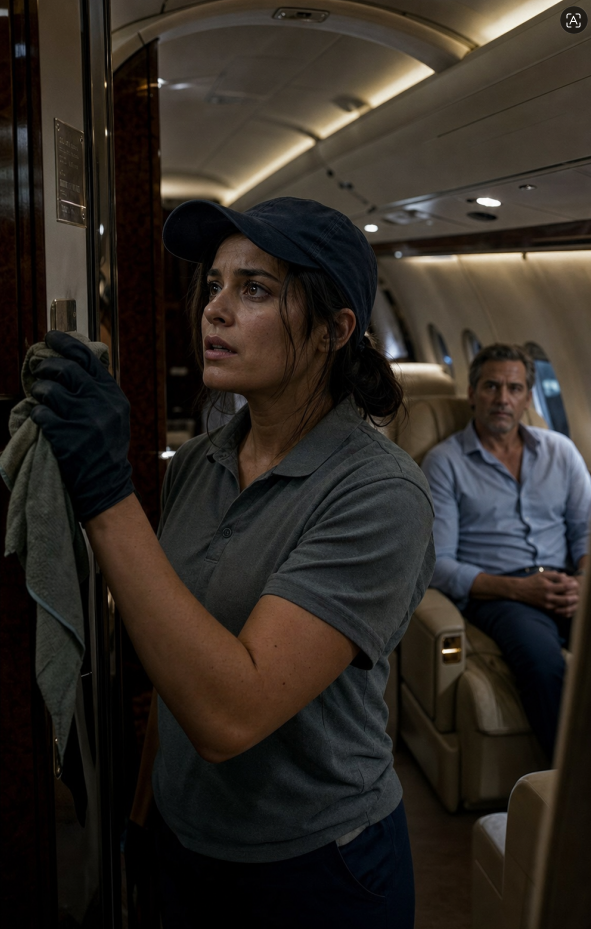
“You know that number,” a voice said from the back of the cabin.
I nearly dropped the cloth. I’d been told the aircraft was empty. But there was a man in the last seat, silver in his dark hair, his collar open, a stillness about him like he’d been sitting in the dark on purpose. Julian Hart. I know the name now. That night he was just a shape that had watched me work without my knowing.
“I’m sorry,” I said, the way you apologize on instinct when you’re the help and you’ve been caught feeling something. “I didn’t mean to—”
“You read the tail number and your whole face changed,” he said. “I’ve been looking at that number for a long time too.”
I should tell you what that plane was. It hadn’t crashed into any water. It had been re-registered, repainted, sold through a chain of shell companies, and flown for a decade under a new identity — and the reason a reclusive man had spent years and a great deal of money quietly buying it back was that his own family had been on a flight tied to the same broker, the same falsified manifests, the same little airfield that swallowed people and issued clean paperwork.
He’d been pulling one end of a thread. I’d been pulling the other. Neither of us had known the thread ran through the same rotten operation — a charter outfit that, years ago, had been moving more than passengers, and had learned that a “lost” plane asks fewer questions than a seized one.
I sat down. I wasn’t supposed to; you don’t sit in the cabin you’re cleaning, in the seat across from the owner. But my legs had stopped negotiating with me. And Julian Hart, who I would later learn hadn’t spoken more than a sentence at a time to anyone in years, started talking. He told me what he’d found. Records I’d been refused, he’d been able to buy. Names I’d never gotten, he had in a folder. And there was a passenger log — a real one, not the official fiction — with two names on a later flight that I had spent eleven years being told were at the bottom of the sea.
They hadn’t died the way I’d been told. That’s as much as I’ll put here, because the rest belongs to the people who lived it and to a case that isn’t closed. But the short truth is this: the story I’d been handed at twenty-three was a lie built to protect the men who ran that field, and the man watching me clean his jet had spent his fortune assembling the proof that the lie existed.
By the time the sky over the hangar turned gray, we had my cloth abandoned on a seat and his folder open on the table between us, and we were two strangers matching pages — my dates against his names, his flights against my letters. I kept saying “that can’t be right” and it kept being right.
I want to be careful not to make this sound like the movies. Nobody came running down a jet bridge. There was no music. There was a tired woman in a work polo and a tired man in a wrinkled shirt, in a cold hangar, discovering that they had each spent a decade of their lives refusing to accept the same official lie — and that between the two of them, they finally had enough of the truth to do something with it.
I still don’t fully understand why the shift got assigned to me that night, of all the crews, on that plane, of all the planes. Julian says it wasn’t chance — that he’d bought the aircraft specifically, that it was parked at that field specifically, and that the odds of the one cleaner in the country who’d memorized that tail number ending up in that cabin were so small they stopped feeling like odds. I don’t know. I’ve stopped needing the coincidence explained.
What I know is that I went to work that night to disappear into someone else’s wealth for eight hours, the way I always did, and I came out the other side of it with a partner in a search I thought I’d have to carry alone for the rest of my life.
The search isn’t over. But for the first time in eleven years, I’m not the only one pulling the thread — and the man in the back of the cabin, who everyone said had given up on people, turned out to be looking for the same lost family I was.
Comments are closed.