I sat there in that quiet room with the chart open on my lap and the afternoon light coming soft through the gauzy curtains, and I read the name on Eleanor’s wristband four or five times, because my brain kept refusing to make it mean anything.
Okafor.
My husband’s name. My name. The name on the chain around my neck.
It is not a common name where I live. I had never once met another person outside my husband’s own small circle who carried it. And here it was, printed on a hospital band, on the wrist of a seventy-nine-year-old woman I had been coaxing to eat for a week.
I told myself it was a coincidence. There are more Okafors in the world than the handful I married into. But my hands had gone cold, and Eleanor — who noticed almost nothing anymore — reached over and patted them, the way you comfort someone else’s grief before you understand it.
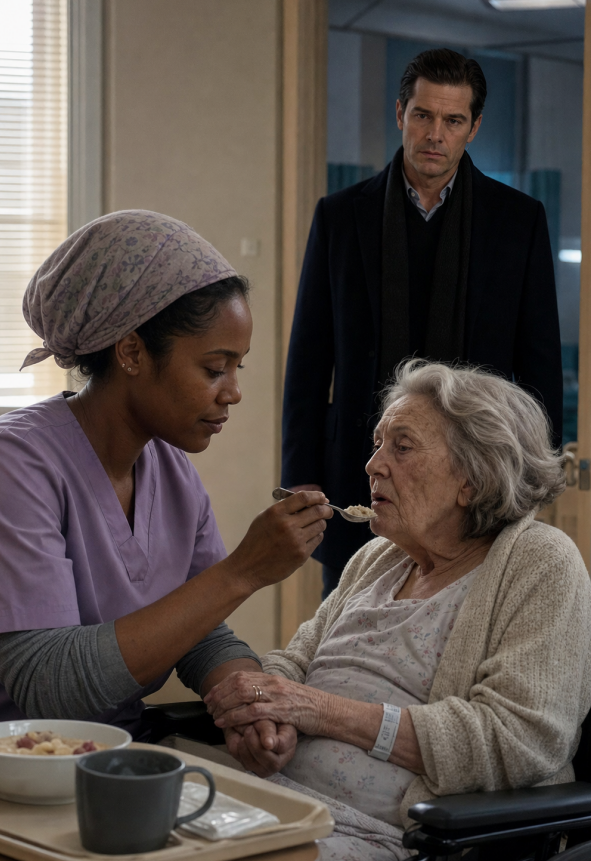
“You have kind hands,” she said. It was one of her clear moments. They came and went. “My son had kind hands too. Before.”
“Before what, Miss Eleanor?”
She looked at the window for a long time. “Before I let them tell me he’d married beneath us,” she said. “Before I let my husband cut him out of everything. Chidi. My Chidi. He changed his name after. Took my maiden name, Okafor, so he’d never have to carry ours again.” Her eyes filled. “I never met his wife. I was too proud. And then he was gone, and it was too late to be sorry.”
Chidi.
That was my husband’s name.
I had buried Chidi Okafor three years ago after a heart attack took him at forty-two, in a small service paid for out of my own savings, with almost none of his family there because he’d told me, always, that he didn’t have any family left worth calling. He’d said his parents were dead. He’d said there was no one. He’d said it so simply and so often that I’d stopped asking, because I could see it cost him something every time.
He had lied to me. Not out of cruelty. Out of a wound so old he couldn’t bear to press on it.
His mother was not dead. She was sitting in front of me in a lavender cardigan, mourning a son she’d let her husband disown, living out her last clear afternoons in a memory-care ward paid for by the very family that had thrown him away.
I don’t remember standing up. I remember the man in the doorway.
He had come in — actually stepped over the threshold for the first time in all the days I’d seen him haunting it. Julian. The son who owned half of downtown, the one who paid for the wing and never crossed into it. He was staring at the chain that had fallen loose from my collar when I stood, at the thin worn wedding band hanging on it.
“Where did you get that ring,” he said. His voice was wrecked.
“It was my husband’s,” I said. “Chidi’s.”
For a moment neither of us could speak. And then this quiet, powerful, terrifying man put a hand against the doorframe like the floor had shifted under him, and he said, “Chidi was my brother.”
I learned the rest in pieces, over the weeks that followed, in a hospital family room and then in Julian’s too-quiet house.
Their father had been a hard, controlling man who ran the family and everyone in it. When Chidi — the younger son — fell in love with a nursing student their father deemed beneath the family name, the old man gave him a choice: leave her, or leave with nothing. Chidi left with nothing. He gave up the name, the money, all of it, and he built a whole quiet life on the far side of the city where none of them could find him, and he married that nursing student.
Me.
Julian was the brother who stayed. Who inherited the empire and the guilt along with it. He’d spent years trying to find Chidi, to make it right, and he’d been three years too late — Chidi was already in the ground under a name none of them recognized, in a service none of them knew to attend. Julian hadn’t even known his brother was dead until I told him, standing in that ward with a chart in my hand.
And Eleanor — their mother — had slid into memory care around the same time, so that the two of them, mother and surviving son, had been circling the same grief without ever quite touching it. Julian couldn’t cross the doorway. Eleanor couldn’t hold a clear thought long enough to grieve. And into that frozen space the hospital had, by pure accident of scheduling, floated the one nurse in the building who happened to be the widow of the man they’d both lost.
Here is the part I keep coming back to.
Eleanor took food from me before either of us knew why. Before the wristband, before the ring, before any of it. Something in her wanted to be cared for by me specifically, some thread neither of us could name, and it turned out the thread had a whole family tied to the other end of it.
I never got to give Chidi’s mother the years she’d thrown away. But I got to give her the ones she had left. I stayed on that ward. On her good afternoons I told her about her son — the man he’d become, the father he’d been to our two kids, the way he hummed when he cooked, the fact that he’d been happy, truly happy, even without any of them. I think that mattered to her more than anything the money ever bought. She died the following spring with her hand in mine and Julian, finally, sitting on the other side of the bed.
My children have an uncle now. A grandmother’s grave to visit. A whole half of a story their father was too hurt to tell them.
I still wear the ring on the chain. But it doesn’t feel like the end of something anymore. It feels like a thread — the kind you follow, in a quiet room, in soft afternoon light, all the way back to the people you were supposed to find.
Comments are closed.