Cole waited until the whole table was listening before he said it.
That was always his way. My brother-in-law doesn’t insult you when it’s just the two of you. He waits for an audience, for the moment the plates are down and the wine is poured and the whole family is leaning in, and then he says the cruel thing with a grin so it lands like a joke and you’re the sourpuss if you don’t laugh.
“City softie,” he said, pointing his fork at me down the length of the harvest table. “Doesn’t know a vine from a fence post. Flew in from his little desk job to collect a check off land he wouldn’t know how to walk across.”
They laughed. Most of them. A couple of the cousins looked at their plates. My sister looked at me with an apology in her eyes she’d never say out loud, because she’s married to him and she has to live in that house after I fly home.
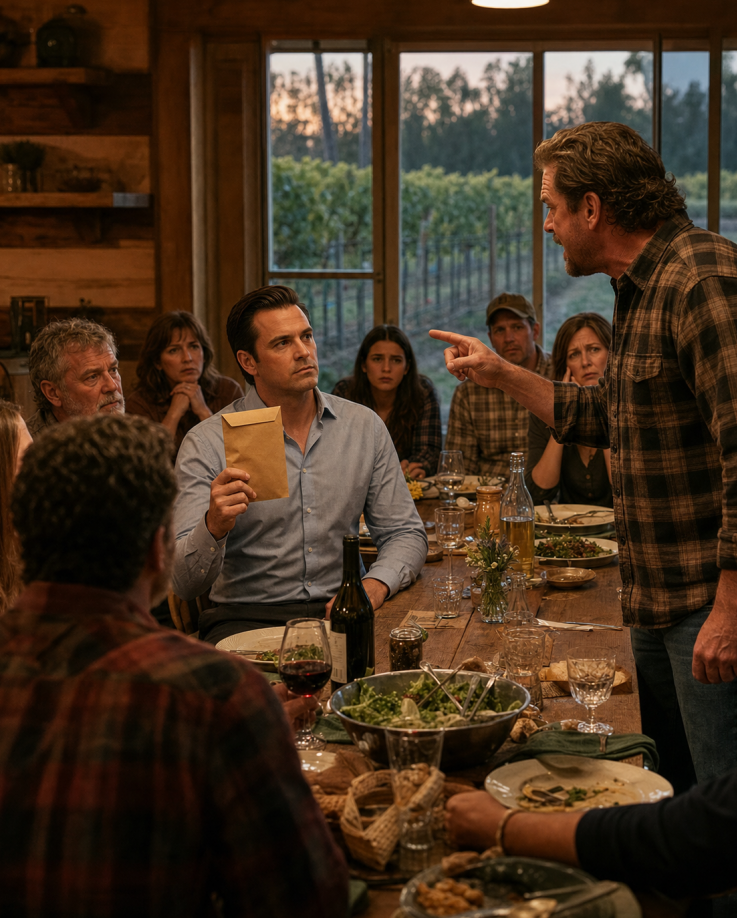
I’d come back to the vineyard for the first time in six years for the harvest dinner. My parents left the operation split between my sister and me when they passed, and Cole had run it since, and I’d let him, because I did have a desk job in the city and because it was easier than fighting a man who treats every conversation like a fistfight. I came back that fall because a letter from the county had crossed my desk. A letter I don’t think Cole knew existed.
So I let him have his laugh. I let him do the whole routine — the soft hands, the fancy shoes at a farm table, the son who left. I’ve learned that the loudest man at the table is usually the one with the most to hide, and Cole was very, very loud that night.
Then I took the folded envelope out of my jacket and set it on the table.
“You want to talk about who knows this land, Cole? Let’s talk about the water.”
Here is what I’d learned, sitting at my little desk job that everyone found so funny. Our valley runs on water rights — old adjudicated rights, filed by parcel with the county, worth more than the land itself, because in that valley land without water is just a place to watch grapes die. When my parents set up the estate, they didn’t split the water with the acreage the obvious way. They put the senior water right — the one the whole vineyard draws from, the one every vine on both parcels depends on to live — under my name. Mine. The city softie’s. Probably because they knew that whatever else happened, water was the thing worth protecting, and I was the one who read documents instead of talking over them.
Cole knew the vineyard needed that water. What he’d done about it was the part the county letter was about.
Two years ago, someone had filed a transfer with the county water district moving the senior right off my name and onto Cole’s parcel. The filing bore my signature. I had never seen it. I had never signed it. It was a forgery — a decent one, but a forgery — and the county, in the routine way counties do things, had sent a confirmation notice to the address of record. Mine. To my desk in the city. To the softie who wouldn’t understand it.
I read it three times the day it came. Then I pulled the whole file. And then I flew home for the harvest.
“This is a certified copy of a water-rights transfer filed with the county two years ago,” I said, and the table had gone very quiet, because even people who don’t understand water understand the word certified. “It moves the senior right — the water this entire operation drinks — off my name and onto Cole’s parcel. It’s signed by me.” I looked at him. “I never signed it, Cole. I’ve never seen it before the county mailed it to me. You want to tell everyone whose handwriting that really is, or should I let the district’s forensic examiner do it?”
I have never watched a man’s face fall the way Cole’s fell. The grin went first. Then the color. Then something worse than either, which was the understanding that every person at that table had just recalculated everything they thought they knew about the loud brother and the soft one.
Because here is what forging that transfer meant. It meant that for two years, every drop of water keeping his vines alive had been flowing under a filing that was a felony. It meant that the moment I challenged it — and I could challenge it, I was the actual holder — the transfer collapsed, the right snapped back to my name, and Cole’s whole parcel was one signature away from having no legal water at all. The man who called me a softie had built his entire operation on a crime that depended, completely, on me never reading my own mail.
My sister put her hand over her mouth. One of the cousins said, quietly, “Cole. What did you do.”
He tried, for about a minute, to bluster. To make it my fault for “hiding out in the city.” To make it a misunderstanding, a paperwork thing, something the family didn’t need to air at dinner. But the certified copy was on the table, and you cannot grin your way out of a forensic document examiner.
I didn’t file that night. I want to be honest — part of me wanted to, part of me had wanted to for six years. But my sister lives in that house. Her kids were at that table. So I did something Cole never once did for me. I gave him a way down that didn’t destroy the family, on my terms, in writing, with the water right restored to my name and an ironclad agreement about how it gets used going forward.
What those county records said about who really owns the water this vineyard drinks — and the deal I made the man who humiliated me sign before I’d agree not to file — is the part that changed which brother the family calls when something actually matters. Full story, and what Cole signed, is below.
Comments are closed.