He said my name first. Not Lily’s. Mine.
“Megan.” Just that. Barely a sound. Like a man testing whether the floor would hold his weight.
I don’t remember deciding to move, but I had Lily against me, one arm across her chest, backing us into the shelf of clearance paperbacks. My heart was doing something violent. Around us the store kept going — a register beeped, someone laughed near the cafe — and it felt obscene, all that ordinary noise, while the dead man in the green jacket stood six feet away with his glasses in his hand.
“You’re not real,” I said. It came out flat. Stupid. “You died. There was a casket. There was a—”
“There wasn’t.” His voice broke on it. “Megan, there wasn’t anyone in it.”
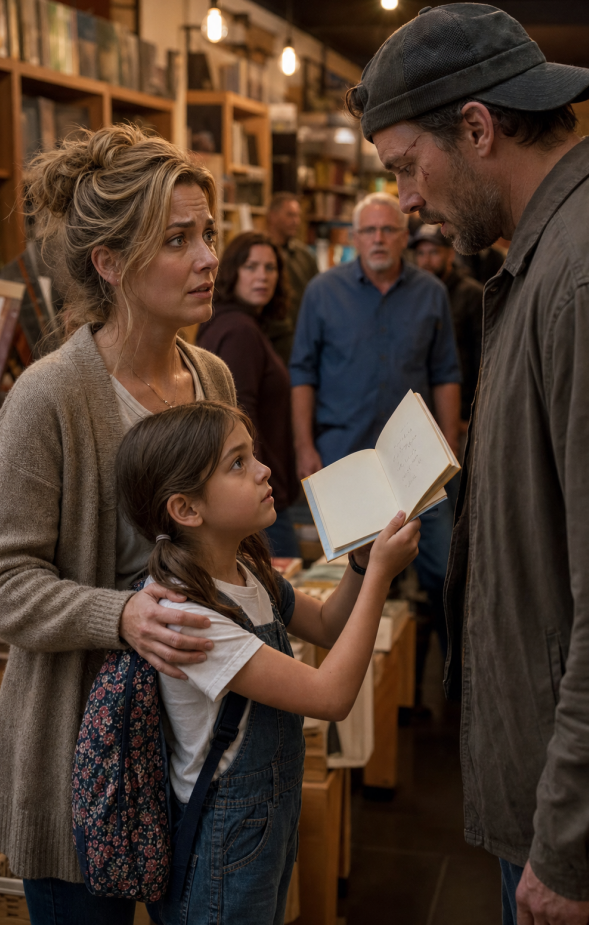
Lily twisted in my arms. She wasn’t scared. That’s the thing that undid me — my daughter, who woke screaming for a year, who drew our family with a gray smudge where her father should be, was not scared. She was reaching for him.
“Daddy, I kept the book,” she said. “I didn’t lose it. I kept it the whole time.”
And she held it up again, and this time he took it, and his hands were shaking so hard the pages fluttered. He opened the front cover. I knew what was written there because I had read it to her nine hundred nights. His handwriting. To my sweet pea Lily — no matter how dark it gets, turn the page. There’s always a next page. Love, Daddy.
He put his hand over his mouth and made a sound I had never heard a grown man make.
We ended up in his car in the parking garage because there was nowhere else that wasn’t full of strangers. Lily fell asleep against him within twenty minutes — just climbed into his lap and went out, like her body had been holding its breath for two years and finally exhaled. I sat in the passenger seat and listened to him tell me how a funeral gets faked.
It started with money. It always starts with money. A studio deal that went bad, a man Jesse borrowed from when the banks said no — the kind of man who doesn’t send letters, who comes to the house. Jesse said he came to the house. Once, when Lily was napping and I was at the store. Stood in our kitchen and said her name and her preschool’s name and the color of her car seat, and smiled, and left.
“I couldn’t tell you,” Jesse said. “If you knew, you’d have looked at every stranger the way you were supposed to look at nobody. He’d have known I told you. That was the whole — that was the leash. That I stayed quiet and stayed scared and kept paying.”
So he found another way to stop paying. There was a man he knew from the road, a fixer who owed him, who knew how to make a bus crash on a mountain road read like a tragedy and not a disappearance. Jesse said he stood on a hillside in the dark and watched the lights of the emergency vehicles and understood that from that second forward, the safest thing he could ever do for us was to be dead.
“The creditor stops hunting a dead man,” he said. “There’s no leverage in a widow who doesn’t know anything. You were safer grieving me than you’d ever have been loving me.”
I wanted to scream at him. I want you to understand that. I wanted to take that battered book and hit him with it. Two years. Two years of Lily’s gray drawings, of my mother flying in to sit with me because I couldn’t be trusted to eat, of teaching a child the exact shape of a loss that a living man had built on purpose and mailed to us like a gift.
But I looked down at my daughter asleep in his arms, at the color back in her face, and the scream just — died. Sat in my chest like a stone.
“Two years, Jesse.”
“I know.”
“You let her think she made you up. She stopped talking about you because she thought wanting you was making her crazy. Do you understand what that did to her? To me?”
“Every day,” he said. “I know exactly what it cost. I’ve been adding it up every single day.”
The creditor, he told me, is not a threat anymore — a federal case, other people, a name that went to prison eighteen months ago for things that had nothing to do with us. Jesse had been living four states away under a name he bought, working construction, and he’d driven back through Nashville because he couldn’t stop himself from being close, just once, to the city where we were. He was going to look at our building from across the street and leave. Instead he wandered into a bookstore to kill an hour, saw a little girl by the picture books, and forgot himself for one word.
Sweet pea.
Here is what I keep turning over, the part with no clean edge. He didn’t run because he was a coward. He ran because a man told him our daughter’s car-seat color in our own kitchen, and he decided the only love he had left to give was to take himself out of the picture. That is either the most selfish thing a person can do or the least, and I have not, in all the weeks since, been able to decide which.
We are not a photograph on a mantle anymore. We are also not a family that fits back together like nothing broke. Lily has a father again, and she also has a hundred questions no seven-year-old should have to hold, and some nights the joy of him is so tangled up with the fury that I can’t tell them apart. There are lawyers now. There is a therapist’s office with a fish tank where my daughter is slowly learning that she was right — that she did not make him up, that her memory was not the enemy, that the world lied to her and she was the one telling the truth all along.
He reads her the book again now. Same words. There’s always a next page.
I believe that. I have to. I just didn’t know the next page would cost us the two years we spent thinking there wasn’t one.
Comments are closed.