I stood up.
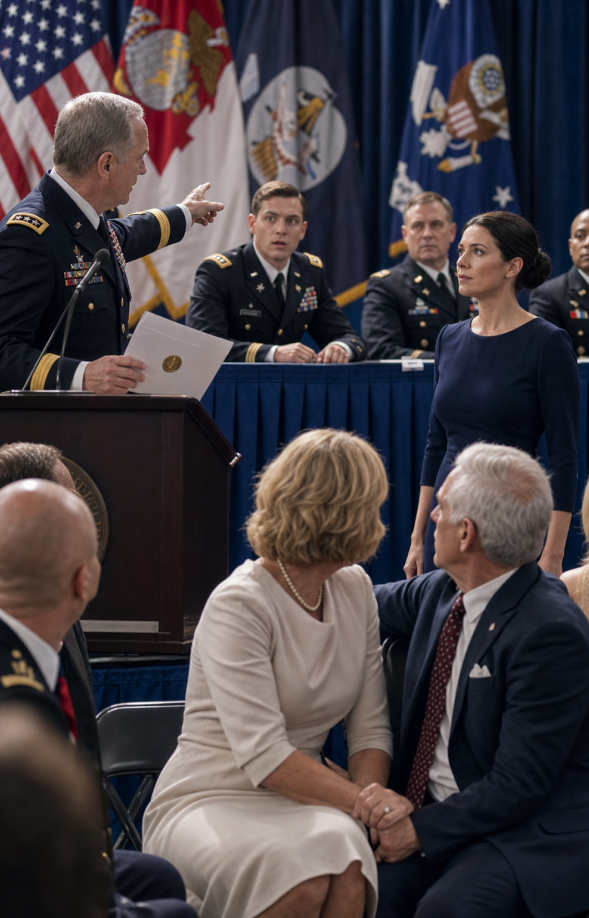
The whole ballroom had turned to find Captain Nadia Brooks, and for one strange, weightless moment I let them look — my mother with her warning still dying on her lips, my brother turning from the stage, a room full of generals and senators craning to see the woman in the plain civilian dress in the back rows.
Then I walked to the front, because when a commanding general calls your name, you go.
Let me tell you what my family never knew, because it explains the whole silent ballroom.
For eleven years I’d served in a capacity I was not allowed to discuss. When my relatives asked what I did, I said “government work” and let their eyes glaze over. When they decided that meant something small — paperwork, a desk, a job that didn’t matter — I let them believe it. It was easier than the truth, and most of the truth was classified anyway. I couldn’t have corrected them without breaking the law, so I let them build their little story: Devin the achiever, Nadia the one who “didn’t do much.”
The operation General Reyes was about to reference had been declassified only weeks before. I hadn’t told anyone. I wasn’t even sure I’d attend the ceremony — until I learned Reyes would be presiding, and I understood, with a sinking and then soaring feeling, what he intended to do.
He waited until I reached the podium. Then he turned to the room.
“Before we close,” he said, “there’s a matter of a citation that has waited three years to be read in public, because until recently it could not be. Captain Brooks led a joint operation that saved the lives of forty-one people, most of whom will never know her name. She did it without recognition, without acknowledgment, and — I’m told — without ever once mentioning it to her own family.”
I heard my mother make a small sound.
He read the citation. I won’t reproduce the parts that still shouldn’t be printed, but he read enough: the commendation, the specifics that could now be spoken, the line about “conspicuous courage and leadership under conditions of extreme risk.” He opened the velvet case and pinned the decoration to a woman her family had told, that very morning, not to embarrass them.
When he finished, the room stood. Generals. Senators. My brother, in his dress uniform, on his feet with tears standing in his eyes. And my mother — my mother, who had smoothed Devin’s collar and not mine — stood too, both hands pressed to her mouth.
The applause went on longer than was comfortable. I let it. Not out of pride, exactly. Out of something closer to vindication for every family dinner I’d sat through as the disappointment, every “some government job” said with a little shrug, every time I’d swallowed the truth because I wasn’t allowed to defend myself.
Afterward, my mother reached me before I could leave. She didn’t have words at first. When she found them, they were the right ones: “I spent thirty years not asking. I’m so sorry I never asked.”
“You couldn’t have known,” I said, and meant it. “I couldn’t tell you.”
“But I could have believed there was something worth knowing,” she said. “I chose to believe there wasn’t.”
That was the truest thing anyone in my family had said to me in decades.
Devin hugged me so hard he lifted me off the floor. On his promotion day — the day that was supposed to be his — he told everyone within earshot that his big sister was the reason he’d joined at all, even when he “didn’t know the half of it.” He does now. Most of it, anyway.
I didn’t embarrass them. That’s the part I keep coming back to. My family walked into that ballroom afraid I’d make a scene, and walked out having learned that the daughter they overlooked had been quietly carrying something they never bothered to imagine.
I think about that a lot now — how a whole family can decide who you are and never once check their work. It took a general with a citation to make them look again.
I never needed the room to know. But I won’t pretend it didn’t heal something, standing there while a general said out loud what my own family never thought to ask — that the invisible one had been the one who mattered all along.
Comments are closed.