The four-star general’s name was Harlan Okafor, and the last time I had seen him it was in a briefing room with no windows, on a base whose name I am not allowed to write, at the end of an operation my father-in-law does not know happened and never will.
He crossed that parade ground in a silence you could feel in your teeth. Hundreds of people who had just watched me be marched toward the gate now watched a man with four stars on his shoulders walk past the reviewing stand, past Brigadier General Voss, past the whole chain of command Voss had spent the morning weaponizing against me — and stop in front of a captain being held by two MPs.
He looked at the young corporal gripping my left elbow. “Son,” he said, not unkindly, “take your hand off the officer.”
The corporal let go so fast you’d have thought I was on fire.
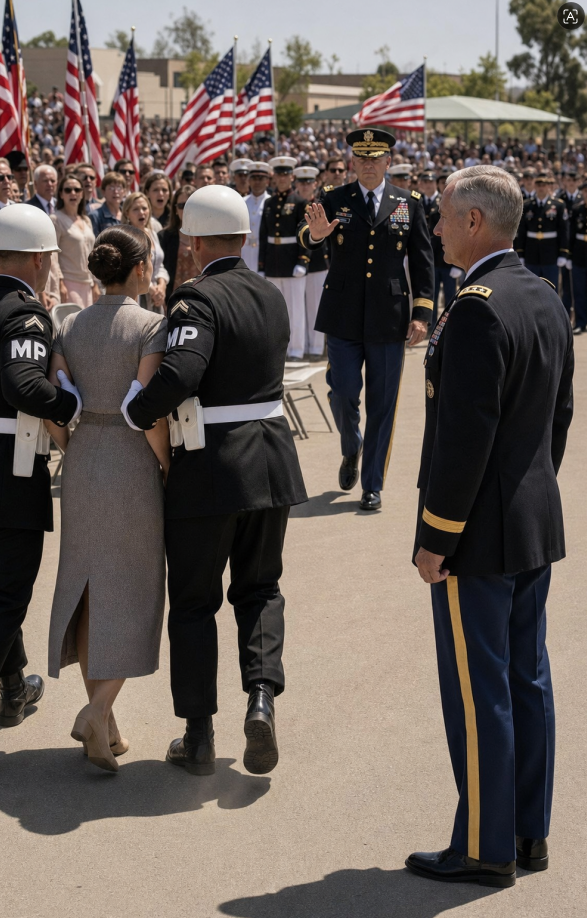
Then General Okafor leaned in, close enough that only I could hear, and said the thing I have carried in silence for three years: “The convoy that made it out of the valley made it out because of you. Forty-one people are alive who read your name in a report they’ll never be allowed to declassify. You don’t have to stand here and take this.” And then, straightening, in a voice that carried all the way to the bleachers: “Whose idea was it to escort this officer off my ceremony?”
My ceremony. Because he was the reviewing officer that day. Because the event my father-in-law had chosen to humiliate me at was, of all the days in the year, the one where the man who knew exactly what I’d done had come to pin something on someone else’s chest entirely.
Voss’s face did a thing I will remember for the rest of my life. He started to explain. He got as far as “General, this is a private family—” before Okafor cut him off with a look.
“You marched a decorated combat officer off a parade ground in front of her own soldiers,” Okafor said, “on a matter you’ve just called private and family. You want to tell me which regulation covers using military police to settle a domestic grudge? Because I know all of them, General, and none of them do.”
Here is what my father-in-law never understood. He thought “overlooked” meant “beneath him.” He looked at a woman who didn’t talk about her deployments, who let his stories go unchallenged at dinner, who absorbed his contempt without firing back, and he decided the silence was proof there was nothing behind it.
The silence was clearance. The silence was the whole point. There are jobs you do that you never get to talk about, medals you earn that get logged in a safe instead of pinned to your chest, and you learn to let people think what they want because the alternative is worse. Voss mistook my discipline for weakness for years. He built his entire picture of me out of the spaces where the classified parts used to be.
General Okafor turned to the two MPs. “This officer will be escorted, all right,” he said. “To the reviewing stand. She’s going to stand up front where she belongs, and the rest of us are going to figure out how a brigadier general confused his daughter-in-law’s marriage for a chain of command.”
They didn’t march me to the gate. They walked me to the front.
My husband found me afterward, ashen, having watched the whole thing from the family section without knowing any more than his father did about what I actually did for a living. He asked me, quietly, why I’d never told him. I told him the truth: that I couldn’t, that I still can’t, that loving someone in this line of work means handing them a version of you with whole chapters blacked out and asking them to trust that the redactions aren’t lies.
Voss faced a formal inquiry into the misuse of military police. He is not, as of this writing, still wearing the rank he was so proud of that morning. I take no pleasure in that. I take a great deal of pleasure in this: forty-one people are alive, and one of them named his daughter after the officer in the report he was never allowed to read.
What General Okafor said to me in private after the ceremony, and what I finally decided to tell my husband about the years I can talk about, and the one thing I’ll carry to my grave unsaid — that’s the rest of it. But the corporal who said “I’m sorry, ma’am” found me at the gate later and said something else. He said, “I knew it was wrong, ma’am. I just didn’t know how wrong until he made us do it in front of everybody.” I told him the same thing the General told me. You don’t have to stand there and take it. Pass it on.
Comments are closed.