The word was “brother.”
Not a name I recognized, not at first. Just four letters, blinked out over and over against the leather alphabet card the night nurse had left face-up on the nightstand, as if she’d never once believed he could actually use it. B. R. Long pause. O. His eyes dragging back to the start when I lost the thread, patient in a way that terrified me, because patience like that only comes from a mind that has been trapped and awake for a very long time.
I had married Julian Ashford eleven hours earlier in a chapel that smelled of lilies and money. My father’s debts had done that. Somewhere in the fine print of a settlement I was never allowed to read, a marriage had been offered as collateral. Marry the injured heir, keep the family’s caretaking respectable, and my father’s name stayed out of the courts. Julian, they told me, would never know anything again.
They were wrong about that, and they had built their entire plan on being right.
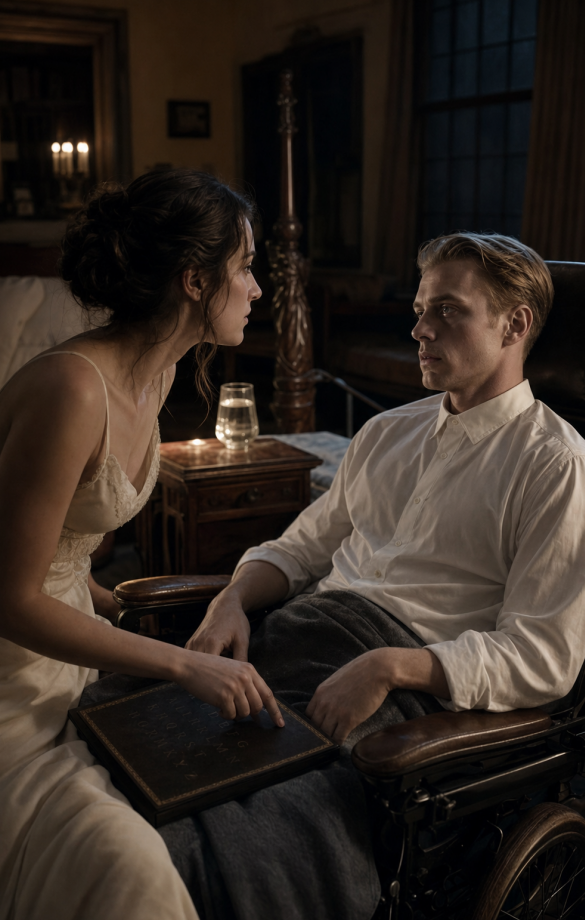
I had come up to that cavernous bedroom only to sit, because I couldn’t stand to be downstairs among his family and their careful, satisfied faces. I’d sat by his wheelchair near the dark windows and said the truest thing I had, which was that I was sorry. That I hadn’t wanted this either. That the moment my father was safe, I would leave and take nothing, because I would not spend my life being paid to guard a man like a piece of furniture.
That was when his eyes moved. Not the vague drift the nurse called “reflex.” They locked onto mine, and they were awake, and they were begging.
It took most of that first night to get the system working. Blink for the letter I landed on. Two fast blinks for yes. The family had a doctor who came Tuesdays and pronounced him unchanged, and I would later understand he was chosen precisely because he never looked closely enough to notice a man clawing his way back to the surface one muscle at a time.
“Brother,” he spelled that first night. Then his eyes went to the door and back, urgent. Jason.
Jason Ashford was the cousin who managed everything — the trust, the medical staff, the house, who was allowed into this room and when. He’d shaken my hand at the wedding and called me “a blessing for the family.” He had signed, I would learn, the papers naming himself trustee of Julian’s fortune “for the duration of the incapacity,” a duration he had every reason to make permanent.
The crash had been eighteen months earlier. A single car, a wet road, no other vehicle, brakes the report called “worn.” Julian blinked me the rest of it over the following week, letter by exhausting letter, while I pretended to the household that I was simply a devoted new wife who liked to read aloud with the door closed. He spelled that the brakes had been fine that morning. That he’d had them checked. That the last face he’d seen clearly in the hospital, before the sedation that never quite lifted, was Jason’s, telling the doctors the family would “handle everything from here.”
He wasn’t in a coma. He never had been. He was being kept under — sedated into stillness by an IV regimen the “doctor” adjusted every Tuesday, kept just submerged enough that his slow recovery looked like no recovery at all. And my marriage was the last piece Jason needed: a grateful, indebted wife who would sign whatever was put in front of her and make a slow theft look like family love.
I did not sign anything.
Instead I did what a woman with nothing to lose does. I learned the medication schedule. I learned which drip fed which hour. And I started, very carefully, doing the one thing no one expected the disposable bride to do: I started keeping him awake.
I skipped the evening doses when I could reach the line unseen. I told the household he seemed restless and I wanted to sit with him longer. I brought a cheap voice recorder from a drugstore in town and hid it in the folds of the blanket over his knees, and every Tuesday when the doctor came and Jason came to murmur about “no change, sadly, no change,” I let it run.
It took three weeks. Three weeks of Julian surfacing hour by hour, of his voice coming back in a cracked whisper that the first time made me press my own hand over my mouth so the house wouldn’t hear me sob. Three weeks of a recorder catching Jason telling the doctor to “keep the dose where it is until the trust vests,” and the doctor fretting that the muscle tone was getting hard to explain.
The night the trust was set to vest, the family gathered downstairs the way families gather around money. Jason came up himself, all warmth, to walk the grateful wife down to sign beside the incapacitated husband’s proxy and make it all legal.
I told him Julian wanted to be there. In his chair. That I’d promised.
Jason humored me, because humoring me cost him nothing. They wheeled Julian into the study where the lawyers waited. And in front of all of them I set the little recorder on the table and pressed play, and Jason’s own voice filled the room describing exactly how long he intended to keep his cousin drowned.
Then Julian lifted his head — the head that hadn’t moved in eighteen months as far as any of them knew — and in a voice like gravel and daylight he said his cousin’s name, then mine, then, “I’ve been awake the whole time.”
Jason had built his entire plan on the certainty that the injured man could not speak and the indebted woman would not. He was wrong on both counts, and those were the only two counts that mattered.
The trust never vested to him. The Tuesday doctor lost his license. And I stayed — not because a settlement required it, but because somewhere in three weeks of blinked letters in the dark, the arrangement I’d been sold into had quietly become the one thing in my life I’d actually choose.
The word he blinked, over and over, until I understood, was never really “brother.” It was the warning that came after it. But I’ll always think of it as the first word my husband ever said to me.
Comments are closed.