He called me “Ms. Marchand, the owner.”
Four words, spoken warmly across a room full of candlelight and brass, and I watched them land on my fiance like a physical blow.
Beau set the champagne bottle down. Camille’s laugh died in her throat. And Beau stood up too fast, knocking the table, and came toward me with his hands already spreading into that helpless charming gesture I had watched him use on waiters and traffic cops and, for two years, on me.
“Jo,” he said. “Baby. This isn’t — she’s a client, we’re celebrating a deal—”
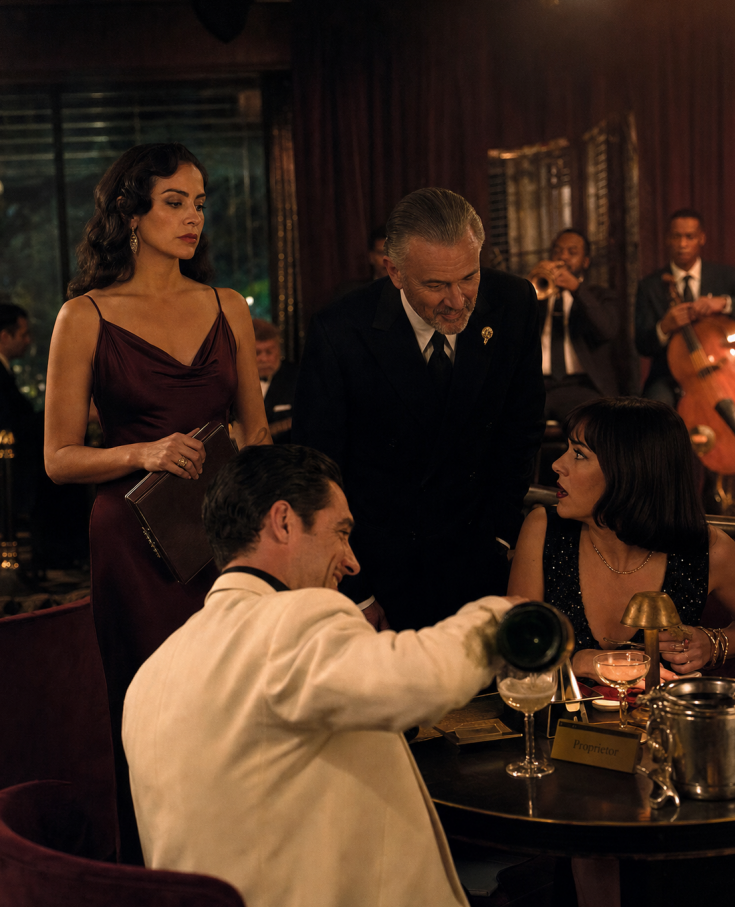
“Sit down, Beau,” I said. I didn’t raise my voice. I didn’t have to. In my lounge, when I speak, the room quiets, and it quieted now, and he heard it quiet, and I watched him finally understand the size of what he’d walked into.
Toussaint stayed at my shoulder. I’d told him two weeks ago, the night the accountant called me, that there would be an evening like this one, and to be ready. He was ready. He always is.
I sat down at the booth uninvited, across from the two of them, and I set my slim leather portfolio on the table between the champagne bucket and Camille’s spilled glass. I opened it slowly. I wanted him to watch.
Inside was the paper trail. The family loan, three hundred thousand dollars, money my grandmother had left in a trust for the express purpose of, in her words, “helping the children start their lives.” Beau had asked to manage it. I’d let him, because that is what you do when you love someone, you hand them a piece of your trust and you hope. The statements showed exactly where it had gone. Not into the investment fund he’d described in such loving detail. Into a business registration for a cocktail bar on Frenchmen Street. Owner of record: Camille Doucet.
“You used my grandmother’s money,” I said, “to buy her a bar.”
Camille, to her small credit, went pale and looked at Beau like she was seeing him for the first time. “You said it was yours,” she said to him. “You said it was your money.”
“It was going to be ours,” Beau said to me, and there it was, the whine under the charm, the sound a cornered man makes. “I was going to pay it back before you ever—”
“Before I ever noticed,” I finished. “Because I’m just the pretty one who doesn’t understand money. That’s what you always said. To me, to your friends, to her, probably.” I closed the portfolio. “You were half right. I don’t spend much time explaining myself. That’s not the same as not understanding.”
I’d like to tell you there was a scene, shouting, something cinematic. There wasn’t. There is nothing more devastating to a performer than an audience that simply stops watching. I stood up. I nodded to Toussaint, and two members of my security staff, men Beau had walked past a hundred times without ever registering, materialized at the ends of the booth.
“Beau’s tab is closed,” I said to the room’s staff, my staff. “He doesn’t have a reserved table here anymore. He doesn’t have a reserved table anywhere I own, and I own more than you’d think.” I looked at Camille. “Your bar’s lease is held by a company. I bought that company on Tuesday. We’ll talk in the morning, when you’ve thought about which of you actually lied to whom.”
Then I walked back to my table in the shadows, the one nobody knows is mine, and I let my manager pour me a glass of the good stuff on the house, because it is, after all, my house.
The money came back. Lawyers made sure of it, quietly, the way I do everything. Beau sent seventeen text messages the first week and four the second and then, mercifully, none. Camille, it turned out, hadn’t known the money was stolen. We reached an arrangement about the bar that was fairer to her than she expected, because my grandmother also used to say that the woman is rarely the enemy, and I have found that to be true more often than not.
I’m not engaged anymore. I’m not heartbroken either, which surprised me. Mostly I feel the way you feel when a long draft you couldn’t locate finally stops, when you realize how cold you’d been only once the room goes warm.
I still stand at the edge of my lounge some nights, unseen in the amber light, watching people be who they are when they think the owner isn’t in the room. It’s the best seat in the house. And now I know, better than I ever wanted to, exactly how much a person will reveal when they’re certain no one who matters is watching.
Someone always is.
Comments are closed.