For a moment I was sure I’d imagined it.
I’d been talking to Adrian Vane the way you talk to a wall you’ve grown fond of — softly, without expecting anything back — telling him the marriage meant nothing to me, that I only wanted to leave with my dignity when it was over. His eyes had been half-shut for an hour. His breathing hadn’t changed.
Then his hand closed over mine on the blanket, and he said it again, so quietly it barely disturbed the air.
“The amnesia isn’t real, Elena. Don’t look at me. The nurse is right outside.”
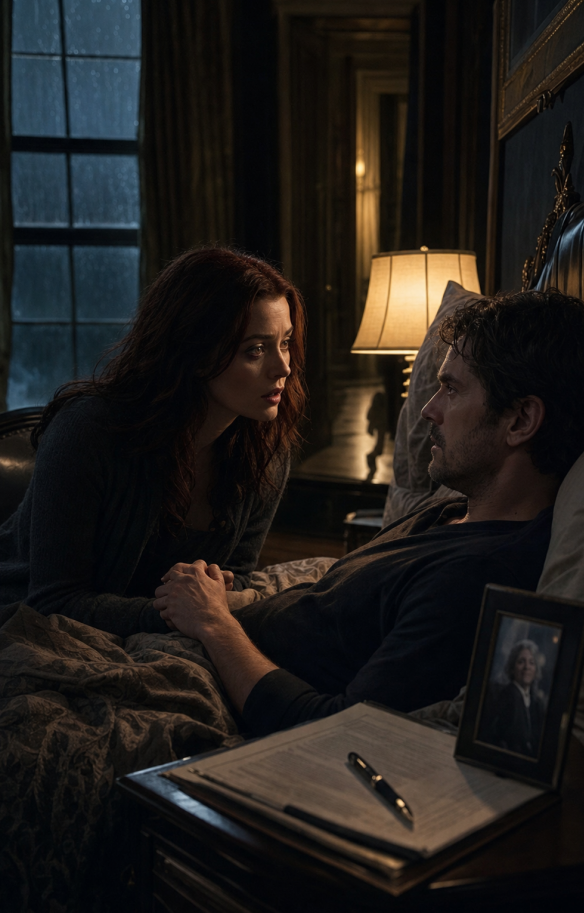
I froze with my back to the door. Through the crack I could see her shadow, the blue of her scrubs, the little glow of her phone.
“Smile,” he murmured. “Like I said something sweet. Fix my blanket.”
I don’t know why I obeyed. Six months of watching this family treat him like furniture, and the first time the furniture spoke I did exactly as it asked. I laughed a small nothing laugh and smoothed the blanket over his chest and leaned in as though I were only fussing.
“I’ve been awake the whole time,” he said against my ear. “Two years of it. I know what I signed this morning. I know what’s on that nightstand.”
My eyes went to it before I could stop them. The black-bordered card for his father — Died peacefully, the estate had printed, though no one who knew Charles Vane believed peace had anything to do with it. Beside it, the stack of transfer documents, half of them already bearing Adrian’s loose, drifting signature. And the fountain pen, capped, waiting for the rest.
“Your father,” I whispered. “Gregory told me he passed in the spring.”
“My father is in a private clinic in Montana under a name that isn’t his,” Adrian said. “Gregory told me the same thing he told you. He’s very good at funerals for people who aren’t dead.”
I sat down slowly in the bedside chair, because my legs had stopped being reliable.
“Every week they bring me papers,” he went on, lips barely moving. “They put the pen in my hand and they guide it and they tell the nurse I’m having a lucid stretch. Transfers. The shipping arm. The Baltimore terminal. Three trusts that used to have my name on them and now have a company that has Gregory’s. I sign them blind, because a man who can’t remember his own face has no reason not to.” His thumb moved once across my knuckles. “And a man who signs blind needs a witness who’ll swear he never understood a word of it.”
The floor of my understanding gave out all at once.
“That’s what I am,” I said. Not hurt. Just seeing it. “That’s why he paid my father’s debt. Not to care for you. To stand up in a courtroom someday and say the poor confused husband didn’t know what he was doing, so none of the signatures count and the estate stays clean.”
“You were supposed to be his insurance,” Adrian said. “I decided you were going to be mine.”
I should have been afraid. Part of me was. But under the fear was the first thing I’d felt in months that wasn’t shame — a hot, clean anger on behalf of a man I’d been paid not to see.
“Why tell me now,” I said. “Why tonight.”
“Because you meant it.” His eyes flicked open a slit, found mine, closed again. “When you told the wall you wanted to leave with your dignity. I’ve listened to a hundred people talk over me like I was already gone. You’re the only one who ever talked to me like I still counted. A person who wants their dignity back doesn’t sell someone else’s.”
Outside, the nurse shifted. A chair scraped. Adrian’s hand went instantly slack in mine, his face emptying into the blankness I’d spent six months mistaking for the whole of him.
“Everything all right in there?” she called.
“He’s resting,” I said, and my voice came out even, which surprised me. “I was just saying goodnight.”
When her shadow settled again, Adrian’s fingers tightened one last time.
“There’s a drive taped under the third drawer,” he breathed. “Copies of everything they made me sign, and the dates, and the times the nurse logged me as unconscious while I was signing. It doesn’t add up unless someone was moving my hand. That’s the proof. I couldn’t move it out myself without them noticing. But a wife tidying her husband’s room can.”
I understood then that he had waited two years, playing hollow through every indignity, not because he was weak but because it was the only card left in his hand and he meant to play it once, perfectly. And that he had just handed the whole game to a woman he’d known for six months, because she had been kind to a body she thought was empty.
I got the drive out that night, folded into the lining of my cardigan while I hummed and straightened the memorial card and told the nurse I’d sit until he slept.
The rest didn’t happen the way I’d have written it. There was no single dramatic morning. There were three months of me being exactly the vacant, agreeable wife Gregory had bought — smiling at his dinners, signing the visitor log, letting him believe his insurance was holding — while a lawyer Adrian named from memory built a case out of timestamps and bank routing dates.
Charles Vane came home in October, thin and furious and very much alive. Gregory’s expensive gray suits didn’t help him in the room where the timestamps were read aloud.
And Adrian, the night it was finally over, sat up in that same bed under his own power and looked at me with eyes that had stopped pretending.
“You could leave now,” he said. “With your dignity. Like you wanted. I’d see to it you never wanted for anything again.”
I thought about the wall I used to talk to. About all the people who had talked over him for two years while he lay still and counted them.
“I think,” I said, “I’d rather stay and find out who you are when you’re not pretending to be no one.”
He laughed — a real one, rusty from two years of disuse — and for the first time the house that had treated him like furniture went quiet in a way that felt like it belonged to us.
Comments are closed.