The commissioner walked the length of the apparatus bay while two hundred people held their breath, and he stopped in front of me.
“Are you Dana Rourke?” he asked, gently, the way you ask a question you already know the answer to.
“Yes,” I managed.
He turned to face the room. He was a big man, silver-haired, and his voice filled the bay without him raising it. “Three weeks ago, a woman came to this department claiming to be Sean Rourke’s widow. She filed for his pension and his benefits. She had a marriage certificate.” He paused. “We checked it, the way we check everything now. It was forged. Sean Rourke has one wife, and she has been standing at the back of this room all night because she was too grief-stricken to correct a lie at her husband’s memorial.”
Every head turned. Sloane, at the front, had gone the color of the flag on the wall.
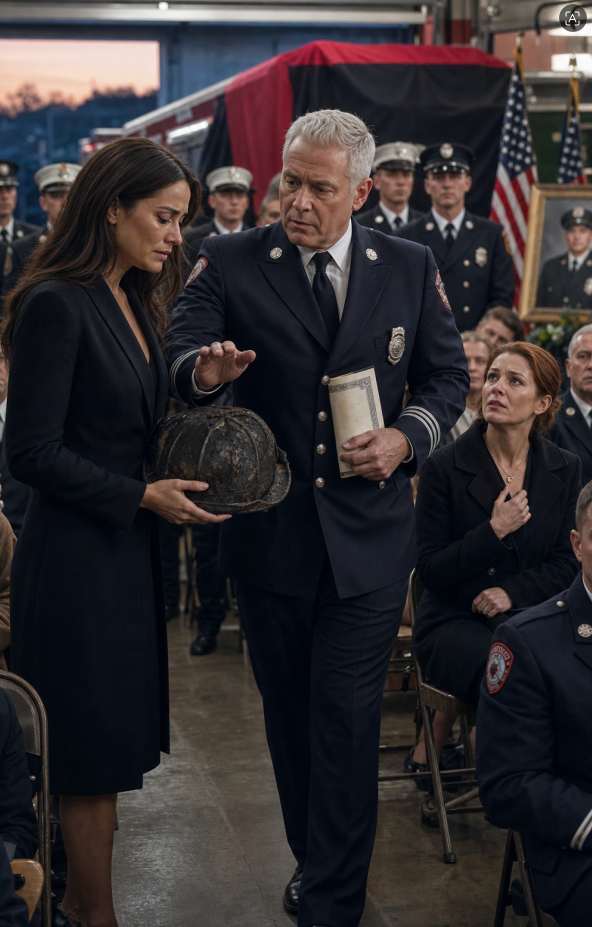
The commissioner reached into his coat and drew out a folded document. “This is the real certificate. Cook County. Twelve years ago. Sean and Dana Rourke.” He held it up. “We honor the right widow tonight, or we don’t honor him at all.”
Then he did the thing that broke me open. He walked to the draped engine where the helmet sat, lifted it in both hands, carried it back across the bay, and placed it in my arms. Scorched. Heavier than I expected. Still smelling, faintly, of smoke and of him.
“He was one of ours,” the commissioner said quietly, just to me. “Which means you’re one of ours. Where have you been sitting?”
“The back,” I whispered. “I didn’t want to make a scene.”
“You’ll sit in front from now on.”
Behind us, Sloane was trying to explain. That there had been a misunderstanding. That she and Sean had been close. Two officers were already at her elbows, polite and immovable. It came out later, in the investigation, that she’d done it before, in another county, to another dead man’s family. She’d read the obituaries. She’d learned which departments paid out fast. My husband’s death notice had made the regional news because of how he died, going back in, and she’d seen an opportunity.
She hadn’t counted on a department that had been burned before and now verified every claim. She hadn’t counted on a commissioner who took it personally. And she hadn’t counted on me being in the room, because on paper, after three years of him living near the firehouse two states away while I kept our home, we barely looked married at all.
But we were. God, we were. The distance was the job, not the marriage. He called every night. He came home every third weekend and we’d fight about the distance and then not waste the weekend fighting. We were saving to close the gap. We were a year, maybe two, from him transferring home for good.
The pension came to me, in the end, after the paperwork was sorted. So did the flag, refolded and presented properly at a second, smaller ceremony that the commissioner arranged just for me and Sean’s crew, because he said the first one had been stolen and I deserved one that was mine. His crew told me stories that night I’d never heard. The nickname they had for him. The rookie he’d talked out of quitting. The kid he pulled out of the house that killed him, who was there, fourteen years old, who couldn’t speak, who just held my hand.
I keep the helmet on a shelf where the afternoon light hits it. People who don’t know sometimes ask why I have such a beat-up old fire helmet in my living room. I tell them it belonged to the best man I ever knew, and that a stranger in designer black almost walked out of a firehouse with it, and that the only reason she didn’t is that one honest man refused to let the wrong woman be honored.
Sloane pled out. Fraud, multiple counts, across two states. I went to the sentencing. She didn’t look at me. That was fine. I didn’t go for her.
I went so that on the record, in a room with a judge and a flag, it would say the true thing once and for all: that Sean Rourke had a wife, that her name was Dana, and that she was there. At the back, and then at the front, and finally, permanently, on the page where it belonged.
Comments are closed.