The little girl’s name was Pippa, and she was the daughter of my new housekeeper.
I did not want a child in the house. I want to be honest about that, because it is the truest thing I can say about the man I was six months ago. I had bought the estate outside Nashville for the silence. Fourteen thousand square feet of imported marble and museum glass, and I had chosen it, if I am honest, because it echoed. Because a house that big makes a single man feel like the last person alive, and after the year I’d had, that was the only feeling I could stand.
I’d made my money in software and then in the far colder business of buying companies and taking them apart. People feared me. I had trained them to. And when the housekeeper I hired — a quiet woman named Rosa — asked, on her first day, whether it would be a problem that she had a five-year-old with no one to watch her, I nearly fired her on the spot. I said the child was to stay out of my way. Out of my sight. I did not want to know she was there.
Pippa did not get the memo.
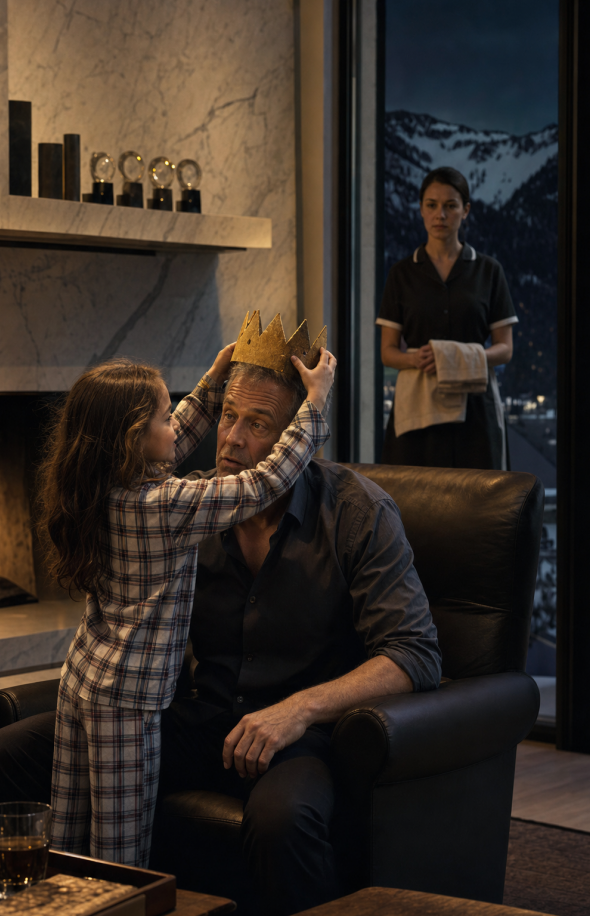
She found me everywhere. She found me in the study with my three monitors and she stood in the doorway and watched me the way children watch weather. She found me on the terrace at dusk and asked me why a grown-up would sit alone in the dark. She left things — a dandelion on my keyboard, a rock she’d painted, a drawing of a stick man she informed me was “the sad king who lives here.”
I told Rosa to keep her contained. Rosa apologized. Pippa kept coming.
And then one night, three weeks ago, I fell asleep at my desk. This is not something I do. I had been awake for most of two days closing a deal to dismantle a family manufacturing business in Ohio — good people, four hundred jobs, none of which would survive me — and somewhere around 4 A.M. my body simply quit.
I woke because something touched my hair.
Pippa was standing on a footstool she’d dragged from the kitchen, and she was placing a crown on my head. A cardboard crown, gold-painted, the kind you get free at a birthday party, held together with tape and hope. She settled it very carefully so it wouldn’t fall, and she stepped back to look at her work, and she whispered, so as not to wake me — not knowing I was already awake — “There. Now everybody knows you’re the King of the Big House. Even when you’re asleep. So you don’t have to be sad about it.”
I kept my eyes almost closed. I did not trust my face.
She climbed down off the stool and padded out, and I sat there in the blue light of three monitors with a cardboard crown on my head and a spreadsheet open that would end four hundred jobs, and for the first time in longer than I could measure, I could not breathe around the thing in my chest.
I had spent my whole life wanting to be respected. Feared, then respected — I’d told myself they were the same currency. Every award on my shelf, every headline, every man who went pale when I entered a room. And a five-year-old had just handed me a paper crown and I understood, with the clarity of a struck bell, that I would trade every real thing I owned to be worth crowning by someone who wanted nothing from me.
In the morning I did something I have never done in twenty years of business.
I killed the Ohio deal.
I called my head of acquisitions at 7 A.M. and told him to unwind it, and when he asked why, I said we were going to try being the kind of company that fixes things instead of the kind that strips them, and he was quiet for a long moment and then he said, “Okay. Okay, sir. That’ll take some doing.” And I said we had time.
Then I went down to the kitchen where Rosa was making Pippa’s breakfast, and I sat at the counter — not the dining room, the counter, on a stool, like a person — and I asked Pippa if I could keep the crown.
She considered this very seriously. Then she said I could, but only if I promised to wear it “at least on Fridays,” because everyone needs one day of being king.
The crown is on my desk now, beside a photograph I finally took out of a drawer, next to the awards that never once warmed me. My staff have noticed the change. Rosa noticed first, and then, slowly, everyone else — that the man who bought a house for its silence had started leaving doors open, so he could hear a child somewhere in it, drawing.
When Rosa tried to give her notice last month — a better-paying job, closer to her sister — I did something I could never have imagined the man I was would do. I offered them the whole guest wing. Their own kitchen, their own everything, no rent, for as long as Pippa wants to grow up in a house big enough to get lost in and never be lonely again.
Rosa cried. I nearly did.
Pippa just asked if that meant she could paint more of the statues.
I told her yes. I told her to start with the sad one in the foyer, the bronze of a man I’d bought at auction without ever admitting he had my brother’s face. I told her he’d been waiting a long time for somebody to make him pretty.
Comments are closed.